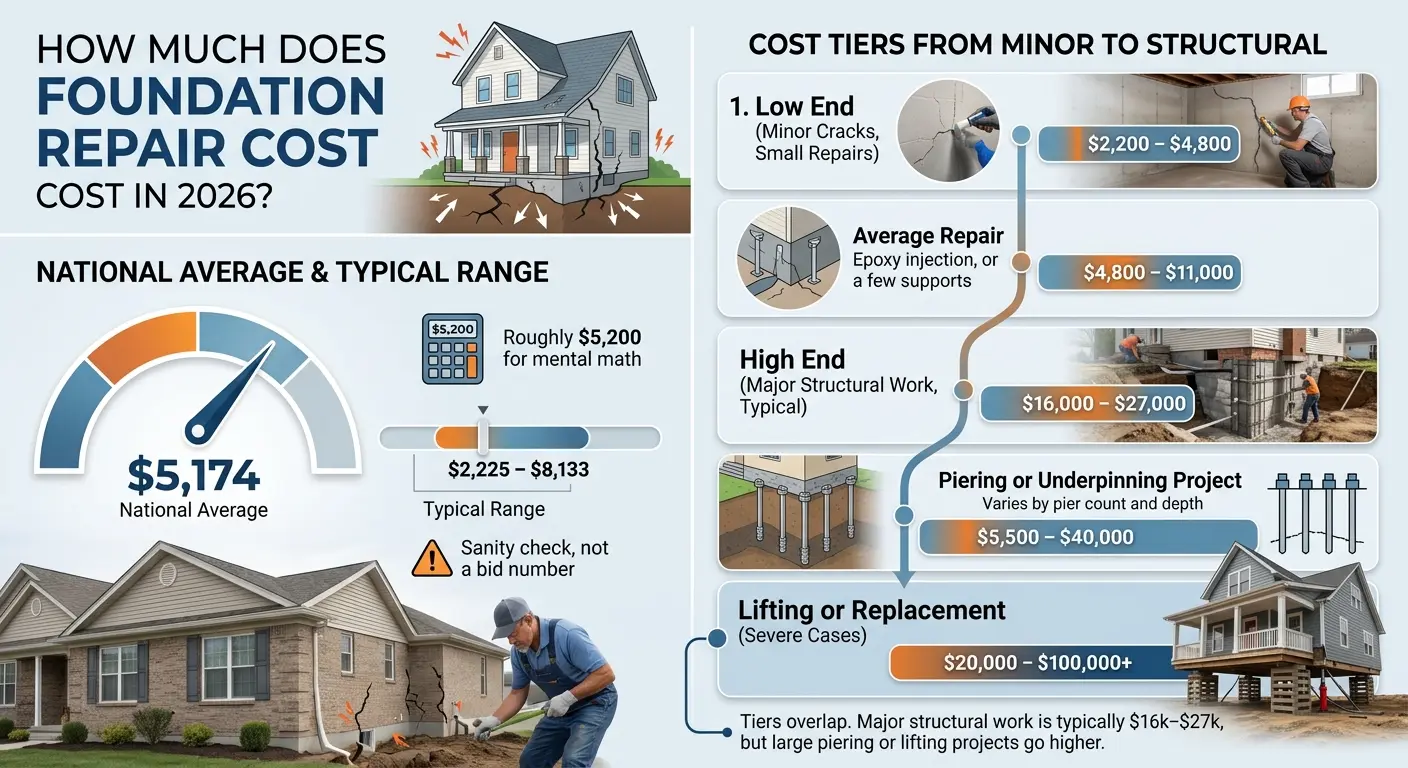
Foundation repair costs $2,225 to $8,133 for the typical homeowner, with a $5,174 national average (survey data, Aug 2026).
If you bid, build, or develop for a living, that number only goes so far. It blends $300 crack seals with $40,000 underpinning jobs, and it reflects retail pricing, not sub bids.
This guide breaks down 2026 foundation repair costs by method, foundation type, problem, and region. It also covers soft costs, scope splits, engineering triggers, and contingency.
Key Takeaways
- The national average is $5,174, with a typical range of $2,225–$8,133.
- Piering projects run $5,500–$40,000, and lifting or replacement reaches $20,000–$100,000.
- Engineering, permits, excavation, build-back, and contingency are the most commonly missed line items.
How Much Does Foundation Repair Cost in 2026?
Foundation repair typically costs $2,225 to $8,133, with a national average of $5,174. That average blends crack sealing with structural work, so piering, wall stabilization, and lifting run well above it.
National Average and Typical Range
Use $5,174 as the national benchmark, with a typical range of $2,225–$8,133. Think of it as roughly $5,200 for quick mental math. Treat it as a sanity check, not a bid number.
Cost Tiers From Minor to Structural
| Tier | Typical range |
| Low end (minor cracks, small repairs) | $2,200–$4,800 |
| Average repair | $4,800–$11,000 |
| High end (major structural work, typical) | $16,000–$27,000 |
| Piering or underpinning project (varies by pier count and depth) | $5,500–$40,000 |
| Lifting or replacement (severe cases) | $20,000–$100,000 |
These tiers overlap. A typical structural repair falls in the $16,000–$27,000 range, but large piering jobs with many piers or deep installs can reach $40,000, and lifting or replacement goes higher still.
Why the Homeowner Average Misleads Contractors
A $5,174 average mixes a $300 epoxy injection with a $25,000 settlement fix. Bids need scope-based ranges and unit prices, so use the average only as a sanity check.
What Does Foundation Repair Cost by Repair Method?
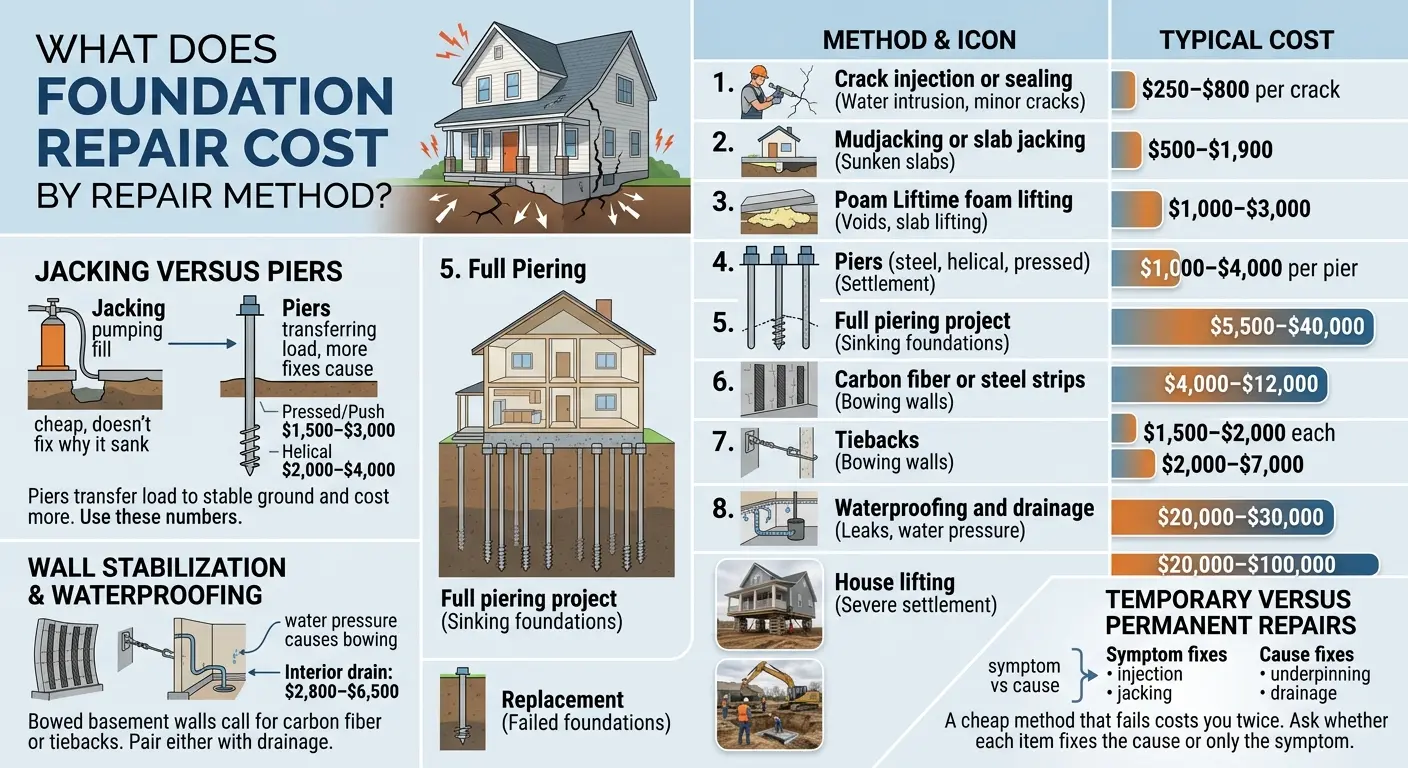
Crack injection runs $250–$800, jacking $500–$1,900, and piers $1,000–$4,000 each. Wall stabilization costs $4,000–$15,000, lifting $20,000–$30,000, and replacement up to $100,000.
| Method | Typical cost | What it addresses |
| Crack injection or sealing | $250–$800 per crack | Water intrusion, minor cracks |
| Mudjacking or slab jacking | $500–$1,900 | Sunken slabs |
| Polyurethane foam lifting | $1,000–$3,000 | Voids, slab lifting |
| Piers (steel, helical, pressed) | $1,000–$4,000 per pier | Settlement |
| Full piering project | $5,500–$40,000 | Sinking foundations |
| Carbon fiber or steel strips | $4,000–$12,000 (typical wall repair) | Bowing walls |
| Tiebacks | $1,500–$2,000 each | Bowing walls |
| Waterproofing and drainage | $2,000–$7,000 | Leaks, water pressure |
| House lifting | $20,000–$30,000 | Severe settlement |
| Replacement | $20,000–$100,000 | Failed foundations |
-
Jacking Versus Piers
Jacking lifts a slab by pumping grout or foam underneath. It is cheap, but it doesn’t fix why the slab sank, and heavy cementitious fill can add load to weak soil. Piers transfer load to stable ground and cost more.
Use these per-pier numbers: pressed/push piers $1,500–$3,000, helical piers $2,000–$4,000, and $1,000–$4,000 as the overall range across types.
-
Wall Stabilization and Waterproofing
Bowed basement walls call for carbon fiber strips or tiebacks. Pair either with drainage or waterproofing, because water pressure usually causes the bowing. Interior drainage installation runs $2,800–$6,500, which sits inside the broader $2,000–$7,000 waterproofing range.
-
Temporary Versus Permanent Repairs
Injection and jacking treat symptoms. Underpinning and drainage correct causes. A cheap method that fails costs you twice, so ask whether each line item fixes the cause or only the symptom.
What Does Foundation Repair Cost by Foundation Type?
Slab repairs usually run $1,000–$10,000, pier and beam $2,000–$15,000, crawl space $2,500–$12,000, and basement $2,500–$25,000. Basements cost most because of excavation, waterproofing, and wall work.
Slab
Slabs have no walls to bow or leak, so repairs center on settlement, using jacking or piers at corners and perimeters.
Pier and Beam
Access is easy, and costs climb when many piers need replacement. Steel replacements for rotted wood piers run $1,000–$1,600 each.
Crawl Space and Basement
Crawl spaces add block walls that can crack or bow. Basements sit deepest and face the most soil pressure and moisture, so they carry the highest costs.
Block, Brick, and Stem Wall
Cinder block and brick run $350–$25,000; stem wall runs $350–$20,000. Mortar-joint cracking is common where drainage is poor.
Which Foundation Problems Cost the Most to Fix, and When Is Replacement Worth It?
Settlement and sinking cost the most at $4,500–$25,000, followed by bowing walls at $4,000–$15,000 and leaks at $2,000–$10,000. Replacement at $20,000–$100,000 becomes the alternative when repairs cannot stop movement.
Cracks and Width Thresholds
Hairline vertical cracks under 1/8 inch usually need only sealing, at $250–$800 per crack. Horizontal or stair-step cracks, or any crack wider than about 1/4 inch, suggest structural strain and call for an engineer.
Leaks and Bowing Walls
Leaks range from $2,000 for minor intrusion to $10,000 for comprehensive waterproofing. Bowing walls usually trace back to drainage and hydrostatic pressure, so fix the water first.
Settlement and Sinking
Settlement costs the most because it needs piers or lifting. Settlement and sinking run $4,500–$25,000.
Repair Versus Replace Decision Points
Replacement requires lifting the structure. Consider it when movement continues after repairs, the footing cannot carry the load, or repair scope approaches replacement cost.
Pro Tip: Compare any replacement quote against the foundation cost of building new before you decide.
What Do Foundation Repair Costs Look Like per Square Foot and per Unit?
Foundation repair averages $1.50–$12 per square foot. Per-unit pricing works better for bidding: per pier, per crack, and per strip.
Cost per Square Foot by Foundation Size
| Foundation Size (sq ft) | Cost Range |
| 500 | $750–$6,000 |
| 1,000 | $1,500–$12,000 |
| 1,500 | $2,250–$18,000 |
| 2,000 | $3,000–$24,000 |
| 3,000 | $4,500–$36,000 |
Unit Costs for Estimators
- Epoxy: $8–$12 per sq ft
- Sealant: $1.25–$4 per linear foot
- Polyurethane foam: $8–$25 per sq ft
- Carbon fiber: $85–$250 per foot
- Steel support beams: $6–$20 per foot
- Hydraulic (pressed) piers: $1,500–$3,000 each
These are published retail and material figures, not sub bid prices.
Pier Count Rule of Thumb
A common screening rule is to divide the linear feet of the damaged wall by seven, round up, and add one pier. Treat it as a screening estimate only, because the engineer sets final count and spacing.
Accurate quantities start with a proper takeoff, and our foundation construction takeoff services turn plans and engineer reports into pier counts, linear feet, and concrete volumes before you price.
Limits of Square-Foot Pricing
Square-foot figures assume uniform damage. One sinking corner can cost thousands while the rest of the foundation needs nothing, so the affected portion matters more than the home’s size.
What Costs Do Foundation Repair Bids Leave Out?
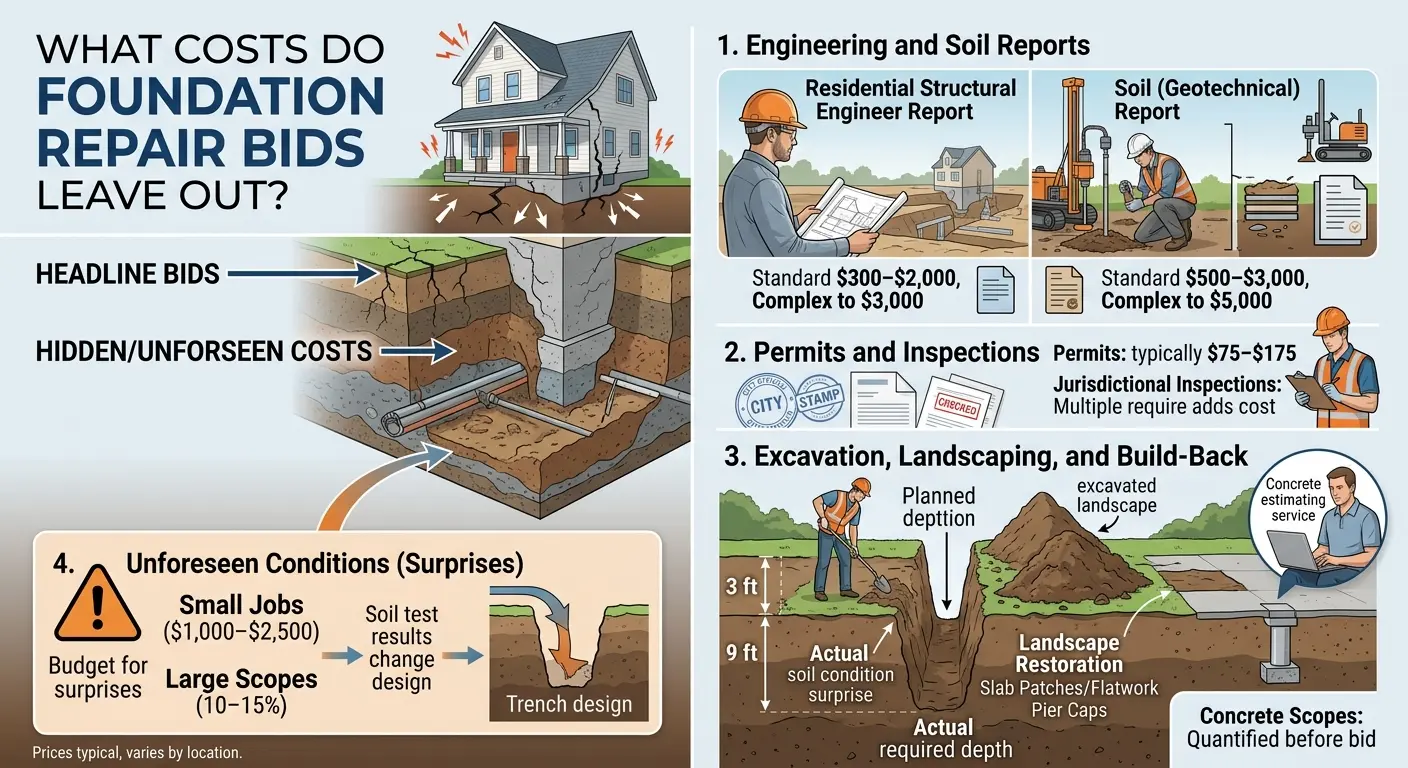
Engineering, geotechnical reports, permits, excavation, build-back, and contingency often sit outside the headline quote. Budget $300–$3,000 for an engineer, $500–$5,000 for a soil report, and 10–15% for contingency.
Engineering and Soil Reports
Budget $300–$2,000 for a standard residential structural engineer report, and up to $3,000 for complex jobs. Soil (geotechnical) reports run $500–$3,000, reaching $5,000 on complex sites.
Permits and Inspections
Permits typically add $75–$175. Some jurisdictions require multiple inspections during the work, which adds cost.
Excavation, Landscaping, and Build-Back
Excavation, landscape removal, and restoring finishes can raise totals significantly. Slab patches, flatwork, and pier caps are concrete scopes, and concrete estimating services can quantify them before bid day.
Unforeseen Conditions
Soil conditions can change scope fast. A trench planned at 3 feet can become 9 feet after a soil test, tripling excavation depth. Budget $1,000–$2,500 for surprises on small jobs and 10–15% on larger scopes.
Labor Rates
Foundation labor runs about $200–$210 per hour in 2026. Use $200 as your baseline and $210 in higher-cost markets.
Need a bid-ready number for foundation repair?Cost Bidding’s foundation estimating services turn your scope and quantities into a line-item budget with soft costs included. |
How Do Region and Soil Change Foundation Repair Costs?
Metro prices range from $1,700–$5,500 in New York to $3,500–$14,000 in Denver. Soil type, frost depth, water table, and seismic risk drive how often repairs happen and how complex they become.
Regional Price Differences
| Metro | Cost Range |
| New York | $1,700–$5,500 |
| Houston | $3,300–$6,800 |
| Los Angeles | $3,200–$9,200 |
| Miami | $4,500–$9,100 |
| Denver | $3,500–$14,000 |
Soil and Climate Drivers
Expansive clay shrinks and swells with moisture, and it is linked to the highest average repair costs. Cold climates add freeze-thaw cracking, coastal areas face water intrusion and erosion, and seismic regions often need retrofits or reinforced piers.
Using Local Data
Pull soil data from the USDA Web Soil Survey and wage data from the Bureau of Labor Statistics OEWS program. OEWS reported an annual mean wage of $65,360 for construction and extraction occupations in May 2025. Adjust national ranges to your market.
How Do GCs and Subs Estimate and Scope Foundation Repair Work?
Sub bids differ from homeowner retail prices in scope split, markup layers, and risk allocation. A usable bid separates pier count and depth, engineering, permits, excavation, build-back, drainage, warranty, and contingency.
Retail Price Versus Sub Bid
Published ranges reflect what homeowners pay. A GC sourcing a specialist sub buys that scope, then adds its own overhead, profit, and risk. Markup varies by market and contract type, so build yours from your own cost data.
Scope Split Between GC and Specialist
Define who excavates, who shores, who restores finishes, who pulls the permit, and who retains the engineer. Gaps between these roles produce change orders.
Bid Leveling Checklist
- Pier type, count, depth, and capacity
- Engineering and stamped drawings
- Permits and inspections
- Excavation, shoring, and backfill
- Build-back and restoration
- Drainage or waterproofing
- Warranty terms, exclusions, and allowances
- Contingency
Differing Site Conditions and Change Orders
Set unit prices for extra piers, extra depth, and added excavation before work starts. Define what triggers a change order, such as obstructions, voids, or hidden damage.
Multifamily and Light Commercial Notes
Larger structures involve engineered designs, deeper piles, and special inspections, so do not scale residential unit prices up without engineering input.
When Should an Engineer Be Involved, and Which Codes Apply?
Bring in a structural engineer for structural cracks, active settlement, bowing walls, or any job where permits require stamped drawings. Engineers also set pier design, spacing, and load testing.
Engineer of Record Triggers
Call the engineer before pricing when movement is ongoing, walls are bowing, or the soil is unknown. A geotechnical report helps when changed site conditions may be behind the damage.
Code References
Check IRC Chapter 4 for residential foundations and IBC Chapter 18 for soils and foundations. Then confirm the locally adopted edition and amendments with your building department or engineer.
Specialist Versus General Contractor Approaches
Non-specialist GCs often propose widening the footing, which adds weight to failing soil and can make the problem worse. Involve an engineer before choosing a fix.
How Long Does Foundation Repair Take, and When Should You Schedule It?
Minor repairs take one to five days, standard residential jobs one to two weeks, and underpinning two to six weeks. Schedule around frost, rain, and crew availability.
Timelines by Repair Type
Use these durations: minor repairs 1–5 days, standard residential jobs 1–2 weeks, and underpinning 2–6 weeks (including excavation, pier installation, and build-back).
Seasonal Timing
Schedule for late spring through early fall, when the ground is unfrozen and rain delays are least likely. Frozen ground and heavy spring rains can delay work. In cold climates, winter can bring discounts because crews are less busy.
What Do Insurance, Warranties, and Liability Cover on Foundation Repair?
Homeowners insurance generally excludes gradual settlement and covers foundation damage only from a sudden covered event, such as a burst pipe or fire. Builders and subs must also weigh warranty terms, licensing, and liability.
Homeowners Insurance Limits
Earthquake damage usually requires separate seismic coverage.
Warranties, Licensing, and Insurance
Confirm that the sub is licensed, bonded, and insured, and get warranty terms in writing, including transferability. Review builder’s risk and general liability coverage with your broker or attorney.
How Are Foundation Repair Prices Changing in 2026?
The national survey average is $5,174 as of August 2026, and labor is reported at $200–$210 per hour.
Labor and Material Drivers
Steel price swings affect piering and stabilization costs. Check current steel pricing and tariff conditions before locking long-lead bids.
What Historical Data Shows
Reliable multi-year trend data is limited, so base your bid on current figures. Re-price each bid against current labor and material costs, and professional construction estimating services can help you apply them to your takeoffs.
What Else Do Builders and Developers Ask About Foundation Repair Costs?
How much does a foundation inspection cost?
A foundation inspection typically costs $400–$750. Many repair companies offer free inspections with an estimate, but those come from a firm selling the fix. An independent engineer’s assessment gives you an unbiased scope.
Can you live in a house during foundation repair?
Usually yes. Most repairs allow occupants to stay, though work can be noisy and disruptive and may last weeks. Occupants may need to relocate if the damage is severe and the structure is deemed unsafe.
Is it worth buying a house that needs foundation repair?
It can be, if an engineer defines the scope and the price reflects the full repair. Get a qualified inspection first, and check whether the root cause was fixed, since unaddressed causes make repeat movement likely.
What is the difference between helical and push piers?
Helical piers are threaded shafts screwed into the ground, with little soil disturbance. Push piers, also called pressed or hydraulic piers, are smooth shafts driven by hydraulic force. Your engineer selects the type based on soil, load, and access.
What causes most foundation problems?
Common causes include expansive or poorly draining soil, water and drainage problems, plumbing leaks, tree roots, earthquakes, and poor construction. Most issues stem from the soil around the home, so evaluate soil and drainage early.
Does foundation repair increase a home’s value?
Not directly. Repairs don’t raise value, but they prevent the loss a damaged foundation causes. A failed foundation can cost a home up to 20% of its value, so repair protects equity.
What Should You Budget for Your Next Foundation Repair Project?
Budget the repair method first, then add engineering, permits, excavation, build-back, and 10–15% contingency. Get at least three scope-matched bids, and bring in an engineer before pricing anything structural. Treat national averages as a sanity check, not a bid.
Budgeting Checklist
- Method and unit quantities
- Engineering and soil reports
- Permits and inspections
- Excavation and build-back
- Drainage or waterproofing
- Warranty terms
- Contingency of 10–15%
Next Steps With Cost Bidding
Cost Bidding provides foundation repair budget estimating services for GCs, subs, developers, and builders. Send us your scope, plans, or engineer’s report, and we will help you build a line-item budget that accounts for quantities, soft costs, and contingency, so your bid reflects real project conditions instead of a homeowner average.
Ready to price your next foundation repair job?Contact Cost Bidding for your foundation repair budget estimate! |