Recent studies, by Market Report Analytics, show that the global concrete slab market is worth $250 billion. Concrete is used in floors, foundations, pavement, roofs, ceilings, and more. However, a common question arises: how long does concrete take to dry?
The concrete drying time depends on several factors, including slab composition, water-to-cement ratio, location, and others. A common rule that is followed is the thumb rule. This means that a concrete slab takes 28 days per inch of thickness to dry.
Trying to hurry up the concrete drying process isn’t a good idea. Why? It can cause cracks, shrinkage, poor bonding, and even mold growth. This article defines in detail the time required for dry concrete estimating services, factors affecting the drying process, and ways to speed it up.
Drying vs. Curing: What’s the Difference?
Concrete cannot be dried instantly after it is placed. It needs hydration and moisture for a long time, so it gains strength and durability within the mixture. Premature drying from water can cause cracks and a weak surface. Therefore, concrete is cured first and then dried.
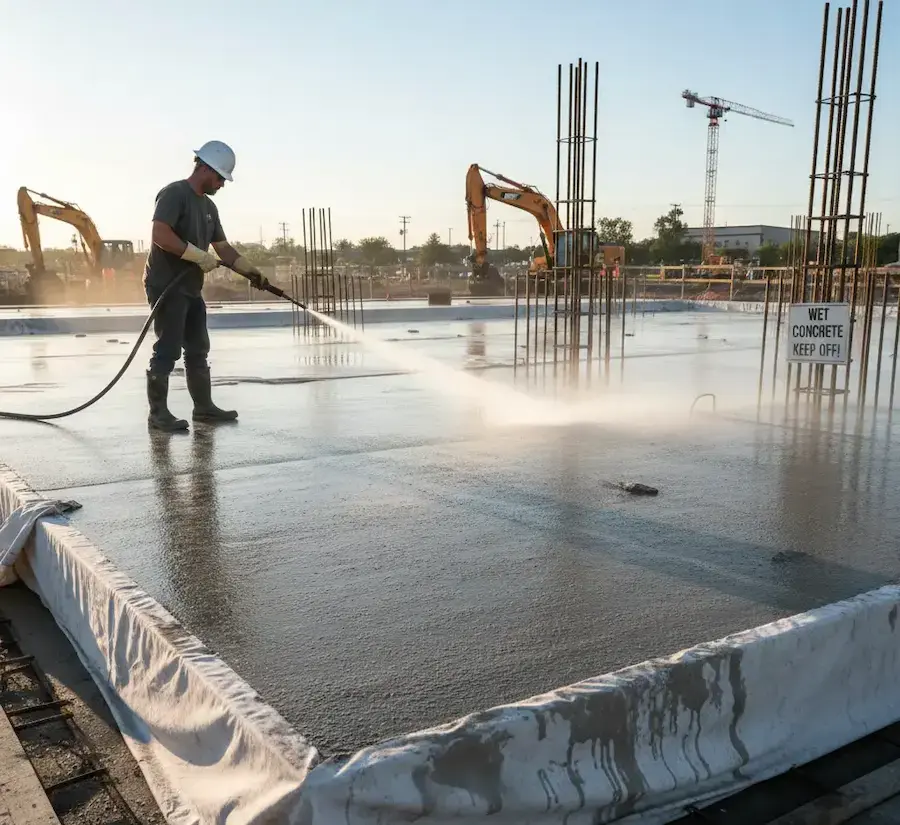
Curing concrete is the time during which the hydration reaction occurs with the cement, water, and other materials. It involves covering the laid-out concrete mix with a layer that prevents moisture escape. A polythene, hessian, or a curing blanket is used for this purpose. This prevents the loss of moisture and hydration. Concrete cure time is approximately 7-28 days to achieve its long-term strength.
Drying, on the other hand, is the process in which the concrete loses its water content. Concrete consists of about 200 litres of water during mixing. Most of this water is not required to keep the concrete hydrated. So the water that is not chemically bonded in the mix evaporated.
According to BS 8204-1, a 155 mm thick layer of concrete can take above an year to dry out. If the slab is allowed to dry from both sides, this time period can be reduced to half.
General Timeline for Concrete Drying
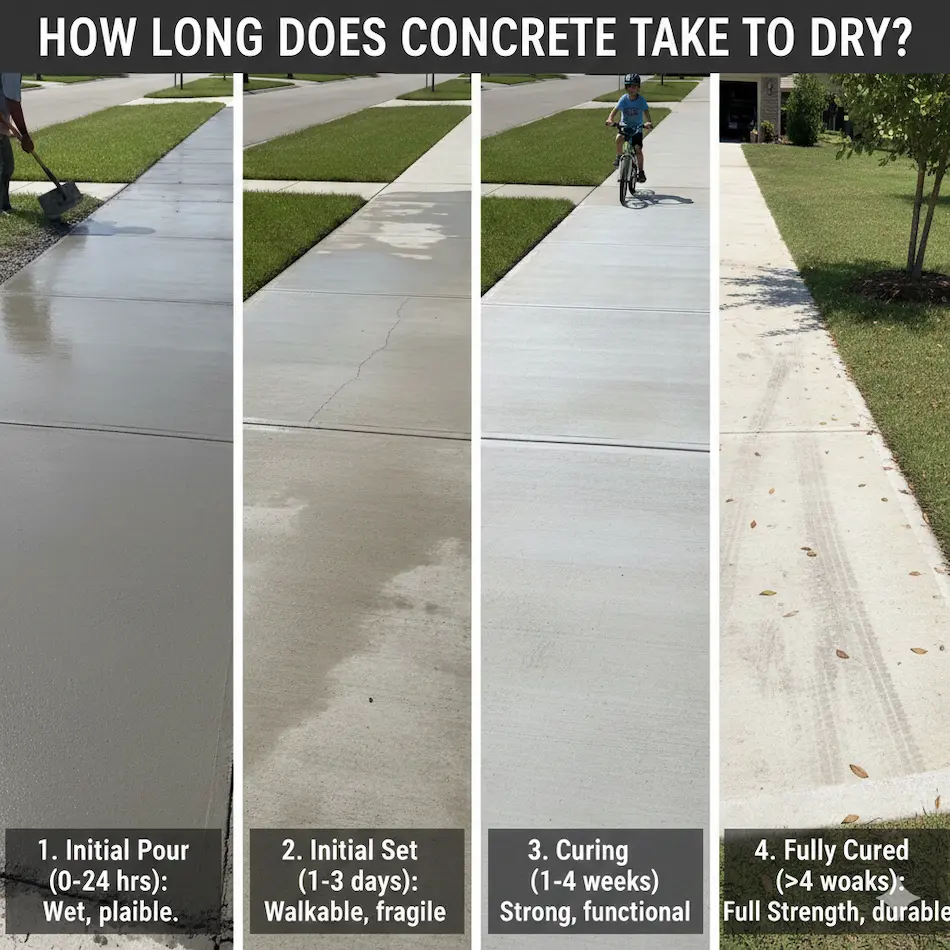
Generally, concrete takes about 28 days for every inch to completely dry out and is ready to bear a load. It is recommended to leave the concrete to cure and dry gradually, according to the standard process. This ensures that concrete completely gains compression strength and is able to last up to the optimal 100 years. Here’s the time period taken by concrete to completely dry.
The First 24-48 Hours: Just after pouring the concrete mix, it starts to dry out in 24 to 48 hours. During this time, concrete gains strength for minor light-weight traffic. However, it must be kept away from heavier objects to prevent damage.
(48 Hours of Drying): It’s never clear how much concrete has dried out after 48 hours. However, concrete becomes safe to hold lightweight after 48 hours of pouring. Lighter pedestrians can easily walk on it, but high stress and weight should be avoided.
Bear Vehicle Load (7 Days): The concrete has become hard enough to bear a vehicle’s weight after seven days. Now, it reaches about 60-70% of its strength. Now it’s hard enough to support light vehicles. Depending on several factors, this time period may be prolonged. Aspects like slab thickness, humidity level, and temperature play a key role in determining the drying time.
85-90% of Strength (14 Days): Just after 14 days, concrete reaches about 85-90% of its strength that it would have achieved in 28 days. After 28 days of curing, the concrete is fully ready to bear high vehicle loads. To make sure that the concrete gets adequate strength, gradual drying is needed without a rush.
Understanding the key phases of concrete drying allows you to manage schedules and activities. This enables you to coordinate different trades and achieve their optimal strength.
What Factors Affect Concrete Drying Time
An estimated time for drying up concrete is given to be 28 days, but the exact time cannot be identified. The concrete drying process is influenced by several variables.
Understanding these factors helps contractors and construction teams to effectively schedule successor tasks and activities. This enables you to avoid costly delays and maintain concrete quality at its best.
Optimal Concrete Temperature
Another crucial factor that goes hand in hand is humidity levels. When humidity is high in the environment, evaporation is slow. Hence, concrete takes more time to dry. While low humidity surrounding make drying process even faster. It is crucial to inspect and monitor humidity levels. Using an RH tester could help measure concrete humidity. Using sprinklers, fans, or dehumidifiers can be used to manage humidity levels in concrete.
Mixture of Ingredients
The type of mixture composition affects concrete drying. A concrete mixture with a higher water content may take more time to dry. While a high cement mixture takes less time since cement produces greater heat. Moreover, adding aggregates and additives like sand, gravel, or crushed stone also affects the time taken for concrete to dry.
Water-to-Cement Ratio
Water to cement ratio directly affects the strength and drying time of the concrete. Concrete with less water to cement ratio dries faster. The reason is that it contains less water content to evaporate. Similarly, concrete with a higher water-to-cement ratio will take more time.
Tips to Speed Up the Concrete Drying Process Without Causing Damage
A quick drying process is not always a suitable thing. You might end up with concrete that hasn’t developed its full strength. Thinking about how to reduce concrete drying time? Managing adequate temperatures, using the right mixture, or using some crucial techniques can help you achieve just that!
Control the Temperature:
Using an insulated material that covers concrete and maintains the right amount of heat can speed up the drying process. Curing blankets, polyester boards, polyethylene sheets, or hessian rolls can be used. Moreover, a fan can be used in cold weather to maintain the optimal temperature for drying.
Add Additives
Additives increase the hydration process and produce heat in concrete. This early heat generation causes the concrete to dry fast. Some common additives that can be used include calcium chloride, sodium thiocyanate, calcium formate, sodium silicate, or calcium nitrate.
Moisture Control
Controlling the surrounding moisture helps speed up the concrete drying process. Use dehumidifiers, fans, exhaust fans, air movers, or sealants to retain moisture. Contractors also use vapor barriers below the concrete to prevent ground moisture from entering the concrete.
Control the Water-Cement Level
Reducing the water-cement ratio means there will be less water that needs to evaporate. This reduces the overall drying time. Also, cement with water gives an exothermic chemical reaction. It produces more. Hence higher quantity of cement also increases the drying process.
When Is Concrete Ready for Use?
When concrete is mixed and poured, it initially sets up. It acquires its shape, but doesn’t achieve its full strength yet. Proper curing and drying are required for it to be fully ready to use. Concrete reaches to 70% of its entire strength in 7 days.
Concrete becomes completely strengthened and usable after nearly 28 days. Getting to complete strength is a gradual process. Proper moisture, temperature, and hydration are required to achieve that.
Once completely cured, it is capable of bearing load while being resistant to shrinkage or cracks. Moreover, the structure becomes stable and reliable with high compressive strength.
How to Know When Concrete is Dry Enough
Have you poured concrete, and now you’re wondering how long does it take for concrete to dry? Well, a good way is to test the amount of humidity in the concrete slab.
You must make sure that your concrete is completely dried out before floor covering or coating. The reason is that moisture moves to the surface, causing adhesive failure and peeling of the coating. Moreover, mold and mildew can also grow below the finishes.
Using a Humidity (RH) test can help. The humidity tester involves drilling small holes in the concrete slab. Then, sensors are placed to understand the amount of humidity that still remains. This accurately defines whether the concrete has been completely dried up for further construction work.
Professional Tips for Perfect Curing
Making sure your concrete dries and cures on time and flawlessly is crucial. With careful planning and estimates makes sure that the concrete installation is executed seamlessly. Here are a few professional tips that can make concrete drying easier, accurate, and error-free for you.
Timing and Weather Considerations
Always forecast the weather before working on the concrete installation and drying process. In hot weather, concrete dries faster. Therefore, it becomes difficult to set it. At extreme temperature it instantly dried. Planning it at the right time with low temperatures makes concrete easier to set.
Discover how long cement really takes to dry and cure. Learn safe timelines, avoid cracks, and plan your project confidently. Read the complete guide now.
Adequate Mix Composition
Thinking of how long does cement take to dry? You need proper mixing with the exact composition of the material. Increasing or decreasing the volume of water cement may speed up the drying process; however, the concrete still may not be able to achieve its full strength. It may also become prone to cracks and damage. An ideal water-to-cement ratio is 0.40 to 0.60. For example, higher water quantity can result in weakened concrete that can easily develop cracks.
Proper Handling
Always use safety measures when handling concrete. Concrete is heavy and difficult to handle, and therefore, you must be equipped with all safety equipment. This includes safety goggles, footwear, a dust mask, and more. Also, keeping aware of the harmful chemicals and the safety steps in case of exposure is important.
Apply Regular Sealants
After pouring concrete, you must cover it with a proper sealant. This protects concrete from water, stains, cracks, oil penetrations, and other damage. The sealant or the protective layer must be applied regularly to ensure that the concrete is cured and dried perfectly.
Repairing Cracks and Damages On-time
Even when you have perfectly laid concrete, cracks may still appear. Initial cracks may seem minor, but can cause major problems to structural stability, water infiltration, and reduced concrete strength. Therefore, you must repair those cracks on time. Using polyurethane foam injections, epoxy injections, concrete patching, cement grouting, or other methods can help you fix it on time.
Conclusion
Concrete drying requires great attention to detail and patience. Want to speed up drying concrete? You need to have the accurate temperature, water-cement ratio, and insulated material. Hiring an expert will also help you understand the different factors that affect concrete drying and make better choices for your project.
Want to estimate how long for concrete to dry? Cost Bidding has got you covered. We not only help you with an accurate curing and drying process but also provide valuable construction insights for safe concrete project execution.
FAQS
How long does it take concrete to dry?
While concrete initially sets up its shape in 24-48 hours, the total time taken for it to dry is 28 days. After this period, concrete develops its complete strength and durability. Proper drying time is required for concrete to achieve a long lifespan of 50-100 years.
Does concrete drying and curing occur at the same time?
Concrete curing and drying occur simultaneously, but they are distinct processes. Curing involves maintaining an adequate temperature and moisture in which the cement and other elements can react with water. This creates the concrete strength, while drying takes a few weeks and is a gradual, slow process to let excess water evaporate.
How long does cement take to cure?
It takes 28 days for cement to dry completely, with optimal temperature and water-cement ratio.