A few months ago, a project manager in Texas shared a case study. He said that he won a project of painting an interior of a 2,500 sq ft house. Everything went perfectly, and his bid was impressive on paper. But when it reached the site, the manager experienced extra expenses in the form of coating and hidden trims.
Do you know how much more the job took? The job took $4,800 more than estimated. As a contractor, you can understand the situation.
This situation shows that one overlooked detail turns a precise win into a money waste. Therefore, every contractor, builder, architect, and project owner needs clear answers on interior painting costs.
The house interior paint expense has shifted with labor rates, material prices, and supply chains. But you can get a precise and accurate estimate for a particular painting project using this guide. Let’s start!
Average House Interior Painting Cost
Here is the table showing some values.
| Average cost to paint the interior of a house | ~$2,022 |
| Lowest Cost | $965 |
| Highest Cost | $3,088 |
In addition, tiny condos can cost around $350, and large custom homes can cost ~$5,800.
Note: These numbers include walls, trim, ceilings, as well as labor, paint, and basic prep costs.
Factors that Affect the Cost to Paint the Interior of a House
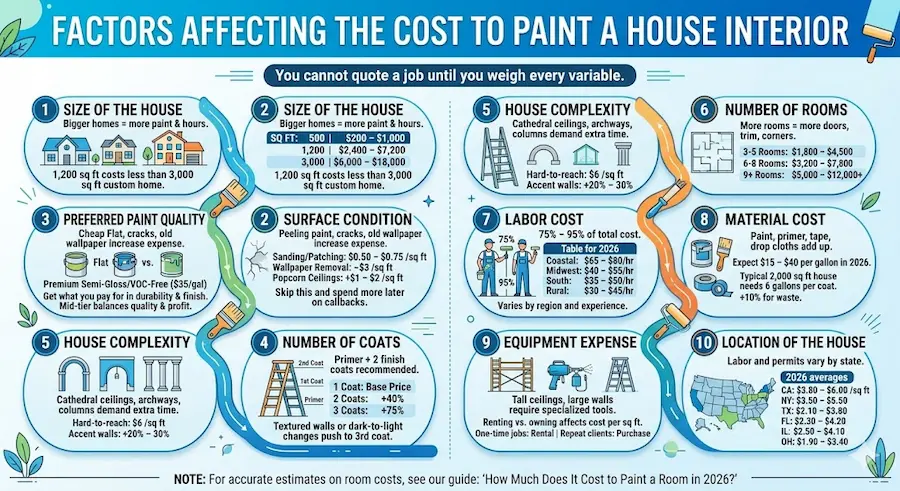
You cannot quote a job until you weigh every variable. Here are the 10 factors that affect the cost.
1. Size of the House
Bigger homes take more paint and more hours. For example, a 1,200 sq ft starter home costs less than a 3,000 sq ft custom home.
Here is the table showing house interior painting cost, depending on the size of the house:
| House Size (sq ft) | Average House Interior Paint Cost |
| 500 | $200 – $1,000 |
| 800 | $1,600 – $4,800 |
| 1,000 | $2,000 – $6,000 |
| 1,200 | $2,400 – $7,200 |
| 2,300 | $4,600 – $13,800 |
| 2,500 | $5,000 – $15,000 |
| 3,000 | $6,000 – $18,000 |
2. Surface Condition to be Painted
Peeling paint, cracks, or old wallpaper adds money to the project’s total expense. Nowadays, people spend $0.50 to $0.75 per square foot just on sanding and patching. Wallpaper removal costs around $3 per square foot. Furthermore, popcorn ceilings add $1 to $2 per square foot. If you skip this step, you’ll spend more later with callbacks.
3. Your Preferred Paint Quality
Cheap flat paint costs $13 a gallon. However, premium semi-gloss or VOC-free costs at $35, and high-gloss enamel hits the same. You get what you pay for in durability and finish—builders who choose mid-tier paint balance quality and profit.
4. Number of Coats
One coat rarely cuts it. Most jobs need primer plus 2 finish coats. Below is the table showing the house interior paint cost, spending on the number of coats.
| Number of Coats | Cost Increase |
| 1 | Base price |
| 2 | +40% |
| 3 | +75% |
Note: Textured walls or dark-to-light color changes push you toward that third coat.
5. House Complexity
Cathedral ceilings, archways, and columns demand scaffolding and extra time. Furthermore, hard-to-reach areas cost $6 per square foot, and accent walls add 20% to 30% to the room paint budget.
If you are painting a room, whether 1 or more, you must read our guide “How Much Does It Cost to Paint a Room in 2026?” for accurate estimates.
6. Number of Rooms
More rooms mean more doors, more trim, and more corners. In other words, the cost of the project increases with the increase in the number of rooms to be painted. Here is a table for better understanding:
| Number of Rooms | Cost for House Interior Painting |
| 3–5 | $1,800 – $4,500 |
| 6–8 | $3,200 – $7,800 |
| 9+ | $5,000 – $12,000+ |
7. Labor Cost
Labor takes 75% to 95% of every house interior painting cost. In 2026, painters will charge $40 to $80 per hour, depending on the market. Additionally, labor costs vary from region to region. Here is a table showing this.
| Region Type | House Interior Painting Labor Cost (per hour) |
| Coastal cities | $65 – $80 |
| Midwest | $40 – $55 |
| South | $35 – $50 |
| Rural areas | $30 – $45 |
Note: Labor experience also affects the cost to paint the interior of the house; more experience means higher demand (per hour/per project).
8. Material Cost
Paint, primer, tape, and drop cloths add up to the project total cost. You must expect $15 to $40 per gallon in 2026. As per a study, a typical 2,000-square-foot house needs 6 gallons per coat. Remember to consider the cost of brushes, rollers, and cleanup supplies, plus 10% for waste.
9. Equipment Expense
Scaffolding for tall ceilings, sprayers for large walls, and ladders all cost money in a house interior painting project. Renting or owning these tools affects your interior painting cost per square foot. So, make decisions according to your budget; one-time jobs favor rental. Repeat clients justify purchase.
10. Location of the House
Labor and permit costs vary wildly across states. Track these 2026 averages:
| State | Interior Painting Cost per Square Foot |
| California | $3.80 – $6.00 |
| New York | $3.50 – $5.50 |
| Texas | $2.10 – $3.80 |
| Florida | $2.30 – $4.20 |
| Illinois | $2.50 – $4.10 |
| Ohio | $1.90 – $3.40 |
How to Estimate the Interior House Paint?
Step 1: Measure Everything.
Walk the house to measure every wall, ceiling, and trim run. Similarly, get the length and width in square footage. Also, add irregular areas as rectangles, and then total the figures.
Step 2: Assess Surface Condition.
Note cracks, stains, and texture. Add $0.50–$0.75 per square foot for prep.
Step 3: Choose Paint and Number of Coats.
Decide primer plus 2 coats. Divide the total square footage by 400 to get gallons per coat. Multiply by 3, and add 10% for waste.
Step 4: Calculate Labor Hours.
Figure 1 hour per 100 square feet for standard work. Add time for trim and prep, and then multiply by the hourly rate of force.
Step 5: Add Equipment and Overhead.
Include scaffolding, sprayers, and 15% for insurance and profit.
Step 6: Build Contingency.
Add 10% to 15% for unforeseen expenses.
If your target is house exterior painting, get insights in this guide: What is the Average Exterior House Painting Cost?
Mistakes Related to Painting Cost Estimation Plus How to Avoid Them
● Underestimating Surface Preparation
Most contractors experience 15% to 20% of their margin disappearing here. When you skip sanding or patching, the paint fails in 6 months.
Solution: Always walk the site with a flashlight and add the prep line item.
● Improper Measurement
If you measure only the main walls and forget trim or ceilings, the job can run 25% over budget.
Solution: Grab a laser measurer, double-check every room, and write it down on the spot.
● Ignoring Surface Texture and Porosity
Smooth drywall needs 1 coat while textured or porous walls require up to 2 coats. In the case of 2 coats, you can run out of paint mid-job.
Solution: Test a small patch first and adjust gallons upward.
● Underestimating Labor Rates & Time
When teams quote yesterday’s rates, they lose money when wages rise.
Solution: Track local union scales monthly, plus add buffer hours for breaks and cleanup.
● Buying Low-Quality Materials
Cheap paint looks good for 3 months, then fades. In this situation, you need rework, and callbacks cost more than premium paint ever will.
Solution: Buy mid-grade and charge accordingly.
● Miscalculating Overhead and Profit
When a contractor forgets insurance, truck fuel, or marketing, his profit turns into a disaster.
Solution: Add 15-20% line items and protect your business.
Why Do Painting Estimating Services from Experts Matter?
● Expense Control
Professional estimators who provide painting estimating services lock budgets tight. They spot every hidden cost before you sign. Projects stay on budget 92% of the time instead of wasting money.
● Time Saving
With their assistance, you hand over measurements once. Experts deliver accurate bids in hours, ensuring that your team moves from one job to the next without downtime.
● Risk Mitigation
Estimating experts flag lead paint, structural issues, or supply delays early. This way, they help you avoid lawsuits and change orders.
● Client Satisfaction
Clear, detailed painting cost estimates set honest expectations. Clients thank you instead of arguing about numbers. Furthermore, repeat business and referrals follow naturally.
● Pro-Level Bidding
An estimator turns rough guesses into winning numbers. Ultimately, you beat competitors who still guess, plus your margins improve, and your reputation grows.
FAQs
How much does a painter cost in 2026?
Painters charge $40 to $80 per hour in 2026.
How much will it cost to paint an interior house in 2026?
The average cost to paint the interior of a house is $2,022. Most jobs fall between $965 and $3,088, depending on size and wall condition.
Can you paint over old lead paint safely?
You can if you encapsulate it properly with primer and new paint. Test first and follow EPA rules. Also, hire a certified pro to stay legal and safe.
How long does it take to paint a 2,000 sq. ft. house?
A professional team finishes in 3 to 5 days. Prep takes 1 day, painting 2 to 3 days, and final touch-ups half a day.
Conclusion
Now, you know the cost to paint the interior of the house as well as its affecting factors. Using all the data, you can easily estimate your project cost. If you are still confused about things and worried due to inaccuracies and a shortage of time, you must rely on painting estimating services provided by the industry experts.
At Cost Bidding, we provide precise, market-specific estimates that protect your profit and impress your clients. Over 25+ years, we have helped builders across the country win more jobs and improve their reputation.
Ready to bid smarter? Drop your project details and get a professional interior painting estimate within 10-24 hours!