A few millimeters can be the difference between a perfect finish and a costly mistake. For a lead architect or an estimator, brick dimensions aren’t just numbers on a page; they are the “DNA” of the entire building’s grid. If you are confused about the standard US modular brick at 7⅝ × 3⅝ × 2¼ inches or navigating the 215 mm British Standard, this guide is perfect for you!
It skips the basics and focuses on how specific tolerances and regional sizes, from the UK to Australia, impact your load-bearing calculations and labor speed. We will look at the real-world shift between actual and nominal sizing. It helps ensure your project stays accurate and your masonry joints remain perfectly straight from the foundation to the roofline.
Learn more about construction cost estimation and planning in our detailed Estimate Construction Costs guide.
What Is the Standard Brick Size?
Standard brick size refers to the commonly accepted dimensions used in a specific region. Every country has its own standard brick sizes. These dimensions are specifically set to make the project consistent and reliable.
Mortar is basically a material that connects the bricks and makes the foundation strong for any structure or design. The most common standard/modular size is 7 ⅝ × 3 ⅝ × 2 ¼ inches. A standard mortar joint adds 3/8 inch to it, which makes the nominal brick size 8 × 4 × 2 ⅝ inches.
Purpose of Considering Standard Brick Dimensions
Standard brick dimensions are precisely engineered on the basis of stability, a clean look, and structural reliability. There’s a reason for the precise execution! A fixed standard size helps builders calculate the number of bricks required to build walls. Moreover, it assists the contractors in estimating the total weight and material required for the structure’s completion.
Variation of Standard Brick Dimensions in Different Countries
This standard size of brick varies slightly for different countries. These changes are made based on the legal codes and standards of that specific country. There are multiple purposes behind this variation. Tax evasion was one of the most common reasons why these sizes kept varying. In history, contractors used bigger sizes while building a big project.
From 1784 to 1850, the British government imposed taxes on the construction firms based on the number of bricks to fund wars. Bigger sizes reduced the number of bricks used and ultimately decreased the overall tax. As for the US, smaller sizes were used for the easy handling and seamless transport of bricks to the construction site.
Standard Brick Dimensions in Construction
To ensure a building is structurally sound, every brick must sit exactly where the blueprints say it should. These specific dimensions allow for a perfect vertical course, meaning three rows of brick will always reach a predictable height for easy floor-to-floor planning.
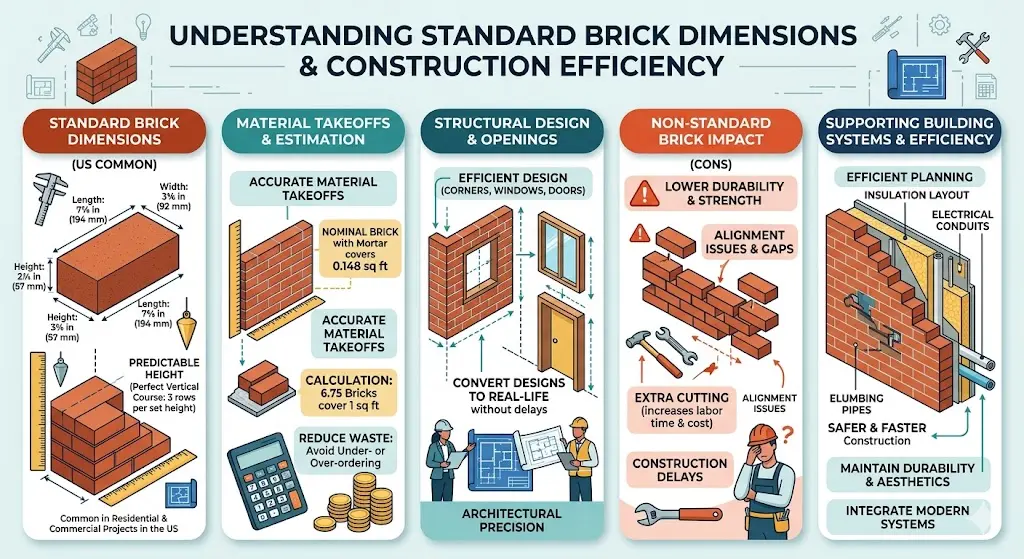
| Dimension | Inches | Millimeters (mm) |
| Length | 7⅝ in | 194 mm |
| Width | 3⅝ in | 92 mm |
| Height | 2¼ in | 57 mm |
These standard-sized bricks are commonly used in the US for most of their residential and commercial projects while ensuring consistency across different buildings.
Role of Considering Brick Size in Construction Material Takeoffs
All thanks to the standard brick size, material takeoffs are not a tough nut to crack anymore. A nominal brick with mortar covers 0.148 sq ft. That means 6.75 bricks would cover 1 sq ft. Multiplying this number by the total area of the wall brings us the total number of bricks. Knowing the right number helps contractors avoid under- or over-ordering bricks for construction.
Use of Standard Bricks in Structural Design and Openings
These standard bricks are considered to be really helpful when there’s a need to design or construct the corners, windows, doorways, or any architectural pattern. The measurements of these bricks are standardized, and drawings are made considering these measurements more accurately. It helps in ensuring designs can be converted into a real-life project without any delays.
Impact of Non-Standard Brick Sizes on Construction
The use of non-standard brick sizes significantly impacts the construction process. Builders use a consistent size of bricks when working on some projects because it ensures the alignment and there are no gaps between the bricks. When different sizes of bricks are used, builders often face the issue of lower durability and misalignment. Also, those bricks need additional cutting to achieve specific measurements to follow the architectural and project drawings. It leads to delays because more time is required for task completion, and also increases the labor cost.
Standard Dimension as a Support for Building Systems and Efficiency
Not only is the standard dimension helpful in construction, but it also helps predict the measurements for insulation, electrical conduits, and plumbing within the walls. As engineers are aware of the dimensions, it makes it easy for them to plan electrical and plumbing systems to be drawn and laid without affecting the external structure of the building. Using constant brick dimensions helps maintain durability, strength, and the overall aesthetic look of the building. It gets safer and faster for the constructors to plan any modern residential or complex commercial project.
All About Standard Brick Length, Width, & Height
Understanding the height, length, and width of the bricks is very crucial for anyone who is involved in any sort of construction task. Understanding the brick dimension is a must, whether you are a designer or a builder who needs to make structural drawings or convert drawings into real-life projects. Let’s break it down.
● Length
It is the longest side of the brick. In the U.S., it is 7⅝ inches. The length of the bricks affects the number of bricks combined to reach a certain architectural structure length. The shorter the brick length, the more bricks are required to achieve the goal.
● Width
The width is 3⅝ inches in the U.S. The width of the brick determines the insulation and soundproofing properties of the wall. The structure of the building tells how much stability and strength it requires, whether one brick width can stabilize the structure, or requires more.
● Height
The standard brick height is 2¼ inches. The height of the brick determines how many rows of brick are required, including mortar, to reach the specific height of the wall.
Brick Sizes In Inches Explained
In the US, while the actual physical size of a standard brick is 7⅝ × 3⅝ × 2¼ inches, the nominal size used for planning is 8 × 4 × 2 ⅝ inches. These measurements are just the brick measurements, but it also includes the mortar joint, which is typically about ⅜ inch thick. A mortar joint is basically the material that connects the bricks in an aligned pattern and keeps them intact, and with time, the material gets hard and strengthens the base of any project. Mortar joint measurements are included in the brick calculation so that after joining them together using the mortar, it must not affect the design’s measurements or increase beyond the actual requirements. The purpose is to get the aesthetic external appearance and a durable foundation.
How Exact Sizes Helped The Builders
In addition, having the exact measurements of the bricks prevents any type of confusion among the builders, as they are all well aware of the design and the calculations. Having different dimension bricks on site can confuse the contractors and increase the chances of using different bricks, resulting in uneven walls and a rough appearance. To ensure the efficiency and structural integrity of any project, standard bricks play an important role.
Size of a Brick in Different Countries
There is a slight difference in the sizes of the bricks for different countries. These differences in dimensions are not random; they are designed and calculated considering the codes and construction standards for each country.
If you are working on an international project estimation or construction project, it is important to know the standard dimension of the brick used in that specific country, because the slight difference in the brick size may look small at first, but it makes a lot of difference in the overall cost and time required for completing that project.
For example, if the brick size is large, then it’ll construct the wall of a certain height in less time than using the smaller brick size. The differences in the sizes of different countries affect the aesthetic appearance, wall strength, and most importantly, construction planning.
These are the common brick sizes for different regions:
- United States: 7⅝ × 3⅝ × 2¼ inches (194 × 92 × 57 mm)
- United Kingdom: 215 × 102.5 × 65 mm (8.46 × 4.04 × 2.56 inches)
- Australia: 230 × 110 × 76 mm (9.05 × 4.33 × 3 inches)
These differences altogether affect the construction process of different projects.
Why Brick Dimensions Matter in Construction Cost Estimation
Using the right size of brick is important for completing any construction project on time. It also helps in keeping the cost factor in control and providing quality work on any construction project. The overall structure of the building depends on consistency in using the right size of brick for better alignment and to avoid a rough appearance.
Predicting Your Total Costs Using Standard Sizes
For the countries UK and Australia, the bricks are larger compared to the standard size in the US. This helps the builder to complete the project faster because the area covered per brick is more, and requires less labor cost and material. Calculations in the beginning prevent cost overrun and a shortage of materials during the construction process, resulting in delays.
Choosing the Right Width for Strength and Savings
Brick thickness affects multiple factors like insulation, soundproofing, and a strong foundation. For complex and larger projects, bricks with greater width are preferred because they cover more area per brick, which eventually reduces the labor cost.
Using a weaker brick or a brick with less width can be used for a separation wall, but not for structures that require strength and support the load. The project comprises multiple floors. It’s preferable to use the bricks with a greater width because they’ll have to bear a lot of the load of the upper floors. By picking the correct size at the start, you ensure the structure is both affordable to build and strong enough to last for decades.
How Design Patterns Impact Your Material Budget
To achieve an architectural design, sign, and structure, it’s important to select the right amount of brick that ensures alignment and uniformity. Brick size determines how patterns like running bond, stack bond, or decorative layouts are applied. For the UK project, the length of the brick is large and needs more mortar joints to connect them firmly. This would require more material to stack the bricks together in an aligned way and increase the overall cost of the project.
How Brick Size Sets Your Labor Cost Estimate
The size of the brick affects the overall cost estimate of the project, as the bricks with large dimensions cover more area per brick installation. At the same time, the small-sized bricks require more time and a larger quantity of bricks. Size affects the overall labor planning because the larger the area, the faster the construction process, and the project gets completed in less time. For the smooth completion of the project, it’s essential to have accurate knowledge about the bricks of different regions.
How to Choose the Right Brick Size for Construction
Choosing the right brick size is the first step to saving money on your project. It helps you avoid wasting materials and keeps your labor costs low. When the bricks fit the plan perfectly, the whole job site runs faster. The size selection varies depending on the strength required and the complexity of the construction project. The complete structure and aesthetic look of the project mainly depend on the right brick selection. For different projects, engineers’ main priorities are different. Let’s look more into the brick dimensions and their suitability for different projects.
For Residential Projects:
Bricks with 7⅝ × 3⅝ × 2¼ inches are ideal to use in the US. These bricks are easy to handle because they are lighter in weight than the bricks in the UK and Australia. They fit well for any residential structure design. Standard dimension bricks set well for the living room construction that connects most parts of the home together and covers more curves. These bricks ensure the edges are smooth, the walls are straight, and durable.
For Commercial Projects:
For large and complex commercial projects, larger utility bricks are often preferred by the constructors because they cover more area per brick and maximize the speed of the construction process. As the brick size is large, it requires fewer mortar joints. They are also considered to be effective because they can bear the load of multiple floors and different types of loads, such as dead, live, and natural. It helps in reducing the labor cost as well because larger bricks take less time to build the exact project than smaller bricks do.
For International Projects
When working on international projects, it’s important to research well on the standard brick size used for different projects. There is a slight variation in the dimensions of bricks for different countries. These differences seem small, but when calculating the total estimate of the project, they make a big difference because the UK and Australia’s brick sizes are bigger than those of the US. Not considering this factor leads to cutting extra brick edges to make them fit the frame or to follow the design, which eventually increases the labor costs.
Request your detailed cost estimate today and build with confidence
Conclusion
To understand the technicalities and complexities of the project, anyone who is involved in the construction process must know the dimensions of the brick. By understanding the criteria a builder uses to select specific brick sizes for different regions, you can ensure cost calculations are accurate and the final structure is aesthetically clean and durable.
Knowing all these essential guidelines can help you to plan the project precisely. It also helps you in reducing any unexpected errors and hidden costs.
FAQs
What is the difference between nominal and actual brick size?
Actual brick size is the actual measurement of the brick itself, whereas the nominal size covers the brick and mortar joint measurement. Constructors use nominal size when planning the project so that the extra mortar joint material won’t affect the design and structure of the project.
Why is mortar joint consideration important in brickwork?
A mortar is the material used for sticking the bricks together and strengthening the bond between the bricks. If the thickness of the mortar joint is ignored, it will lead to a weak bond and cause misalignments of the bricks.
Can different brick sizes be used in the same project?
Using bricks of different dimensions in the same project is not a good choice. Professional constructors do it with proper planning so the difference in size won’t affect the surface to look rough or cause misalignment.
How do brick dimensions impact thermal and sound insulation?
The thickness of a brick acts like a thick winter coat for your home. Wider bricks trap heat during the day to keep you cool and release it at night to keep you warm. Because thick bricks are so heavy, they also act like giant earplugs that block loud outside noises.