A contractor like you always tries to bid smartly to win the contract while keeping a maximum margin. This becomes highly challenging when it comes to concrete driveway sealing since it looks simple on paper, but shows up issues when it comes to aligning plans with the spending.
In 2026, this issue is multiplying due to increasing inflation that is affecting both materials and labor expenses. If you want to stand out when bidding, you must know the cost to seal a concrete driveway, the factors that can affect your spending, and smart ways to save maximum, and this is what we are going to break down in this guide. Let’s start with the average cost!
Average Cost to Seal a Concrete Driveway
In the US, the average cost to seal a driveway is around $1.35 to $2.50 per square foot with labor included. Coming to materials required for the concrete driveway sealing, expenses range from $0.10 to $0.75 per square foot.
And you know how the size of a driveway affects the sealing cost. See the table for the estimated ranges.
| Driveway Size | SpecificArea | Estimated 2026 Cost |
| Small driveway | 50 sq ft | $65–$150 |
| Small driveway | 100 sq ft | $135–$250 |
| Mid-size driveway | 250 sq ft | $335–$650 |
| Large driveway | 500 sq ft | $625–$1,250 |
Including size, there are many factors that affect the cost of sealing a concrete driveway. Explore them below!
Concrete Driveway Sealing: Cost-Affecting Factors
The following are the factors that decide the actual cost of driveway sealing. Understand them so you can control them better.
-
Driveway Size
A driveway size changes everything because coverage, time, and material demand all change with area. A small driveway costs less, while a large one demands a higher budget. Wider areas also need more edge work, which adds labor and material expenses.
Below is the table showing the sealing cost of 1-car, 2-car, and 3-car driveway sealing.
| Driveway Type | Width Range | Length Range | Est. Cost Range |
| Single-car driveway | 10–12 ft | 18–20 ft | $240–$600 |
| Double-car driveway | 20–24 ft | 20–24 ft | $480–$1,200 |
| Three-car driveway | 30–36 ft | 20–24 ft | $720–$1,800 |
Note: Many US cities have specific codes regarding minimum widths, maximum driveway openings at the curb, and setbacks from property lines, commonly 3–5 feet. Consider them to avoid legal issues later.
-
Accessibility
Driveway accessibility decides how quickly the labor can move and how much equipment fits on the site. Surfaces with tight turns, steep gradients, narrow gates, or poor lighting slow the job down. A smooth approach with room for hoses, sprayers, and wash equipment keeps the labor efficient. But a cramped side yard or a sloped entry usually adds setup conflicts, increasing labor working hours.
Therefore, surfaces should be stable and free from soft soil. Gradients above about 5% can create runoff control issues, and widths under 4 feet restrict movement. Turning radii below the width of a wheeled cart can force hand-carry transport. Furthermore, poor transitions between sidewalk, garage apron, and driveway edges create extra masking time. And if the project runs near dusk, lighting becomes part of the labor plan instead of an afterthought.
Additionally, tight-access jobs often add 10% to 25% to labor, or roughly $0.15 to $0.50 per square foot. In rough conditions, that spot can go higher if the labor needs extra hose runs, manual material handling, or staggered application.
-
Surface Condition & Prep Needs
Site condition affects cost because the sealer only performs as well as the slab beneath it. Light dust and open pores take little more than washing and drying. But oil stains, efflorescence, scaling, prior coatings, and minor cracking all increase the prep load. That prep work often costs more than the sealer itself on smaller jobs.
Check for porosity, contamination, and adhesion risk. A dense slab may need a different product path than a chalky one. Old sealer residue can also create bonding issues, especially where previous work peeled or turned cloudy.
In 2026, surface condition can add $0.25 to $1.50 per square foot, depending on whether you need degreasing, crack filling, or coating removal. Therefore, you must always separate pure slabs from problem slabs when estimating the project cost.
-
Sealer Type
Sealer chemistry changes both the installed price and the expected performance of a concrete driveway sealing. It also changes the pace of the application. Some products soak in fast and keep the slab natural. Others sit on top and create a sheen or film. The wrong choice can affect the appearance, resistance, and durability of the site.
See the table below for the estimated range of different types of sealers used for concrete driveways in the US.
| Sealer Type | Cost Range per sq ft | Specifications |
| Penetrating sealers | $0.89–$1.04 | Low sheen, breathable, durable on porous concrete |
| Acrylic sealers | $1.52–$1.79 | Faster application, decorative finish, moderate wear life |
| Polyurethane sealers | $1.45–$1.71 | Strong film, better abrasion resistance, good for traffic |
| Epoxy coatings | $4.00–$4.79 | Thick coating, high-build finish, more prep-sensitive |
Choose the One Based on the Preferences of Your Clients:
- Penetrating products work best when you want protection without a shiny look.
- Acrylics suit homeowners who want a noticeable finish without a premium coating price.
- Polyurethane gives you a tougher film.
- Epoxy jumps into a different price bracket because of prep, mixing, and build thickness.
-
Project Location
The location of the project changes expenses through labor wages, product freight, and local operating costs. A busy metro city with higher payroll pressure will usually price higher than a small market with lighter overhead. Climate also matters here. Hot, wet, freezing, or coastal zones can require better products and tighter scheduling windows.
Here is the table showing the concrete driveway sealing cost range in different states in the US.
| Location | Est. Cost Range per sq ft |
| California | $1.55–$2.85 |
| Florida | $1.20–$2.25 |
| Texas | $1.15–$2.20 |
| Washington | $1.60–$2.90 |
| Alaska | $1.75–$3.15 |
| Austin | $1.15–$2.15 |
These ranges reflect local labor pressure.
- California and Washington are above the national center because concrete finishers there earn more than the U.S. average.
- Florida and Texas usually come at the lower point.
- Alaska tends to run highest because remoteness and labor scarcity push jobs upward. And Austin stays competitive, but tight metro scheduling can increase the final project cost.
How to Maximize Savings on a Concrete Driveway Sealing Project?
There are always some smart ways to solve an issue. Yours is a lower profit, which you want to increase. Below are some pro-level tips you must use to win the bid while making the maximum profit.
-
Schedule on a Sunny Day
Dry, sunny weather shortens cure risk (the critical process of maintaining moisture and temperature in fresh concrete to allow cement hydration, ensuring strength and durability) and reduces rework. It helps the sealer flash off evenly, which cuts the chance of streaks, cloudy spots, or delayed return trips.
That matters because weather delays often turn a one-day job into a two-day task. Scheduling on a favorable day can save roughly 5% to 12% on labor-related costs. On a moderate driveway, that can mean $25 to $150 in avoided extra time.
-
Choose a Simple Design
Simple designs save money because they reduce edge work, masking, transitions, and layout mistakes in a concrete driveway sealing project. A simple rectangular driveway with few joints costs less to seal than a driveway with curves, islands, or decorative borders. Every extra seam and corner slows the labor down.
A simple design can cut labor by 5% to 15% compared with a complicated layout. By simple, which means straight runs, easy access, and minimal decorative detail, you can keep the project moving and lower the chance of over-application.
-
Use Polyurethane Rather than Epoxy
Polyurethane brings solid abrasion resistance, good chemical tolerance, and a cleaner application path than epoxy. Epoxy works, but it usually comes with more prep, tighter mixing, and more delicate timing; this extra increases the labor time, and hence the project total.
If the homeowner wants a cleaner sheen without a full coating build, polyurethane must be your choice. Epoxy can deliver a stronger visual finish, but it also feels less tolerant of marginal concrete.
-
Reuse Base Materials
If you have compatible base materials on site, you can confidently reuse them for sealing. A sound gravel base, existing edge restraint, or undisturbed subgrade can reduce prep and support longer service life.
Note: The key is compatibility. Don’t reuse anything loose, rotten, contaminated, or out of grade.
Reuse is beneficial when the existing material still drains well and supports the slab. It is not worth forcing old material into a failing system. Use it properly by checking compaction, level, and cleanliness before you count the savings. When the base is already serviceable, you avoid haul-off, replacement fill, and some labor. That can cut the job by a meaningful margin, especially on larger outdoor work.
-
Choose Concrete Alternatives
Sometimes the best savings come from not sealing a slab at all. If the client only wants a functional approach, you can go with alternatives, such as gravel, asphalt, pavers, or resin-bound surfaces. They can significantly reduce the sealing cost.
See the table below for alternatives and their cost in 2026.
| Alternative | 2026 Cost per sq ft | Notes |
| Gravel | $1–$3 | Lowest upfront cost, easy to install |
| Asphalt | $7–$15 | Faster to place, lower upfront than decorative concrete |
| Driveway pavers | $17.88–$23.75 | Strong look, high install cost |
| Pea gravel | $2.18–$2.99 | Affordable and simple for light-duty use |
- Group Projects
Grouped work saves money because mobilization gets shared across more square footage. If a labor team seals the driveway, walk, patio, and apron in one trip, the setup cost spreads out. That lowers the cost per task and cuts repeated loading time.
This works best when the properties are close together or the owner controls multiple surfaces at one address. It also works when the labor can batch similar materials and application steps.
What do you need to do for the best results?
- Measure each surface separately.
- Price each scope separately.
- And last, combine the logistics.
The Benefit: That protects the margin while giving the client a better estimate.
-
Estimate the Sealing Cost First
Starting with cost estimation gives a contractor a solid point since it brings precision and quality to each step of the plan. You can perform better, increase your profit, save time, maximize savings, and improve your bidding. (See all benefits in detail below!)
The Benefits of Concrete Driveway Sealing Estimates
-
Strategic & Accurate Pricing
Accurate pricing starts with the right project scope. When you separate well-defined slabs from confusing ones, and simple access from difficult access, your bid gets more accurate. That’s how conflicts disappear, everything becomes transparent, and you increase your margin.
-
Optimized Scheduling
A precise estimate also helps you schedule the project more smartly. You can place drying-sensitive work in better weather, group nearby projects, and avoid idle time. That keeps labor productive and limits backtracking.
-
Risk Mitigation
With estimates, you can spot risk before they cost you money. Cracks, poor drainage, coating failure, and access limits all show up early when you estimate the project cost on time. That reduces change orders and protects the job from hidden losses.
-
Higher Profitability
A right estimate captures labor, material waste, overhead, and contingency before the job starts. Having this information on the table helps you value engineering everything and add more to your margin.
-
Improved Bidding & Win Chances
When your estimating logic is consistent, your bids look more professional. It signals that you understand the project and know how to estimate a driveway without guessing. This improves your bids, which further impresses your clients and increases your winning chances.
How to Estimate the Concrete Driveway Sealing Cost?
Below is the step-by-step guide you can follow.
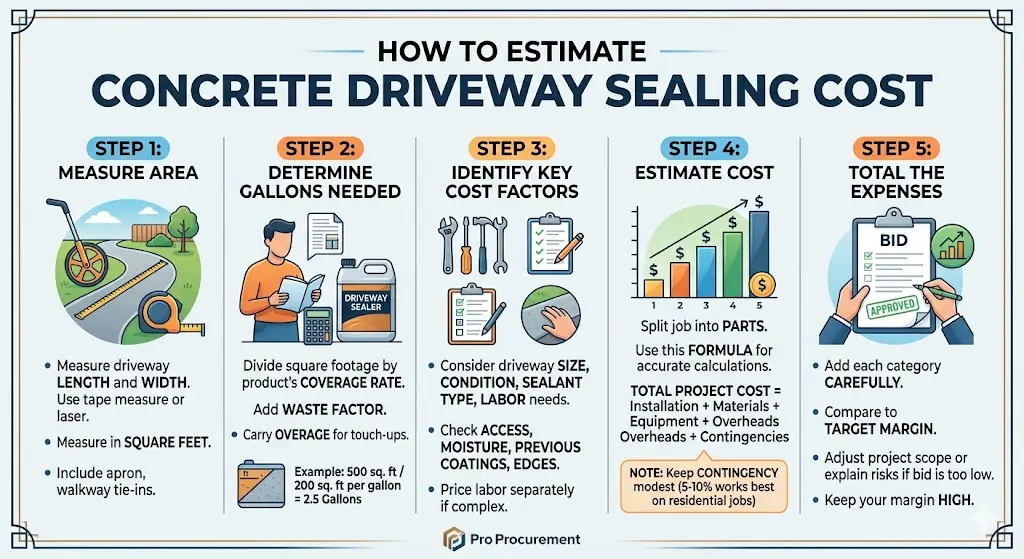
Step 1: Measure Area
Start with the driveway length and width. Use a tape measure, measuring wheel, or laser measure for better accuracy. Break odd shapes into rectangles and triangles, then total the area. Measure in square feet. Then confirm whether the project includes the apron, walkway tie-ins, or entry pad.
Step 2: Determine Gallons Needed
Once you know the area, check the product coverage rate. Most sealers list coverage per gallon, often based on porosity and finish type. Divide square footage by coverage, then add a waste factor. You can also carry a small overage for joints, touch-ups, and thirsty concrete. For example, if a product covers 200 square feet per gallon and the driveway measures 500 square feet, you need 2.5 gallons before waste. Then adjust for the actual slab condition.
Step 3: Identify Key Cost Factors
Now, consider the size, condition, sealant type, labor needs, and materials required for the project. Use your own inspection notes. Check access, moisture, previous coatings, and edge complexity. Then price labor separately from the product when the job needs more than a basic pass.
Step 4: Estimate Cost
Now split the job into parts.
- Installation cost covers labor.
- Materials cost covers the sealer, tape, cleaners, and prep products.
- Equipment cost includes pressure washers, sprayers, rollers, extension poles, and safety gear.
- Overheads cover office time, vehicle use, insurance, and admin.
- And contingencies cover the things you cannot see yet.
Use this formula for accurate calculations.
Total Project Cost = Installation + Materials + Equipment + Overheads + Contingencies
Note: Keep the contingency modest on clean jobs and higher on difficult ones. On a residential driveway, 5% to 10% works best. On a messy or weather-sensitive job, you should carry more.
Step 5: Total the Expenses
Add each category carefully. Then compare the final number against your target margin. If the bid is too low, do not shave labor just to sound competitive. However, work on the project scope, adjust product choice, or explain the risk. That is how you can keep your margin high.
What If You Don’t Have Time for Cost Plans?
In the contractors’ case, mostly schedule wins. When bids become challenging or overloading, outsourcing keeps the pipeline moving without pushing your in-house team into late-night math. That is where a specialist concrete estimator helps.
The Benefits of Outsourcing Concrete Estimating Services
Outsourcing helps contractors manage volume without loading the office. It also keeps estimates consistent across busy seasons. And when your estimated load grows, consistency becomes a profit tool. Explore the benefits of freelance concrete estimation services below!
-
Reduced Overhead
You can avoid hiring full-time staff for work that comes and goes. That lowers payroll burden, software costs, and training time. For smaller contractors, that flexibility can protect thousands per year, especially when bid volume changes month to month.
-
Cost Savings
An estimator mostly catches missing items before they hit your margin, which means they meet precision and accuracy standards at the highest level. That means fewer underbids and less rework needs.
-
Faster Turnaround
Speed matters a lot in a contractor’s work life. Outsourcing can keep bids moving without pulling field labor off production. That helps you respond faster and stay in the conversation, even 24/7.
-
Access to Specialized Expertise
Certified estimators know how to estimate local labor, avoid weather delays, and make the right sealer selection. They also spot risk laborers sometimes miss. That expertise helps you save time and improves confidence in the final estimate.
-
Improved Bid Winning Ratio
Precise and accurate estimates usually produce better bids. Better doesn’t mean cheap; this means numbers on point. When your numbers are fair, detailed, and grounded, clients trust them more, and trust wins projects.
Don’t let complex bids slow your growth. Partner with our experts to streamline your workflow, reduce overhead, and deliver bids that win
Commonly Asked Questions
Why is there a need to seal a concrete driveway?
Sealing helps block moisture, oil, and deicing salts from soaking into the slab. It also slows surface wear and helps the driveway hold color and finish longer. That protection matters in freeze-thaw and high-traffic conditions.
Is a concrete driveway worth the money?
Yes, when you plan for durability and curb appeal. Concrete usually costs more upfront than basic alternatives, but it can last longer and need less structural attention. The site value improves when the finish stays clean and sealed.
What is the best driveway sealer?
The best sealer depends on the slab and the goal. Penetrating sealers protect without changing the look much. Polyurethane works well when you want stronger surface resistance. And epoxy gives a harder finish, but it needs more prep.
How to seal a concrete driveway?
Clean the surface, let it dry fully, repair visible defects, and apply the correct product evenly with the right sprayer or roller. Work in manageable sections, factor in cure times, and avoid sealing damp concrete.
How much does it cost to hire an expert for concrete sealing of a driveway?
Expense starts around $1.35 per square foot and can increase with access, condition, and product type. For a standard 1,000-square-foot project, the average sealing cost can be around $1,500.
Conclusion
Concrete driveway sealing estimates get easier when you break it into size, access, prep, product, and labor. Precise and accurate estimates keep the bid grounded, profitable, and easier to win. For professional support, Cost Bidding offers comprehensive concrete estimating services, including all soft and hard costs of the project. We start with feasibility analysis, go into takeoffs, calculate estimates, and finalize with quality assurance, ensuring your win. Reach out today and get reliable cost plans!
Related Guides: