A duct bank provides a way for electrical wires or telecommunication lines to flow underground. It consists of a conduit, also referred to as a tube or pipe, that carries these wires. The conduit is further enclosed in a concrete casing.
As overhead wiring was more prone to sudden electrical outages, causing wildfires and falling power lines, the duct bank has become a more reliable option. Installing these systems underground makes them secure from physical damage and improves the aesthetics of the area.
Duct banks are hard to install and maintain. Even a small error or repair could take weeks to locate and fix. Therefore, contractors and engineers must conduct proper takeoffs and plan duct bank installation for optimal function.
What Is a Duct Bank?
A duct bank is an underground system engineered to carry electrical wires and cables. These cables pass through a conduit, which is enclosed in a concrete or other protective layer.
Concrete encasing makes the system more durable and secure, while other materials like gravel filling can also be used. The encasements prevent different conduits from touching each other. These systems flow below sidewalks, roads, and commercial spaces.
A duct bank provides a secure and organized way to transfer data, electricity, communication lines, and control cables. Being laid underground, these systems are protected from environmental impact, physical damage, and unwanted access.
What Is the Purpose of an Electrical Duct Bank?
An electrical duct bank carries electrical wires for distribution across residences and commercial spaces. They are typically installed beneath roads, sidewalks, and public infrastructure rather than directly beneath houses. but under civil infrastructure, commercial, and industrial buildings.
The wires are separated and organized through different conduits. This provides a controlled and effective way of transferring electricity.
Types of Duct Bank in Construction
Each duct bank type has a different function depending on the encasement material. A duct bank is affected by the casing material. This impacts the installation speed, protection, durability, and cost of the duct bank. The two most common types include
● Concrete Duct Bank
A concrete duct bank is encased inside concrete. These duct banks are strong and offer greater protection against chemical contact or physical damage. Concrete duct banks can be installed under areas with high vehicular traffic. They can bear an immense load and are suitable for high-impact environmental areas.
● Non-Concrete Duct Bank
Non-concrete or fiberglass duct banks are made from weak material. They are not suitable for regular urban installation. These systems can easily incur damage. The conduits are placed directly in the soil and can be easily affected by the harsh climates.
Components of a Duct Bank System
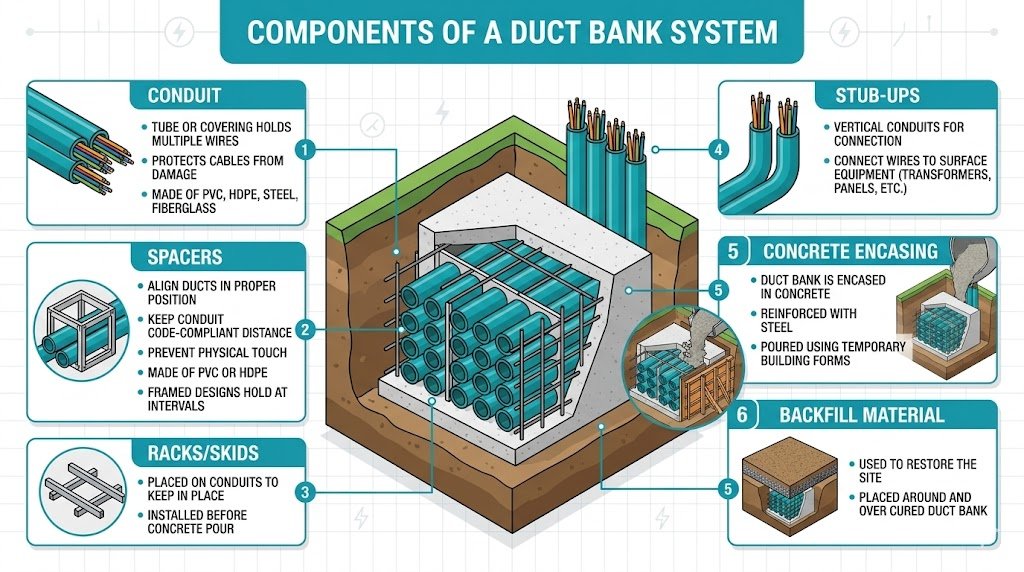
The duct bank involves different wires and cables inside a conduit. The conduits are well-organized in layers. Conduits are arranged in rows and columns within the duct bank. The conduits are separated by spaces, which prevents the physical touch of each duct. The system is enclosed in concrete for the safer functioning of the duct bank.
● Conduit
Conduit is the material that holds the wires. It is a type of tube or covering that holds multiple wires in one place. Conduits protect the cables from physical contact or damage. Conduits are made of PVC, HDPE, steel, and fiberglass.
● Spacers
The ducts are aligned in the proper position with spacers. These are also called stands, frames, or chairs. Duct bank spacers keep the conduit at a code-compliant distance. They are made of PVC or HDPE. Duct spacers come in framed designs. This allows them to hold conduits at regular intervals.
● Racks/Skids
Racks and skids are placed on the conduits to keep them in place. They are placed before the concrete is poured.
● Stud-Ups
Stub-ups are vertical conduits.They are used to connect the wires to surface equipment. They are referred to as connection points to transformers, electrical panels, or communication equipment.
● Concrete Encasing
The duct bank is encased in concrete. The system is reinforced with steel. Concrete is poured and settled in position using temporary building forms.
● Backfill Material
Backfill is the material used to restore the site once the duct banks are installed. These are placed around and over the duct bank once the concrete is cured.
Type of Conduits
There are 4 main types of conduit used for underground electrical systems. This includes PVC conduit, HDPE conduit, fiberglass conduit, and rigid steel conduit.
● PVC Conduits
PVC conduits are the most commonly used for duct banks. It is highly corrosion-resistant. This makes it suitable for safe routing and long-term durability. PVC is also preferred by many electrical code requirements in the U.S.
The most common type of PVC conduit used is 40 schedule, providing quality strength for installation. While an 80 schedule PVC provides thicker protection for parts, maintaining high pressure.
● HDPE Conduit
HDPE is stronger than PVC. It is heat-resistant with zero leak potential. It is suitable for curved paths and horizontal directional drilling (HDD). However, it requires fusion equipment for proper installation, making it more expensive than PVC.
● Fiberglass (RTRC Conduit)
These are also known as Reinforced Thermosetting Resin Conduit (RTRC). Fiberglass cables are more durable and can resist far higher temperatures than PVC.
They are able to handle temperatures at -60°F to +250°F and allow longer pulls during installation. Its weight is ⅓ of a PVC cable and 1/10 of a steel conduit, allowing easy installation and handling. However, Fiberglass is much more expensive than any other conduit due to the high-quality material used in manufacturing.
● Steel Conduit
Steel conduits are generally best for mechanical protection. They can be installed in areas with high loads on the surface. However, the drawback is that it is quite heavy. A 100-foot length of 4-inch galvanized rigid conduit (GRC) weighs about 1030 pounds, as compared to the same size of fiberglass conduit weighing about 72 pounds only. For this reason, steel conduits require more labor and cost to install.
Duct Bank Design Considerations
Duct banks need to follow the local and international codes of installation. The burial depth, conduit material, spacing, and concrete requirements are crucial in determining the system strength and achieving long-lasting results. The National Electrical Code (NEC) and IEEE) set the standards for secure and durable duct design.
● Burial Length
The average depth for burying a duct bank is given by NEC Table 300.5. Duct bank burial depth must be 24 inches for areas under high vehicular traffic. Some jurisdictions might allow 30 inches, but high burial depth can reduce heat dissipation and impact cable performance.
● Conduit Spacing
NEC 310.60 provides the minimum requirement for conduit spacing. For conduits of diameter up to 4 inches, the spacing must be about 7.5 inches center-to-center.
For larger conduits, you need to add 3 inches to the length of diameter to determine the spacing. For example, the outside diameter of a conduit is 7.5 inches, and the center-to-center spacing would be 10.65 inches.
● Concrete Specifications
The duct bank must be covered with 3 inches of concrete spacing on all sides. The concrete needs to attain a compressive strength of 3000 PSI in 28 days for strength and protection against cracking.
● Reinforcement Requirements
#4 rebar needs to be placed parallel to the conduits on both sides. Moreover, #3 rebar is often bent into a U-shape or rectangular stirrup to hold the #4 bars in position. This is placed around the duct bank, forming a frame. This holds the #4 bars in place and aligned with the system structure.
Step-by-Step Duct Bank Installation Process
Correct installation of the electrical duct bank is crucial for long-term durability. Improper installation can lead to water infiltration, cable damage, and collapses. These issues can result in significant expenses for maintenance and repairs.
Executing the entire process with great precaution ensures smooth and flawless installation. Here’s a step-by-step process for installing conduit underground.
1. Excavation
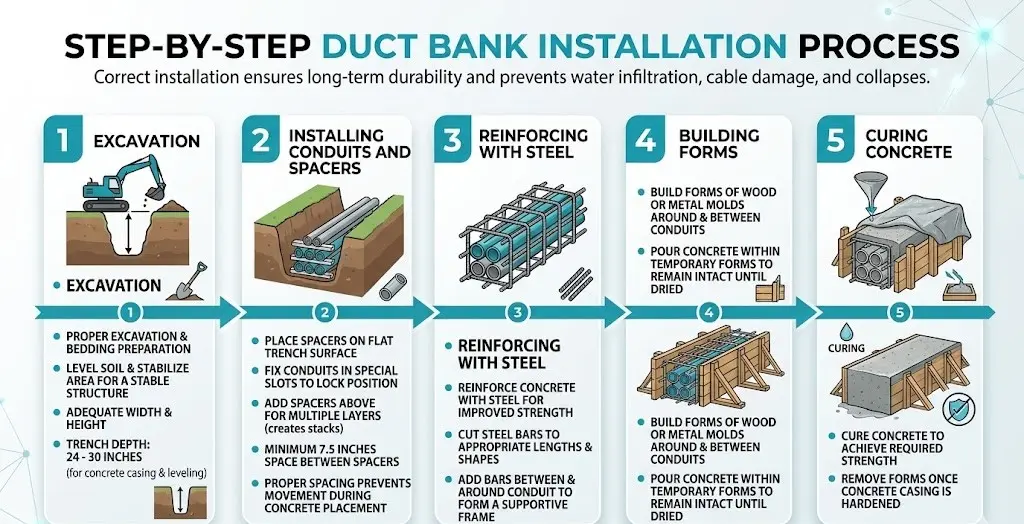
Duct bank involves proper excavation and bedding preparation. The site is prepared so proper paths can be made for laying conduits in place. The soil also needs to be leveled, and the area must be stable so that the structure is stable.
The trench is first dug underground to an adequate width and height. For proper installation, the trench depth must be 24 – 30 inches. This allows all the components to be installed with concrete casing and to level the soil.
2. Installing Conduits and Spacers
Now the spacers are placed on the flat surface of the trenches. The conduits are fixed in specially allocated slots. This locks the conduit in its specific position. If the duct bank has multiple layers, then the spacers are added above the others to create stacks. There must be a minimum of 7.5 inches of space between the spacers.
Proper spacing is required between the conduits so that the conduits do not move during concrete placement.
3. Reinforcing With Steel
Now the concrete is to be reinforced with steel for improved strength. The steel bars are now cut to the appropriate lengths and bent to be shaped for concrete. These bars are also added between and around the conduit to form a supportive frame.
4. Building Forms
Before adding concrete forms are built around and between the conduits. These forms are made of wood or metal molds. Concrete is poured within these temporary forms so that it remains intact in a position until it is dried out.
5. Curing Concrete
Now the process of curing concrete starts. Concrete is cured to achieve the required strength. Then the forms are removed once the concrete casing is hardened.
Prefabricated Duct Bank Installation
Another way to install a duct bank is to use prefabricated components. After the trenches have been dug out, prefabricated elements like conduits, skids, stub-ups, cable pull boxes, racks, etc., can be added along with the steel reinforcements. Once everything is placed in position, the concrete can then be poured for protective encasement.
Duct Bank Detailed Cost Breakdown
Duct banks are costly. However, the value they deliver makes them suitable for long-term investment. Estimating the installation cost is crucial to make key budgeting choices and plan financing. Duct bank cost is mainly affected by the capacity of the conduits it can hold.
| Type of Duct Bank | Installation Cost (Per Linear Foot) |
| 2-way duct bank | $165 – $385 |
| 4-way duct bank | $330 – $770 |
| 6-way duct bank | $495 – $1,150 |
| 8-way duct bank | $660 – $1,540 |
| 10-way duct bank | $825 – $1,950 |
Here’s how much different components would cost to install a duct bank.
| Components | Cost in USD | Key Aspects |
| Conduit (Per Linear Foot) | $2.20 – $27.50 | Conduit types include PVC schedule 40, PVC schedule 80, HDPE, and fiberglass. |
| Spacers (Per Linear Foot) | $1.65 – $13.32 | Plastic/polymer spacers or steel spacers |
| Concrete Encasement (Per Cubic Yard) | $132 – $265 | The type of concrete mix influences this cost |
| Steel Reinforcement (Per Linear Foot) | $0.85 – $19.80 | Standard charge wire or mesh, rebar, and structural cage systems are used |
| Labor Cost | $110 – $2,200 | This cost is influenced by the number of conduit lines, excavation cost, and labor hour charges. |
Key Tip: Duct Banks need access points after 200ft – 500ft, depending on code requirements and pulling tensions. Materials like pullboxes, vaults, and maintenance holes need to be installed for this purpose. These connections further influence the duct bank cost.
Factors That Affect Duct Bank Pricing
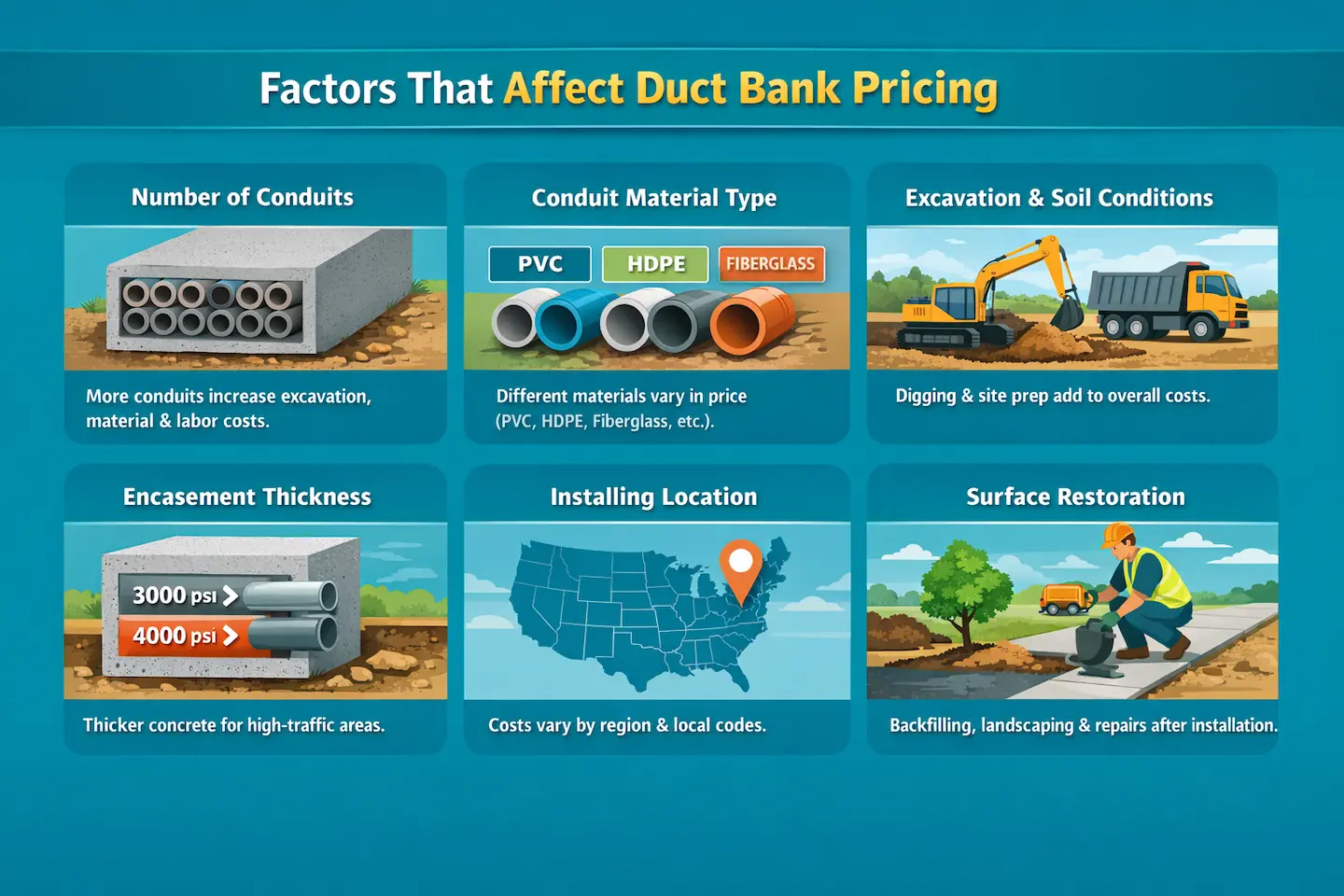
● Number Of Conduits
The higher the capacity of the duct holding the conduits, the higher the cost. Higher conduit means more excavation, material, and labor are required. Each conduit enhances the number of spacers, reinforcement, and concrete installation.
● Conduit Material Type
Different conduit materials are priced differently. For example, PVC schedule 80, which is slightly thicker and used in high-load areas, could cost about $4.40 – $12.10. While PVC schedule 40 costs about $2.20 – $5.50. Similarly, fiberglass is expensive due to the high manufacturing costs of up to $8.80 – $27.50.
● Excavation and Soil Conditions
Digging ground and preparing the area for electrical duct bank installation requires labor, expertise, and equipment. Excavators, backhoes, trenchers, dump trucks, and other materials are required for this purpose.
● Encasement Thickness
Concrete encasement thickness depends on the soil pressure and external loads. Low traffic areas use a concrete encasement of a 3,000 PSI mix. In high traffic areas like under roads, highways, or industrial zones, a 4000 PSI mix or even a greater strength mix is suitable. This gives greater durability and strength for the conduit structures, preventing collapse.
● Installing Location
The specific area you are installing the concrete duct bank in increases its cost. Location impacts labor charges, availability, labor costs, and code requirements. This is why you see significant price variations across different states in the USA.
● Surface Restoration
Once concrete duct banks are installed, the site needs backfilling and restoration to its original appearance. This includes sidewalk reconstruction, landscaping, or topsoil replacement. Effective restoration ensures that municipal codes are being followed and the site requires little maintenance in the future.
Why Accurate Duct Bank Takeoff Is Critical?
Accurate takeoff for duct bank installation is important to plan finances and follow safety measures during operation. It allows you to have the right amount of material available when you need it.
With a professional takeoff, you don’t need to worry about the material overstocking or understocking. Takeoffs define the material, equipment, and labor required for each process. Contractors are able to make material choices based on quality, durability, and site load-bearing requirements. This protects you from massive delays and structural failures.
Are you looking for quality takeoff services for duct bank installation? Cost Bidding brings years of experience to conduct detailed material takeoffs for your projects. So contact us now!
Need accurate quantities for your next project?
Conclusion
Accurate duct bank installation lasts for decades. It is flexible enough to be expanded and offers the right amount of protection for electrical distribution and telecommunication routing.
Unlike overhead installation, it ensures reliable power distribution, without casual cable damage. Choosing the right type of spacers, conduits, and concrete mix can help you achieve the installation results that you aim for.
Faqs
What is a duct bank used for?
A duct bank is a system of underground conduits that carry electrical or communication cables. It consists of conduits that hold different electrical wires and are separated by spacers. The system is encased by concrete to be strengthened enough to bear high loads and pressure.
Is an underground electrical duct bank worth the cost?
Yes, the electrical duct bank hardly requires any maintenance. They can protect the wires from environmental and physical damage. Moreover, underground electrical service maintains the aesthetics of the place with effective power distribution.
How deep do the trenches need to be dug for duct bank installation?
For secure duct bank installation, trenches need to be dug 24-30 inches underground. This allows you to add adequate protection and minimize structural damage to the system. This brings long-term durability and smooth system functioning.
How much maintenance does the duct bank need?
Once the duct banks are installed, they require little to almost no maintenance. The system is made to hold cables and wires underground for a long period, without any worry of damage or repairs.
How does a duct bank connect to access points?
Duct banks need to be connected with utility holes and handholes every 200 ft to 500 ft. Access points enable cable pulling, fault detection, and emergency repairs.