Whether you are building a small apartment or a large complex building, grading can make a huge difference between a successfully constructed project and a poorly structured building.
Grading in construction is a crucial element that directly impacts the stability, drainage, and sustainability of a building. it ensure a level foundation and effective water flow.
From detailed grading estimating to understanding how to create an effective grading plan, this guide explains everything contractors must know about construction grading. With our step-by-step construction grading guide, you can ensure a safe and secure construction project.
Learn how grading aligns with full project documentation in our guide to construction plans.
What is Grading in Construction?
Construction Grading is the process of shaping and leveling land at the construction site. It helps in achieving the desired elevations, slope, and drainage systems before the construction begins.
Grading prevents water pooling, flooding, and erosion, and improves the accessibility of the site. It is one of the first steps in site preparation and development. It is also a major key holder in overall construction costs. It includes the following features.
- Achieving desired elevations, slope, and drainage systems
- lowering ground levels
- removing excessive spoil
- filling low areas
- creating proper drainage
- land preparation to bear weights
Understanding Site Grading
The understanding of a grading plan is necessary to correctly perform site work, as well as estimate construction costs. A grading plan shows how the current land elevations will be adjusted to the desired slopes, drainage flow, and final site levels.
Contractors can establish cut-and-fill requirements, equipment, and the flow of construction by interpreting contour lines, spot elevations, and drainage directions. The clear knowledge of the grading plan assists in avoiding the drainage problems, rework, and compliance, and also ensures the site is set up in the manner of engineering and permitting requirements.
Types of Land Grading
Now, you might be thinking, what is land grading? It is a process of altering the land to create a level or sloped surface. The procedures of land grading are different depending on the size of a project, the soil type, slope environment, and the use to be made of the land.
The residential, commercial, and infrastructure projects have their own grading styles, which are applied in order to provide correct drainage, structural stability, and regulatory adherence. Site preparation and grading may contribute close to 10-15 % of the total project cost. Therefore, the choice of the right grading method is important in controlling its cost and durability.
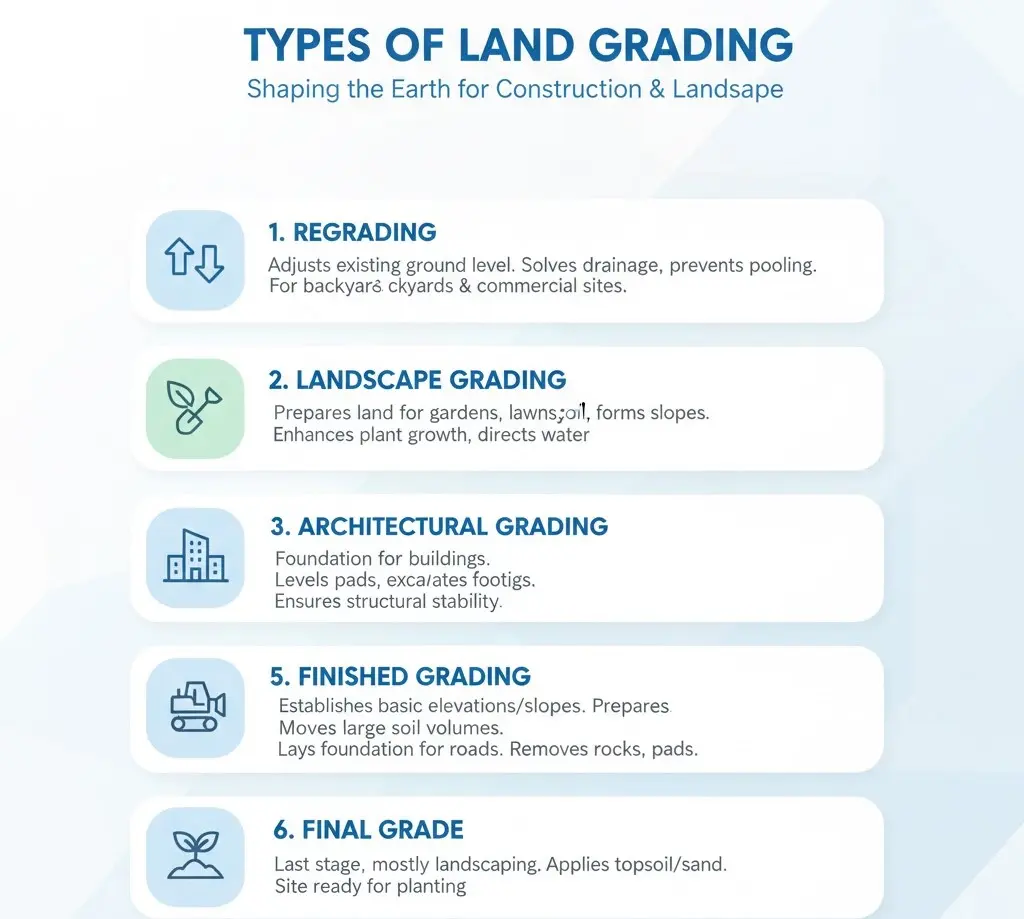
Regrading
Regrading refers to the elevation or reduction of the current ground level to rectify the problem of elevation or drainage. It is applied in residential backyards to stop the pooling of water and soil erosion. In large-scale business developments, it is used to create a uniform site layout around buildings, parking lots, and access roads. The issue of regrading is particularly significant in terms of dealing with drainage failures or making a site redevelopable.
Landscape Grading
Landscape grading works on adjusting the land to accommodate lawns, gardens, planters, and irrigation. This involves the removal of unproductive soil, slope forming, and leveling of grounds to enhance the growth of healthy plants and water drainage. Grading the landscape also assists in laying out undesirable water flowing towards buildings. Thus, avoiding stagnant water, which may ruin the landscape and the foundation of the buildings.
Architectural Grading
Architectural grading is concerned with the preparation of land for building construction. It involves the levelization of the building pad, excavating the foundation zones, the removal of the surplus soil, and the restructuring of the terrain to bear the structural loads and drainage needs. This method of grading makes sure that the foundations are constructed on solid, well-shaped grounds.
Rough Grading
The process of rough grading provides the fundamental elevations, slopes, and contours of a location based on the grading plan. Large amounts of soil can be transported in a short period of time using heavy equipment like bulldozers and excavators. In this phase, the foundation of drainage channels, building pads, and access roads is laid, but surface finishing is not done with precision.
Finished Grading
Rough grading is done, followed by finish grading, which involves perfecting the site in order to attain final elevations and smooth surfaces. This phase in landscaping work preconditions the planting of the grounds, or the installation of sod, as well as hardscaping. Finished grading in building projects prepares the surface to take up gravel, pavement, or concrete by eliminating rocks, debris, and irregularities on the surface.
Final Grade
The last stage in the grading process is the final grade. This is mostly applied in landscaping projects. It entails the laying of topsoil or sand to form a seed-friendly surface or sods. When final grading is finished, the site will be prepared to be planted and finished, and the period of earthwork will end, and the period of surface development will commence.
See how grading impacts project costs in our guide to estimating construction costs.
Benefits of Construction Grading
Grading provides a firm groundwork, controls surface runoff, and organizes the ground to support structural and aesthetic features by appropriate shaping and leveling of the terrain prior to the onset of the building process. When properly done, grading provides quantifiable long-term results to residential and commercial developments.
There are several advantages to land grading, which are beneficial for your construction site. Here are just a few:
Proper Drainage
Grading may be used to avoid pooling, which may destroy grass or even harbor mosquitoes. It also does not allow the water to flow into your building or that of your neighboring buildings, which would cost you lots of money to suitably repair the structure, particularly in the situation of the neighboring buildings, which may cause liability.
Utilize All The Land
Land is costly. Thus, you should make use of all the land you have. Slope may render extensive areas of the land unusable. As an illustration, a big backyard may look small when it is located on a slope where one cannot build a patio or other landscape items.
Avoid Construction Problems In The Future
Construction workers are advised to prepare for future problems by grading sites as painters do by covering the edges with painter’s tape. It would be an expensive error to put a ground on an uneven surface.
Understand how proper site preparation supports budgets in our guide to construction budgeting.
What Is a Grading Plan?
A grading plan is a detailed engineering drawing that demonstrates the manner in which the land will be shaped, leveled, and drained both before construction starts and after it has started. It gives the contractors accurate guidelines on the location where soil has to be cut, filled, and compacted to reach the necessary heights and slopes.
The grading plans are important in controlling the surface water, guarding the foundations, and also making sure that the site is in accordance with the structural, safety, and environmental requirements.
A grading plan consists of the following elements
- Current and suggested elevation.
- Contour lines
- Drainage flow arrows
- Cut and fill calculations
- Retaining walls and swales
- Property boundaries
How to Create a Grading Plan
The initial step in creating a grading strategy is to carry out a topography of the land. This will give baseline information such as the current grades of the land, the soil makeup, and any other related information regarding flooding or earthquakes.
A civil engineer will come up with a grading plan after carrying out a topographic survey. This plan provides the agenda on how to transform the land to form proper drainage and bear structures.
The evaluation techniques will be based on the local legislation, the requirements of the project, the geography of the land, and the intended result. Although the strategy of any project is to be unique as well, these are some of the general rules that engineers would use:
- Reduce the weight-bearing soil to not less than 95%
- The slope of parking lots should not be more than 5%.
- Main access drives ideally should not slope greater than 8 percent.
- The slope of asphalt ought to be 1.5 percent.
- The concrete slopes of areas and curbs must be a minimum of 0.75.
- Landscapes should not have a slope steeper than 2:1.
- Slopes more than 2:1 are accompanied by retaining walls or other stability measures.
- Allow an exposed foundation wall of .15m between the top of the foundation wall and the top of the surrounding grade.
- These rules would contribute to the establishment of a stable base of the construction sites that comply with the correct drainage standards.
Learn how grading details appear in project documentation in our guide to construction drawings.
How to Read a Grading Plan
A grading plan may not be an easy task to follow at first, with its technical symbols, altitudes, and slope indicators. But after learning the major aspects depicted in the drawing, it is easy to read a grading plan. A grading plan is a visual depiction of how the land shall be formed in order to facilitate construction. It ensures that these are well-drained and stable.
The common grading plan will display contour lines, property lines, proposed structures, access roads, drainage systems, and proposed ground elevation. All these aspects demonstrate how surface water will move over the site and off the buildings, which is the main aim of the grading design.
Critical Components on a Grading Plan.
- Contour Lines: It depicts the topography of the area existing and proposed, typically on a 1- or 2-foot interval. Lines that are close together represent steep slopes, whereas wider lines are used to represent flat areas.
- Property Lines: Designate the legal limits of the site, on which work may be done in grading.
- Proposed Structure: The proposed structure indicates the footprint and the site of the proposed building or structure.
- Roads and Access Areas: Determine driveways, streets, or access paths that need to conform to finished grades.
- Drainage Lines: Show the route paths of stormwater, swales, or underground drains.
- Surveys of Existing Grades: Show the existing land elevations before the start of grading, and these values are usually in feet above sea level.
- Proposed Grades: Indicate the resultant designed elevations once the grading has been done to provide positive drainage.
- Drainage Slopes: Percentages and Arrows showing the path and the steepness of water.
An overview of a grading plan has the main objective of ensuring that the drainage of the proposed building is favorable, i.e., drainage should be away from and not towards the building. With the right interpretation of these factors, contractors can perform earthwork in the correct manner, prevent drainage problems, and be able to adhere to the accepted plans.
Grading Permits and Approval Process
A grading permit is another type of permission that is usually granted before any land change is initiated, particularly in those cases where grading operations are to be done on the slope, drainage patterns, or on adjacent lands. It includes the following steps.
- The process of approval often entails a grading plan, erosion and sediment control measures, and also the details of the site being submitted to the local building or planning authority to be reviewed.
- The proposed grading is examined by the municipal agencies so that it will meet the standards of zoning regulation, environmental protection, and stormwater management.
- After approval, the inspections are normally made in the process of and after grading to ensure that the work is as per the allowed plans.
- Obtaining the right permits will assist in avoiding legal complications, project expansions, and expensive reworking and still having a safe and code-compliant site.
Equipment Used in Grading
The process of grading is carried out using specialized heavy equipment that is used to effectively transport, form, and compact soil as per the project’s needs. The equipment utilized is dependent on the size of the site, the terrain, the degree of precision needed, and the condition of the soil. The acquisition of the right grading equipment will guarantee proper land shaping and enhance productivity, regulate the labour and operational costs in the course of construction.
Typical grading devices are:
- Bulldozers
- Excavators
- Motor graders
- Skid steer loaders
- Compactors and rollers
- Dump trucks
The correct choice of equipment enhances productivity and lowers the grading expenses.
Start Your Project with a Precise Grading Plan Today!
Conclusion
Grading in construction is a fundamental step that directly affects the stability, foundation, and safety of the building project. Whether it is rough grading or final grading, each type serves a specific function in reshaping the land, maintaining the drainage, and preparing the site for construction.
With proper understanding of the construction plans, contour lines, proper equipment, and grade evaluation, one can achieve a cost-effective site grading preparation. Proper grading prevents water damage, erosion, and foundation issues, and reduces long-term maintenance. Looking for the best grading estimates? Consult Cost Bidding now!
FAQs
How can grading improve construction projects?
Construction grading is used to smooth and grade land to form a stable foundation. It improves your project by providing adequate drainage, which channels water out of the buildings and lessens the chances of flooding, soil erosion, and damage to foundations.
What is the total cost of site grading?
The cost of site grading is typically based on factors such as the site size, slope, soil type, drainage complexity, and the amount of cut and fill required. The cost may range from $ 1.50 to $3 per square foot.
How does rough grading differ from finish grading?
Rough grading is aimed at developing the land to approximate elevation and slope. Finish grading is an activity that follows rough grading and entails the application of fine-tuning to the rough grading to ensure accurate elevations, a smooth surface, and appropriate drainage.
Are grading plans important for construction?
Most construction projects need a grading plan in order to be granted permits and approvals. It makes sure that the land changes proposed do not violate the local zoning, drainage, and environmental requirements.
Is drainage important in grading?
Drainage is essential in grading since it will not allow water to accumulate at the foundation and low grounds. Lack of proper drainage may result in soil erosion, structural settlement, intrusion of water, and expensive repairs in the long run.