Last summer, I baked cookies for friends and forgot my measuring cup. So, I guessed the flour and still expected a perfect batch. The first tray puffed up, then spread into one giant, oily pancake. I didn’t ruin the recipe; however, I made a mistake with the measurements that day.
That moment mirrors a bid day in construction. If you make these mistakes in construction, volume gets confused, costs shake, and margins disappear. However, when you lock the estimates early, everything fits perfectly.
This guide shows a field-proven workflow for estimating cubic yards without issues. You’ll learn formulas, quick checks, and the small allowances that win bids. Let’s start reading!
Why Accuracy Matters in Cubic Yard Estimates
First, understand why accuracy matters in cubic yard estimates!
● Materials Ordering Stays On-Point
When you order bulk material, suppliers estimate and dispatch by cubic yards. So, a small takeoff miss quickly turns into extra deliveries and standby labor. If you over-order, you pay twice, which means material cost and disposal headaches. However, if you under-order, you trigger reorders, short-load fees, and schedule gaps.
Most estimators add a small waste factor to cover such placement losses. For example, concrete often needs about 5-10% extra volume.
● Bid Margins Rely on Volume
Your unit price starts with quantities, then you stack labor, equipment, and overhead.
If your yardage floats, your project cost increases, and your markup takes the hit.
Accurate estimating of cubic yards keeps your unit rates reliable on bid day.
Furthermore, it helps you compare supplier quotes without second-guessing the base quantity. When laborers place short, they stop work and waste paid hours. On the other hand, when teams place excess, they haul spoils and pay dump fees.
● Truckloads and Access Decisions
Every yard you add or miss changes how many truckloads hit your gate. Most standard dump trucks carry about 10-16 cubic yards per load. So, a 2-yard miss can force an extra trip on tight urban sites. That extra trip also drags fuel, driver time, and dump wait fees.
Moreover, access limits can force smaller trucks, which raises per-yard hauling costs. Therefore, you should tie volumes to the delivery method before final estimates.
● Project Scheduling
Concrete and earthwork drive early schedules, so volume accuracy protects your start date. When you plan pours, you coordinate finishing, curing, and follow-on trades. Concrete typically reaches full design strength around 28 days after placement. So, a wrong order quantity can ripple through the entire critical path.
Plus, suppliers schedule trucks in tight windows, especially during peak season. Therefore, you need reliable takeoffs before you lock pour dates.
The Core Formula to Convert Measurements to Volume
1. Start with the Base Conversion
In U.S. construction work, 1 cubic yard equals 27 cubic feet.
To calculate cubic yards, measure everything in feet, then multiply:
Length × Width × Depth
This gives you the volume in cubic feet.
Next, divide by 27 to convert the result into cubic yards. This simple formula works for many situations, including slabs, trenches, equipment pads, and stockpile boxes.
If the depth is given in inches, convert it to feet first by dividing by 12.
When someone asks, “How big is a cubic yard?”, imagine a cube that measures 3 feet on each side. That visual helps teams estimate truckloads and check quantities before materials arrive on site.
Example
Suppose a slab measures 30 feet long, 12 feet wide, and 6 inches thick.
- Convert the thickness to feet
6 inches ÷ 12 = 0.5 feet
- Calculate the cubic feet
30 × 12 × 0.5 = 180 cubic feet
- Convert to cubic yards
180 ÷ 27 = 6.67 cubic yards
- Add extra material for waste and placement losses
Typically 5–10%
This means you should order roughly 7.0 to 7.3 cubic yards, depending on job tolerances.
How to Deal with Mulch, Gravel, or Thin Concrete Lifts!
For materials like mulch, gravel, or thin concrete lifts, depth is often given in inches.
You can use this shortcut:
Square Feet × Depth (in inches) ÷ 324
This works because 1 cubic yard = 27 cubic feet, which equals 324 square feet at a depth of one inch.
Example:
- Area = 600 sq ft
- Depth = 2 inches
Calculation:
600 × 2 ÷ 324 ≈ 3.7 cubic yards
As per another useful reference, at 4 inches deep, 1 cubic yard covers about 81 square feet. Use this shortcut as a quick estimate or cross-check, but always rely on full plan takeoffs for final quantities.
● Mixed Units, Especially Metric Plans
Construction drawings sometimes mix feet for layouts and inches for details. In those cases, convert everything to feet first, then calculate cubic feet normally.
If plans use metric units:
- 1 yard = 0.9144 meters
- 1 meter ≈ 1.0936 yards
Convert meters to yards by multiplying by 1.0936, then proceed with the volume calculation.
Pro tip: Finally, always show your conversions in the worksheet; this ensures reviewers and estimators easily follow the math.
Process of Measuring the Accurate Cubic Yards
1. Gather the Right Tools First
Before you measure, grab a tape, a measuring wheel, a level, and a calculator. You can also print the relevant plan sheets, ensuring you mark breakpoints. When teams shoot grades, remember to ask for spot elevations and avoid rough guesses. With these small checks, you can stop bad assumptions before they enter the estimate.
2. Measure the Space
If you ever ask how to figure out cubic yards, start with accurate dimensions. For rectangles, measure length and width, then multiply to get square feet, while for odd layouts, split the footprint into smaller rectangles, then add areas. Next, measure depth or height in feet, not inches, then multiply by area. Finally, convert cubic feet to yards by dividing the volume by 27.
Example:
Imagine a demolition cleanout pile that measures 12 feet by 18 feet by 4 feet.
First, multiply those numbers to find the total volume in cubic feet:
12 × 18 × 4 = 864 cubic feet of loose debris.
Next, convert cubic feet to cubic yards by dividing by 27:
864 ÷ 27 = 32 cubic yards.
In real job-site conditions, haul-off containers rarely load perfectly. Therefore, experts usually round up slightly to allow for loose stacking and uneven loading.
So, for planning purposes, you would likely estimate around 33 cubic yards of debris.
That’s the core idea behind figuring cubic yards, even when dealing with irregular demolition piles. Using this method also keeps disposal and hauling line items clear and defensible in an estimate.
How to Estimate Cubic Yards for Excavation & Dirt?
1. Decide What State You Need Estimates In.
Earthwork does not stay the same volume from cut to haul to fill. Design quantities often reference bank material, while trucking uses loose volume. So, you should label your worksheets as BCY, LCY, or CCY from the start. Then, pick swell or shrink factors based on expected soil conditions. Those adjustments keep load counts realistic before equipment fully mobilizes.
2. Take Measurements from Plans, then Confirm in the Field.
Start with length, width, and depth taken directly from the grading plans. Next, validate depth with spot grades, because plans show intent, not reality. For trenches, measure bottom width and depth, then add any over-excavation. However, for pads, use the excavation limits, not just the building footprint. Additionally, check side slopes or shoring, because they change volume dramatically.
3. Run the Bank-Yard Estimation
Use the basic volume formula:
length × width × depth, all in feet.
Then, divide by 27 to convert to bank cubic yards for pricing.
Example
A 40 ft × 25 ft cut at 3 ft depth gives 3,000 cubic feet.
Multiply the dimensions:
40 × 25 × 3 = 3,000 cubic feet.
Next, divide 3,000 by 27, and you get 111.11 bank cubic yards.
This calculation establishes the baseline volume when estimating cubic yards for excavation and sitework bids.
4. Adjust for Swell, then Plan Trucking
Excavated soil usually swells, so loose volume exceeds bank volume. If you expect a 25% swell, multiply 111.11 BCY by 1.25. That gives about 138.89 loose cubic yards for hauling and stockpiling. Next, divide by your truck capacity, then round up for dispatching. With a 12-yard truck, you need about 12 loads for this cut.
How to Estimate Cubic Yards For Different Construction Projects?
● Concrete Foundation & Flatwork
When subcontractors ask how to calculate concrete yardage, experts follow these steps:
- First, pull the slab area from the plans, then confirm the thickness by use and code.
- Next, convert inches to feet, multiply the area by the thickness, then divide by 27.
- Then, add five to ten percent for waste, edges, and grade variation.
- Last, check how long concrete takes to dry before you stack trades after the pour.
Plus, read How Much Does a 40×80 Concrete Slab Cost in 2026 for a full walkthrough.
● Excavation & Earthwork Projects
In civil work, teams separate cut, fill, and topsoil stripping on the takeoff. Then, they estimate the excavation in the correct volume. Also, they convert bank to loose for hauling, and loose to compacted for backfill.
That discipline keeps equipment hours, truck counts, and dump fees aligned. If the site needs balancing, cut-and-fill estimates can eliminate unnecessary export. This is where estimating cubic yards becomes a profitable game.
● Gravel, Sand, & Aggregate Estimation
Suppliers often quote aggregate by the ton, yet teams place it by volume. So, you should start with cubic yards, then confirm weight conversions with the supplier.
For pricing, gravel commonly runs about $15 to $75 per cubic yard, before delivery. Therefore, a 2-yard overage can add real money, fast, on small jobs. Plus, verify lift thickness in the field, because base compaction reduces volume. When the stakes feel unclear, remember to re-check the dimensions from the plan set immediately.
● Landscaping & Mulch Estimation
Mulch and topsoil bids fail when depth assumptions drift across the site. Therefore, you should measure the bed area, decide on depth, and convert using 324 for inches. At one inch depth, one cubic yard covers about 324 square feet. So, a 600-square-foot bed at 2 inches lands near 3.7 yards.
Next, add a small allowance for fluff losses and uneven edging. If something confuses you, you can outsource estimators for landscaping estimating services.
What Factors Affect the Cubic Yard Cost in a Construction Project?
Cubic-yard costs look simple until the site starts pushing back. These 5 factors usually drive the biggest swings in unit cost.
- Material specifications and density change mix costs and hauling weights.
- Delivery distance and access drive delivery fees and time on site.
- Minimum loads and short-load charges raise unit cost on small pours.
- Placement methods, like pumping or hand placement, change labor and equipment hours.
- Swell, shrink, and compaction change the pay quantity between bank and loose.
How to Save Costs on a Construction Project?
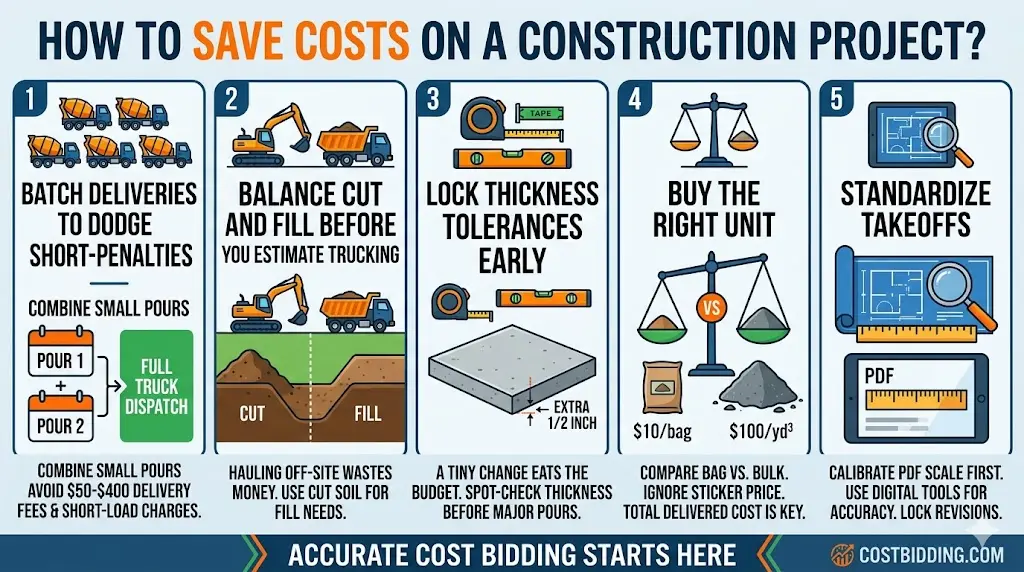
● Batch Deliveries to Dodge Short-Load Penalties
Break your pours into full truckloads whenever the schedule allows. Ready-mix often prices near $119–$147 per cubic yard for delivered loads. However, suppliers commonly add short-load charges when loads fall under about ten yards. They also charge delivery fees, often $50 to $400, based on distance. So, when you combine 2 small pours into a single dispatch, you cut fees fast.
● Balance Cut and Fill Before You Estimate Trucking
Hauling dirt off-site wastes money faster than almost any other line item. Therefore, you should look for opportunities to balance cut areas with nearby fill needs. Shrink and swell factors change those balances; therefore, adjusting volumes early is essential.
When you cut export loads, you cut trucking, disposal, and gate congestion too. And if the math gets heavy, rely on cut and fill estimating services from the industry experts.
● Lock Thickness Tolerances Early
A tiny thickness change can eat your material budget. You should take a 3,200-square-foot slab and add just half an inch extra. That small modification adds about 4.94 cubic yards of concrete to the order.
At $119–$147 per yard, that change can land around $588–$726. Therefore, remember to add grade controls, then spot-check thickness before every major pour.
● Buy the Right Unit
Bagged material feels easy until you estimate it at scale. Bulk purchases by the cubic yard usually cost less on larger projects. Furthermore, bulk orders avoid packaging waste and reduce multiple small deliveries. So, compare bag pricing to bulk pricing using a simple per-yard conversion, and then decide based on the total delivered cost, ignoring sticker price.
● Standardize Takeoffs
Digital takeoff tools save time, but they punish sloppy scale settings. So, you must calibrate the PDF scale first, then run measurements and quantities. Furthermore, keep a quick manual check with a known dimension on the drawing. That small habit catches most off by 10% errors before estimation. Then, export quantities into the estimate template and lock revisions.
Software & Tools Used for Cubic Yard Estimation
● PlanSwift
PlanSwift lets you measure digitally and build assemblies for material and labor quickly. Experts prefer it for concrete and sitework because they can reuse standard thickness items. Plus, it links with Excel so that you can push quantities into your bid workbook. If you need a reliable cubic yard estimator inside the takeoff workflow, it fits well.
● Bluebeam Revu
Bluebeam’s measurement tools help you take lengths, areas, and counts from PDFs. So, set the drawing scale, then measure and track quantities in one place. Because Revu stores a markup list, you can audit takeoff quantities quickly. That audit trail matters when an architect issues last-minute revisions.
● STACK
STACK runs in the cloud to ensure teams can share takeoffs without emailing files. It focuses on quantity and material takeoff, which keeps the workflow simple. Moreover, it speeds up bidding when several estimators split a plan set. Professionals often pair STACK quantities with local pricing to finish a bid faster.
How to Master Shape for Accurate Cubic Yard Estimates?
● Rectangular Spaces
Rectangular pours and excavations fit the standard length × width × height method. So, keep everything in feet, then divide the cubic feet by 27. If a slab measures 12 ft by 16 ft at 4 inches thick, convert the thickness first. That takeoff lands near 2.96 cubic yards, before you add any waste. This approach keeps the rectangular work predictable and easy to review.
● Circular Spaces
Round footings and pits need a cylinder volume, not a box calculation. Therefore, you should use the cubic yard formula for cylinders:
π × r² × height,
measured in yards.
If you measure in feet, compute cubic feet first, then divide by 27.
For example, a 6 ft diameter footing with 2 ft depth needs about 2.09 yards. On bid day, double-check the radius, because diameter mistakes cause issues.
● Irregular Shapes
Irregular beds and excavation limits rarely match one clean rectangle. So, split them into smaller rectangles or triangles, then total the volumes. If the grade slopes, break the area at elevation changes, then average the depths.
That process takes longer, yet it keeps allowances honest and traceable. In tight designs, you can sometimes lean on 3D modeling to confirm volume. That’s figuring cubic yards the way engineers attach quantities expect.
Mistakes to Avoid When Estimating the Cubic Yard Cost of a Building Project?
● Bid Competitiveness
When you miss volume, you often pad it later and lose price. Or, you keep the price low and hope field conditions forgive the gap. Both choices hurt, and neither builds repeat clients or clean closeouts.
Therefore, you should tie every yard to a drawing callout or a field measurement note. That practice keeps estimating cubic yards consistently across alternate options.
● Supplier Coordination
Suppliers dispatch trucks based on what you order. So, if you change depth late, you must update the order immediately. In addition, confirm whether the supplier sells partial yards or rounds up.
That one question can prevent surprise overages in small hardscape scopes. Remember to document assumptions in the estimate, ensuring that procurement can follow the plan, too.
● Trucking Logistics
Trucking fails when you ignore access, turnarounds, and dumping restrictions. So, confirm truck size early, then estimate haul time realistically.
Further, schedule loads around gate hours, because queues kill productivity. If you work downtown, one extra load can wreck your entire pour window. Therefore, remember to tie the load count to the site logistics plan, not a guess.
● Project Scheduling
Scheduling breaks when quantities are underestimated, because teams wait for material. Concrete also needs curing time, so volume errors delay follow-on rough-ins. Therefore, you should confirm pour size, then align finishing labor and curing windows.
If the weather shifts, adjust sequences, but do not adjust quantities blindly. That approach protects timeline commitments and keeps change orders defensible.
● Cost Forecasting
Forecasting goes wrong when you treat volume like a one-time math exercise. Instead, track actual placed yards against estimated yards during the job. Then, update your unit-cost database, because pricing changes by region.
This feedback loop shows which teams overbuild thickness and which stay tight. Over time, you win more bids because your quantities stay sharp.
Tips and Tricks To Measure The Cubic Yards
● Stay Away from Typical Mistakes
- First, always convert inches to feet before you divide by 27.
- Plus, never assume depth stays uniform across long pours or sloped grades.
- When the shape looks odd, break it into smaller parts and total volumes.
That simple approach eliminates the questions asking for the reasons for the shortage.
● Apply Effective Measurement Methods
- Use a measuring wheel or tape for length, then use a level for height.
- Next, mark breakpoints where grades change, so your average depth stays reliable.
- Additionally, consider material behavior, because soil compacts and settles over time.
- If you can, verify one dimension in the field to confirm the drawing scale.
Need a quick cross-check? Contact Cost Bidding before estimating cubic yards on your next bid!
FAQs
What is a cubic yard in construction?
A cubic yard equals a volume of 3 feet by 3 feet by 3 feet. Contractors use it to order bulk materials like concrete, soil, gravel, and mulch.
How many cubic yards fit in a dump truck?
Most standard dump trucks carry about 10 to 16 cubic yards, depending on body size. However, weight limits often control loads, especially with wet soil or rock.
Why is there a need to add extra materials in cubic yard estimates?
When you ask about calculating concrete yardage, include a waste allowance for field loss. Concrete commonly needs 5-10% extra, and soils may need more.
What makes cubic yards important in construction?
Suppliers price bulk materials by cubic yards, so volume drives your procurement plan. It also drives truckloads, schedule windows, and cash flow timing across early scopes.
How to convert yards to feet?
Multiply yards by 3 to convert length from yards to feet quickly. For example, 5 yards equals 15 feet, which helps you scale drawings in the field.
How to convert meters to yards?
One yard equals exactly 0.9144 meters, which means one meter equals about 1.0936 yards. Multiply meters by 1.0936 to convert meters to yards for takeoffs.
Conclusion
Now, you have an answer to “How to Estimate Cubic Yards for Any Project Accurately?”
- Start with feet, multiply dimensions, then divide by 27 for cubic yards.
- Use the 324 shortcut for inch depths when you spread thin lifts.
- Price earthwork by the correct state: bank, loose, or compacted.
- Add realistic waste and round up to match supplier delivery constraints.
- Calibrate your takeoff scale and document assumptions for clean bid reviews.
Cost Bidding supports contractors with estimating services and precise takeoffs.
We focus on estimating cubic yards, scope notes, and unit pricing for better bids. Then, we run a cubic yard estimator check, ensuring that teams order once.