A deck is one of the best ways of expanding the space aesthetically in your home. It is considered the most significant home improvement you can undertake. A deck not only enhances living space but also offers you a place to relax and enjoy moments with your family, and entertain your friends and guests. A well-crafted deck adds top-notch beauty and functionality to your abode. The question always comes to mind: How to build a deck?
Here is the catch! Building a deck is not everyone’s cup of tea due to the complexities. The process becomes intimidating due to several issues and a lack of knowledge and professionalism. The good news is that by choosing accurate planning, design, materials, and tools, you can easily build a deck to uplift the beauty of your home. Worry not! This blog will break down the essential steps you need and offer insights into the process of designing, preparing, and constructing a deck so you can enjoy your special moments with your loved ones.
Planning Your Deck Project
The plan to build a deck project starts by taking into account all the necessary elements, including project size, site preparation, location, budget, building codes, and soil factors. In the first step, the homeowner should decide the purpose of the deck, whether it is for lounging, entertaining, or dining.
The homeowner should choose a suitable site for building a deck. The place should be flat and well-drained, leading to increased accessibility and functionality. If one is working with an uneven and slopy area, there is an increased chance of reducing the efficiency of your work. Moreover, also look for a place where nature provides shade to your deck, and it is closer to greenery and nature.
After selecting a location, you must consider your budget and plan your deck project according to your costs. Draw out a rough plan for your deck, indicating the size, number, and location of deck footings. If you are thinking of building a ground-level deck, the height is around 12 inches to 30 inches above the ground. However, you can choose concrete to lift the deck foundation above the ground.
Checking Permits and Regulations
Before digging or laying the foundation of a deck project, it is also important to check local permits and building codes. It also depends on the location and region in which you are currently residing. Many municipalities demand a building permit for deck construction if a deck is above the ground. These regulations ensure safety standards, railing heights, structural requirements, and property rules. These permits also ensure the legality of a deck. If one fails to comply with regulations, they face fines or other penalties for structural problems. Therefore, it is important to contact the local zoning office to check specific requirements in your area.
Choosing the Right Deck Design
The next step involves choosing the right deck design. It is important for homeowners to build a deck that is a blend of aesthetic, functionality, and lifestyle needs. The design you choose will not only impact your home space but also influence the appeal. Here is the detail of the factors one needs to consider while choosing the right deck design.
Location and Orientation
One must take into account the location and orientation of the deck design. Here are different designs of decks.
Attached Decks: These decks extend directly from the house for easy access.
Detached Decks: such types of decks are built away from the home. These are the best suited for gardens, pools, and recreational spaces.
Rooftop Decks: These decks are ideal for urban homes due to limited yard and home space.
Size and Layout
Rectangular deck: These decks are simple and affordable in price for homes.
Large Yards: Multi-level decks can develop a seamless flow from the house to the garden.
L-shaped decks: These decks can extend usable space and offer better flow and functionality.
Circular decks: Such designs give a unique and modern touch, but they require more planning for effective functionality.
Deck Placement
Front yard decks can enhance the appeal of your home exterior and act as a welcoming porch, so you can enjoy time with your loved ones and guests.
Backyard decks are the most common ones in providing more privacy and access from the living room and kitchen.
Rooftop decks are ideal for homes where the space is small and limited.
Deck Styles
| Deck style | Description | Best suited for | Pros | Cons |
| Platform deck | Low-to-ground, simple flat deck | Flat yards, single-story homes | Easy to build, affordable, and blends with the yard | Limited view |
| Multi-level deck | Multiple connected levels | Large yards, sloped terrain, entertaining | Stylish, separates spaces (dining, lounging, hot tub) | Complex designs and high prices |
| Raised deck | Elevated deck with stairs & railings | Sloped yards, homes with basements | Offers great views | Costly as it requires structural support |
| Wraparound deck | Extends around multiple sides of the house | Farmhouses, country homes, scenic properties | Expands living space | More expensive and high-maintenance |
| Balcony deck | Small deck off a side entrance or upper floor | Tight spaces, bedrooms, second-story access | Cozy, private, perfect for small seating | Limited size and less versatile |
| Island deck | Standalone deck not attached to the house | Large yards, garden retreats, when attaching isn’t possible | Flexible placement | Requires a separate foundation and support |
| Rooftop deck | Built on a flat roof or a garage | Urban homes with little space | Enhance the space | Need waterproofing and permits |
Selecting Materials
When building a deck, it is also crucial to select the right materials for your deck for longevity and durability. The materials we choose affect the look, maintenance, cost, and durability of your deck. Here is the list of materials that you can select based on your requirements and budget.
Pressure-treated Wood
It is one of the most widely used materials in decking projects, with affordable prices.
Pros
- It is a durable option with cost-effective prices
- Being widely available, one can find it easily in home improvement stores
- It is more durable as it resists fungus, rot, and insect damage
- It comes with a customized option so the wood can be painted, stained, or left natural
Cons
- Such types of wood require high maintenance to prevent staining and cracking.
- Over time, it is more likely to splinter
- It does not have the natural beauty of higher-end woods
Cedar & Redwood option
These are naturally beautiful softwoods that are known for rich colours and high resistance.
Pros
- Attractive appearance with warm, rich colors
- The presence of oils in the woods makes them naturally resistant to insects and rot.
- These woods stay cooler in hot weather than composite wood.s
Cons
- More expensive than pressure-treated wood
- It requires regular maintenance in the form of sealing and staining
- Being a softwood, it is more prone to scratches and dents
Tropical Hardwoods
These are called premium natural wood decking with long life spans.
Pros
- The hardwoods are extremely durable
- Highly aesthetic in appearance
- Enhanced longevity with a 30-50-year span
Cons
- Hardwoods are among the most expensive decking materials
- Hard to manage as it requires specialized equipment due to increased density
- Needs annual oiling to maintain its naturally rich colour
- Heavier than other wood decking materials
Composite Decking
It is made from recycled wood fibers and plastic for durability.
Pros
- Unlike softwood and hardwood, it requires low maintenance
- It is resistant to splintering, rot, and insect damage
- It comes in a variety of colours and textures
- It is eco-friendly as it is made from recycled materials
Cons
- Higher upfront cost than pressure-treated wood
- The composite decking possesses high heat absorption and retention
PVC Decking
The decking material is entirely made of plastic.
Pros
- It comes with ultra-low maintenance
- Shows moisture-resistant
- Long lifespan of a maximum of 30 years
- Lightweight and easy to install
Cons
- Lacks in aesthetic appearance
- Retains more heat
- Cost similar to composite decking
Aluminium Decking
It is more modern and an industrial style decking option with high durability and resistance.
Pros
- Known for great durability
- Highly weather-resistant
- Requires low maintenance
- Safer in fire-prone areas
Cons
- Highly expensive
- Not appealing look
- High heat retention on sunny days
Preparing the Site
In building a deck, the next step involves the preparation of the site. It consists of several steps.
Planning and Layout
Before starting any physical work, it is important to check the local building codes and permits that specify deck requirements, height, and footing depths. For layout, it is necessary to mark the boundaries by using stakes and paint for better preparation.
Clearing the site
The site must be clean and free from obstacles that cause hindrance in construction. Always start by clearing the vegetation, including weeds, shrubs, grass, and tree roots. Relocate rocks and debris, and level the surface to maintain the even height of the deck and provide a stable base for footings.
Improving soil conditions
The condition of the soil plays a crucial role in supporting deck footings. Before laying the foundation, always test soil stability for reinforcement. If necessary, add a layer of gravel that improves drainage. Lastly, check for drainage issues to maintain structural integrity.
Marking deck footings
Now mark the exact footing positions with stakes or paint. Make sure the alignment by measuring diagonally to confirm the shape of the layout. Although the distance depends on deck design and local codes, generally, footings are spaced 6 to 8 feet apart.
Excavating for deck footings
Once marked, the site must be dug for footings. In many locations, footings must be below the frost line to prevent shifting. Use the equipment to ensure consistency in the footing hole. Then add the layer of gravel for improved drainage.
Building the Foundation
Building the foundation for a deck is one of the most important steps in ensuring the structural integrity and longevity. The foundation is the support system that bears the weight of the deck and people.
This process of laying the foundation starts with planning and marking the layout. Once the layout is carefully marked up, the next step is digging holes for footings to hold the deck. Concrete or gravel is then added to these holes to create a solid base. Metal post anchors are often incorporated to secure the vertical support posts.
The choice of foundation type depends on local building codes, soil conditions, and deck size. Moreover, proper drainage is also important to avoid water pooling, which can compromise structural integrity over time. A well-built foundation provides durability and ensures long-term safety.
Get In Touch With Us Today For More Details
Framing the Deck
Framing the deck is another step in the process of building a deck, as it forms the structural backbone and supports the entire system.
Attaching Rim Joists
The framing of a deck starts with attaching the rim joists to the post, leading to the creation of the deck perimeter and offering support for the decking board. To secure the rim joists, always use galvanized nails and make sure their evenness. After attaching the joists, cut the posts flush with the top joists to ensure a smooth surface for decking.
Installing Inner Joists
After establishing the perimeter, measure and mark joist spacing on the rim, which must be 12, 16, and 24 inches apart. Now install hangers at these marks and add inner joists to them, making sure that they are placed upward to prevent erosion. Make sure it’s level with the rim joists.
Installing Deck Boards
Fastening Deck Boards
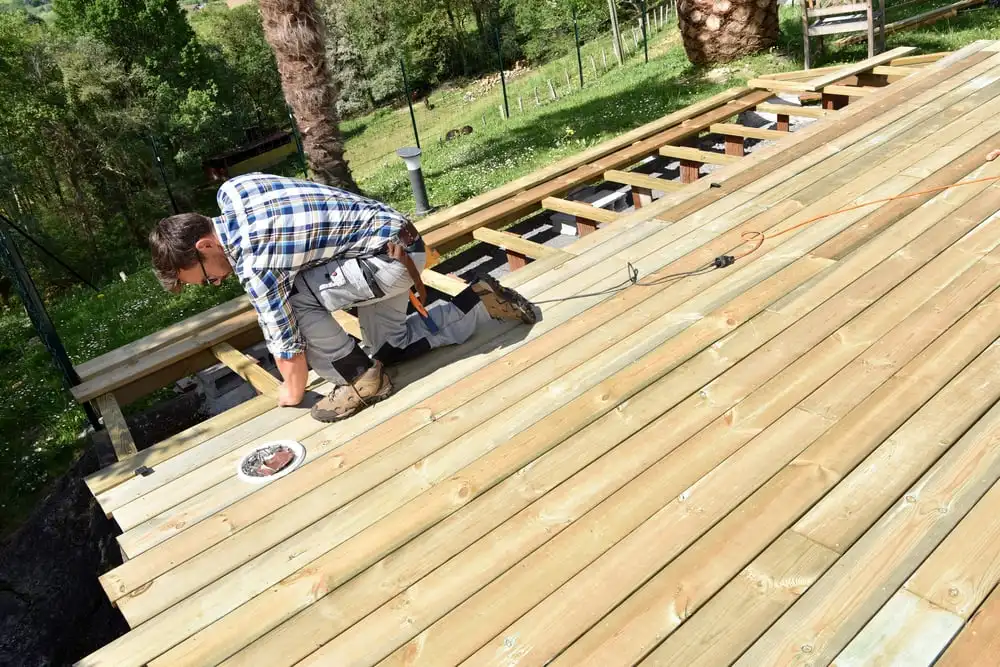
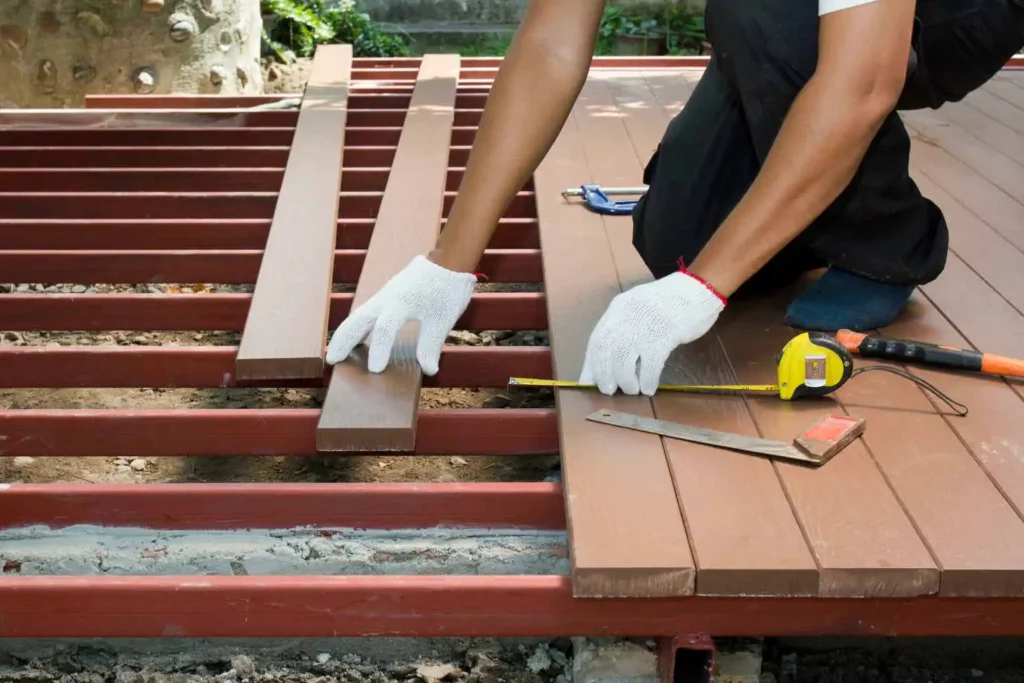
Once the deck frame is completed, the next step involves installing a deck board skillfully. You must lay the first board parallel to the house, leaving a ⅛ to 3/16 inch gap between the boards for airflow and drainage. The deck boards should be installed perpendicular to the deck joists. For better safety, secure the deck boards with proper screws and fasteners, making sure they are evenly spaced and aligned.
Trimming & Smoothing Deck Boards
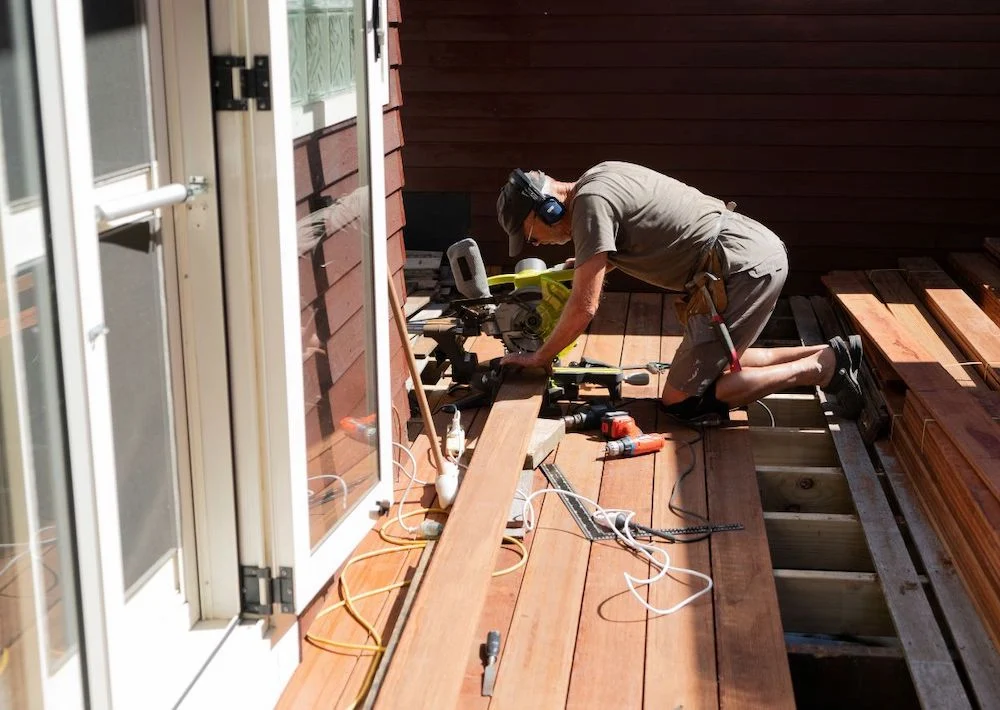
The next stop after installing the board comes the trimming of deck boards. For this purpose, mark the places where to trim the excess and then use a circular saw to make a precise cut. Then comes the finishing and smoothing of the edges with a sander or router.
Adding Railings and Stairs
If the deck is more than 30 inches off the ground, it is important to install stairs for better safety. To install this, calculate the height and width to make sure the steps are even. Also, attach stringers to the deck frame and install the risers and treads securely. You must make sure that the stairs are well-attached and well-anchored to both the ground and the deck.
If needed, also add the railings around the deck’s corners and perimeters. Secure the bottom and top rails between the top. Install balusters 4 inches part, according to local code requirements.
Adding Finishing Touches
The last step includes protecting your newly-built deck from UV damage, rot, moisture, and insects, and applying an exterior wood stain or weather sealer. To enhance the aesthetics of your deck, you can also add privacy panels, outdoor lighting, and lattice screens. These finishing touches will not only uplift the aesthetic look of your decking place but also turn it into a perfect outdoor space for quality time and gatherings.
Maintenance Tips for Long-Lasting Decks
Proper maintenance is important for retaining the longevity of decks. Here are some tips that help you maintain long-lasting decks.
- Regular cleaning is mandatory. Clear dirt, debris, and fallen leaves to prevent the growth of rot and mold. Sweep your deck weekly to prevent buildup. If necessary, use the pressure washer to clean the deck properly.
- Monthly inspection is also important to avoid damage. Inspect the board for popped nails, loose boards, cracking, and splintering. The immediate repairing of the deck prevents major structural issues.
- For wood-type decks, sealing is necessary to protect against moisture, insect damage, and UV rays. The coating of stain also depends on the weather of the region. And you must reapply the stain every 1 to 3 years.
- Humidity also promotes mold growth. Therefore, use a vinegar and water solution and a specific deck cleaner to remove the fungus.
- Over time, nails, bolts, and screws can be damaged due to corrosion. Check them regularly and, in the case of corrosion, replace them with rust-resistant nuts and bolts, ensuring safety and stability.
Are You Looking for a Professional Company to Build a Deck?
Are you looking for a reputable company that can help you build a deck? Look no further than Cost Bidding. We are among the best companies in the town. At Cost Bidding, we excel in providing top-class and professional deck-building services by using advanced tools. Our estimators have been equipped with years of expertise and knowledge in the construction industry. They carefully assess the market trends and offer the best possible solutions according to your deck project requirements. They also help in managing the budget and estimating accurate construction costs for your deck project.
They also possess the knowledge about the software used in lead generation and qualification. If you are wondering how to build a deck, contact us now for a precise estimation.
Conclusion
No one denies the importance of building a new deck for your new home. A deck is useful in enhancing the aesthetic value of your home, maximizing the space, and providing a space for gatherings. By utilizing our premier construction services, you can build a profitable deck by avoiding high costs and reducing financial surprises. If you are looking for a reputable estimating firm to help you with deck-building, Cost Bidding is the right platform. To explore further services, contact us or visit our website.
FAQS
-
What types of materials are best for building a deck?
Hardwood decking materials
Cedar wood
Softwood
Composite decking materials - Do I need a permit before building a deck?
Yes, it is necessary to acquire a building permit before starting a deck. The permit is designed to specify deck requirements. - What tools are needed to build a deck?
Different tools included a tape measure, drill, screw driver, saw, wrenches, post hole digger, and safety gear are needed. - What are the basic steps of constructing a deck?
Obtain permits
Design and plan layout
Dig post holes and pour footings
Install posts and framing (ledger board, joists, beams)
Lay decking boards
Install railings and stairs (if needed)
Apply finish or sealant