It is a framework that categorizes a construction project’s total budget into small, manageable parts.
Consider a situation: A $2.8 million commercial renovation goes to bid. The GC wins it by a good margin. After 6 months, when construction is progressing, the PM reports that the concrete has gone over budget by 22%. Where is the problem? Nobody knows. After a detailed assessment, the team knows that the problem is where the concrete labor, concrete materials, and concrete equipment were estimated in a single line item. When concrete costs started increasing, there was no way to tell which component was causing the overrun. By the time the cause has cleared, damage has also happened.
What does this scenario show? No, not a math problem. It is showing the effects of structural problems. In other words, it is an issue with financial visibility, and you can avoid that with a properly built Construction Cost Breakdown Structure.
What Is a Construction Cost Breakdown Structure (CBS)?
A Construction Cost Breakdown Structure (short form CBS) is a hierarchical framework that organizes every project expense into defined categories, subcategories, and cost codes. Purpose? It ensures that every dollar spent has a home, and every budget variance has a source. Simply put, CBS turns a lump-sum project budget into a trackable, auditable financial system.
While the total structural depth of a CBS varies based on project scale, such as contrasting the straightforward estimated cost to build a 4-bedroom house with a highly partitioned multi-million dollar commercial build, the core logic remains identical, which is total visibility.
Well, you can take CBS as the financial architecture of a construction project.
- The total contract value is at the top.
- Below it, costs break into major categories, including site work, structure, MEP, finishes, etc.
- Each category breaks further into labor, materials, equipment, and subcontractor costs.
Each of those gets a cost code linked to the project schedule and the scope. By the end, every field decision has a corresponding budget line it gets charged against. This financial architecture works hand-in-hand with comprehensive construction documentation services to ensure that what is modeled in the drawings aligns perfectly with what is tracked in the ledger.
Construction Cost Breakdown Structure Vs Work Breakdown Structure (WBS)
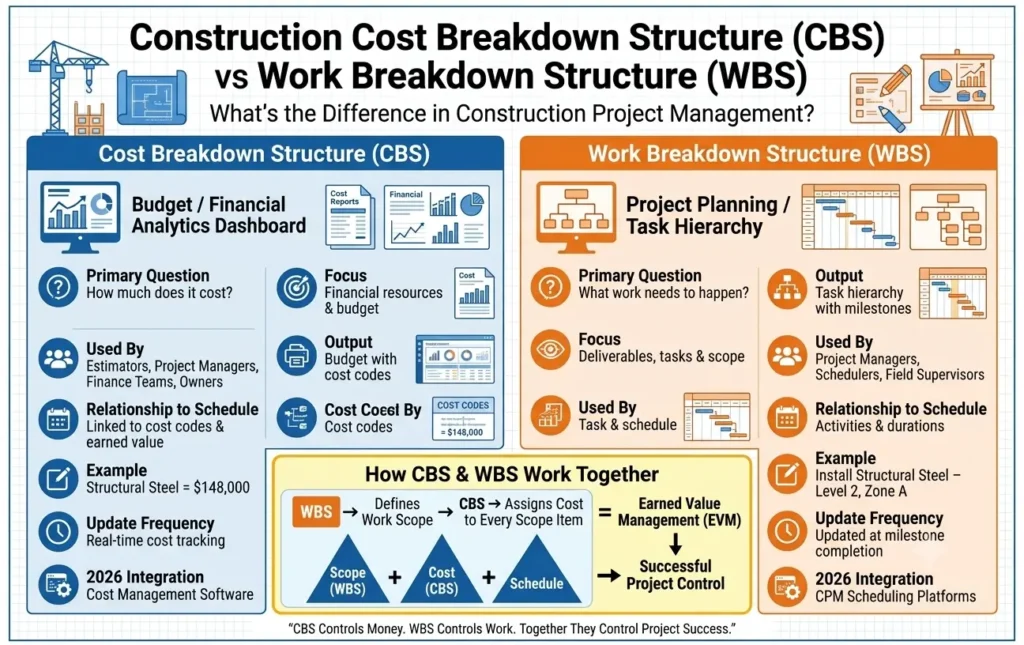
In the construction sector, teams confuse the CBS with many other terms; the first is Work Breakdown Structure (WBS). Let’s understand the difference between the two.
| Category | Cost Breakdown Structure (CBS) | Work Breakdown Structure (WBS) |
| Primary Question | How much does it cost? | What work needs to happen? |
| Focus | Financial resources and budget | Deliverables, tasks, and scope |
| Output | Budget with cost codes by category | Task hierarchy with milestones |
| Used by | Estimators, PMs, finance, owners | PMs, schedulers, field supervisors |
| Relationship to schedule | Tied to cost codes and earned value | Tied to activities and durations |
| Example entry | Structural steel: $148,000 | Install structural steel: Level 2, Zone A |
| Update frequency | Real-time against actual costs | Updated at milestone completions |
| 2026 integration | Feed cost management software | Feeds CPM scheduling platforms |
What’s the Relationship Between CBS and WBS?
The WBS defines what’s being built and in what sequence, and the CBS assigns financial weight to every element the WBS identifies. Together, they form the basis for Earned Value Management (EVM), which is the method that integrates a project’s scope, schedule, and costs into a single, cohesive system. Purpose? EVM measures performance by comparing the amount of work completed against what was originally estimated. Using this, you can forecast future outcomes and address risks early.
Well, CBS built it without a WBS reference, mostly miss scope items. And a WBS built without a CBS produces a task list with no financial accountability. So, both are stronger together, and therefore, many professionals use them both for project management.
Cost Breakdown Structure vs Resource Breakdown Structure (RBS)
The second term that the construction team confuses with CBS is the Resource Breakdown Structure (RBS). As the name reflects, an RBS organizes cost data by resource type, like labor, materials, equipment, subcontractors, etc. It has no concern with project scope and deliverables. Simply put, it shows “who or what is spending the budget”, not “where the money is getting spent in the project”.
Comparing RBS with CBS, the difference is clear. CBS shows you that the MEP work is $340,000 over budget, and RBS shows that MEP labor (not materials, not equipment) is causing that overrun. This means that by using them together, you can get both the location of a budget problem and its cause, like CBS + WBS, CBS and RBS are used together in the industry.
Let’s get back to the main focus on this page, CBS.
Why Construction Cost Breakdown Structures Matter?
Most construction projects don’t fail because the work was estimated incorrectly. However, they fail because costs weren’t tracked against the right categories, so nobody saw the problem until it was too late to fix it. You can avoid that failure with CBS. Explore HOW!
-
It Creates Budget Accountability by Project Scope.
When concrete is over budget, a CBS shows you whether it’s the labor rate, the material quantity, or the equipment cost that’s increasing the project total.
Note: Leveraging precise, accurate concrete estimating services during the pre-construction phase ensures these variables are baseline-tested against current market conditions before hitting the field.
Let’s explore the benefits of CBS!
-
It Feeds Precise & Accurate Forecasting.
A project that’s 30% complete should be able to forecast final cost within 2-3% accuracy using actual-vs-budget comparisons by CBS category. That only works if the CBS was structured correctly at the start.
-
It Supports Procurement Decisions.
When you know exactly what a subcontract scope should cost (because it’s broken out in the CBS), you negotiate from solid data. Subcontractor proposals get evaluated against specific cost categories, not just a total number.
-
It Protects the Contractor’s Margin.
The projects that consistently deliver on profit aren’t the ones with the best field teams. However, they’re the ones where project managers catch cost problems in week 3 instead of week 10, which means earlier. CBS is how that early warning system works.
Note: In 2026, with material cost volatility driven by supply chain disruptions and global conflict affecting raw material pricing and freight, the margin between a profitable project and a breakeven one is thinner than it was three years ago. The CBS is what keeps you on the right side of that line.
What are the Main Cost Categories in a CBS?
Direct cost, indirect cost, overheads, and contingency. Explore each of them in detail below!
Direct Costs
Direct costs are expenses that connect directly to physical construction activities. They show up in the field, and they move the project forward. These are the costs that change when the project scope changes. Let’s see what direct costs include!
-
Labor
This includes field wages, benefits and payroll taxes for all workers performing physical construction tasks. Remember that, in 2026, the labor rates are 15-20% more than in 2021, due to global conflicts and a shortage of labor.
-
Materials
This category includes all physical materials incorporated into the permanent work; for example, concrete, steel, framing lumber, MEP equipment, and finishes. As a contractor, make sure to track materials costs by purchase order against CBS categories, not just by invoice receipt date.
-
Equipment
This includes both owned and rented equipment used for construction activities. This can include cranes, excavators, concrete pumps and formwork, depending on the scope of work.
-
Subcontractor Costs
It is the full contracted value of all subcontracted scopes, broken into their own CBS categories. Purpose? Subcontractor budget performance is visible independently.
Indirect Costs
Indirect costs support the construction project but don’t physically become part of the finished work. They’re effective, and they’re the category most frequently underestimated in preliminary budgets.
What does CBS’s indirect cost include? It includes
- Temporary facilities (job site trailers, fencing, portable toilets)
- Site utilities during construction
- Construction management labor (project managers, superintendents, safety officers)
- Insurance and bonds
- Permits and inspection fees
- Temporary protection and hoarding
On a mid-size commercial project, indirect costs fall between 8-15% of direct costs. Ignoring this factor means you are risking your margin.
Overhead Costs
Overhead is the cost of running the business, not the construction project. It includes:
- Home office rent
- Corporate salaries
- Software subscriptions
- Marketing
- Accounting
Overhead is normally allocated to projects as a percentage of direct costs, named the overhead rate. This must be calculated accurately to ensure projects contribute appropriately to sustaining the company.
Note: In 2026, overhead allocation has become more complex as many construction firms run hybrid workforce models; some field staff are project-specific (direct), others support multiple projects simultaneously (overhead). The CBS needs to reflect that distinction clearly; otherwise, overhead recovery will be a headache.
Contingency Costs
Contingency is one of the most misunderstood line items in construction budgeting. It’s not a secret fund. However, it’s a calculated reserve for identified risk categories where cost outcomes are uncertain.
A properly built CBS includes contingency as a defined percentage applied at specific levels, for example.
- Design contingency for incomplete documents
- Construction contingency for field condition unknowns
- Escalation contingency for material price movement during a long project duration
In 2026, material escalation contingency deserves more attention than before. Projects with durations over 12 months, procuring materials tied to global commodity markets, should carry 2-4% escalation reserves above standard construction contingency. Proactively accounting for construction cost escalation protects cash flow from unpredictable supply chain increases after contracts are signed.
How to Create a Construction Cost Breakdown Structure?
First, Define Construction Project Scope.
Define what the project includes, what it excludes, and what is uncertain. All this must be done before you assign the first cost code.
If you base a CBS on a confusing scope statement, this will lead to budget and time issues. Wherever the scope gap is now, there will be a change order there later, and every change order degrades the CBS’s ability to track true project performance.
Next, Build a WBS for Your Project.
This means mapping the project into its deliverable components, including site work, foundation, structure, enclosure, MEP rough-in, finishes, and site utilities.
Each WBS element becomes a parent category in the CBS. This alignment ensures every task has a cost category, and every cost category corresponds to the actual project scope.
Then, Perform Construction Takeoffs.
This is the method that translates the construction blueprints into measurable units, such as cubic yards of concrete, tons of structural steel, linear feet of pipe, and square feet of drywall. These quantities are the input the CBS uses to calculate material and labor costs.
Here you get one more thing: A CBS is only as accurate as the takeoffs are. Knowing how to accurately estimate cubic yards or structural tonnage prevents foundational variances from disrupting the budget later.
Simply put, with inaccurate quantities, you will have an estimate that is based on guesses, not industry data. To avoid hassle and keep focused on building, you can outsource construction takeoff services to experienced estimators who can catch the measurement errors and help you avoid issues.
After Takeoffs, Assign Cost Codes.
Cost codes are the numeric or alphanumeric identifiers assigned to every CBS category. They’re how actual costs get charged to the right budget line by the accounting system, by the project management software, and by the field supervisor approving invoices.
A cost code system that’s too broad produces a budget that can’t be tracked. One that’s too detailed creates an administrative burden. The right level of detail is specific enough to catch variances, simple enough to be used consistently.
Next, Estimate the Construction Project Cost.
With quantities established and cost codes assigned, apply unit costs to calculate the project estimate. Make sure the following points are here:
- Labor unit costs should reflect current market rates for the project location, not national averages and old historical data.
- Material unit costs need to reflect current pricing with supplier quotes, not catalog assumptions.
- Equipment costs need to reflect actual rental rates and utilization assumptions.
Many contractors prefer professional construction bid estimating services here. Why? To get precision and accuracy that help them stand out and win the bids without extra efforts.
Last, Add Overhead and Contingency.
Apply the company’s overhead rate to direct costs. Add contingency at appropriate levels, separately for design risk, construction risk, and escalation risk if the project duration is long. Also, document the basis for each contingency percentage so it can be adjusted when risk profiles change during the project life cycle.
Construction CBS Example
Take an example of a 4-story, 32,000 sq ft medical office building in suburban Nashville. The project is in the design development phase. Here’s how the CBS primary categories break down.
| CBS Category | Direct Cost | Indirect/OH | Total |
| Site Work & Demolition | $185,000 | $22,200 | $207,200 |
| Foundation & Concrete | $420,000 | $50,400 | $470,400 |
| Structural Steel & Framing | $610,000 | $73,200 | $683,200 |
| Building Enclosure | $390,000 | $46,800 | $436,800 |
| MEP Systems | $875,000 | $105,000 | $980,000 |
| Interior Finishes | $540,000 | $64,800 | $604,800 |
| Elevators & Specialties | $185,000 | $22,200 | $207,200 |
| Site Utilities & Paving | $145,000 | $17,400 | $162,400 |
| Subtotal Direct + Indirect | $3,350,000 | $402,000 | $3,752,000 |
| Overhead (8%) | — | $268,000 | $268,000 |
| Contingency (7%) | — | $234,640 | $234,640 |
| Design Contingency (3%) | — | $100,560 | $100,560 |
| TOTAL PROJECT BUDGET | — | — | $4,355,200 |
How to Calculate this?
Let’s consider the Foundation & Concrete category from the example above, breaking the $420,000 direct cost down to its components.
Work Scope: Spread footings, grade beams, slab-on-grade, 32,000 SF building footprint.
| Cost Component | Quantity | Unit Cost | Total |
| Excavation & backfill | 1,800 CY | $28.00/CY | $50,400 |
| Footing concrete (3,500 PSI) | 285 CY | $185.00/CY | $52,725 |
| Grade beam concrete | 120 CY | $195.00/CY | $23,400 |
| Slab-on-grade (5″ with WWF) | 32,000 SF | $5.80/SF | $185,600 |
| Rebar (footings + grade beams) | 18,400 lbs | $1.45/lb | $26,680 |
| Formwork (footing + grade beam) | 3,200 LF | $12.50/LF | $40,000 |
| Concrete pump rental | 12 days | $1,800/day | $21,600 |
| Finishing labor (slab) | 32,000 SF | $0.62/SF | $19,840 |
| Foundation Direct Subtotal | $420,245 |
Indirect costs at 12% = $50,429.
Overhead allocation at 8% = $37,630.
Contingency at 7% = $29,417.
Foundation Total: $537,721.
This is how a CBS calculation works at the line-item level: quantities from the takeoff, unit costs from current market pricing, with overhead and contingency applied to the direct cost subtotal. Field managers must track these financial milestones alongside operational timelines, such as coordinating teams’ schedules around how long concrete takes to dry, to avoid costly logistical delays that trigger budget overruns.
What Common Cost Breakdown Mistakes Must You Avoid?
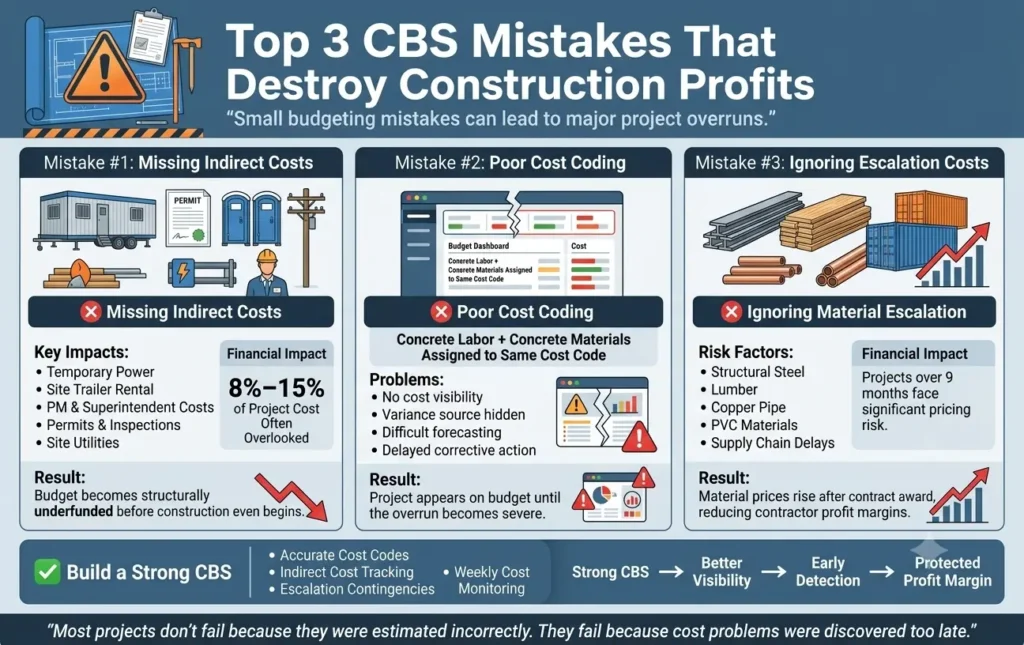
Considering the above method, CBS seems easy, but it’s not. You can make some mistakes; understand them so you can avoid them.
Missing Indirect Costs
Temporary power, site trailer rental, project manager time, permits, and inspections, these line items collectively represent 8-15% of the project cost. If you use a bottom-up estimating method and forget indirect costs, you will have a budget that is structurally underfunded. And you will see the issue with the PM salary, the trailer invoice, and the permit fees hit your project.
Poor Cost Coding
A cost coding system that’s inconsistent, overly broad, or poorly communicated to field supervisors produces a CBS that looks complete but can’t be tracked. If the concrete labor cost code and the concrete material cost code are the same number, the CBS becomes problematic. Effective cost control requires a cost coding protocol that’s trained, enforced, and audited, not just documented in a spreadsheet.
Ignoring Escalation Costs
In 2026, material escalation is a first-order budget risk on any construction project with a duration over 9 months. Structural steel, lumber, copper pipe, and PVC products are all subject to commodity price movements tied to global supply chains, trade policy, and conflict-driven freight disruptions. A CBS that doesn’t carry an escalation contingency for long-duration projects is totally budgeted on guesses. And those guesses cost contractors both time and money.
Weak Quantity Takeoffs
A CBS is a mathematical framework. It produces accurate results only when the input quantities are correct. Takeoffs done too quickly, from incomplete drawings, or by staff without trade-specific expertise, miss scope items, generating weak takeoffs. And weak quantity takeoffs lead to inaccurate cost estimates.
What are the Best Practices for Construction Cost Control in 2026
-
Update Your CBS Against Actuals Weekly, NOT Monthly.
A variance caught in the 2nd week costs a section of what the same variance costs in the 8th week. You must use cloud-based project management platforms to make weekly cost updates possible without a significant administrative burden.
-
Integrate Your CBS with Your CPM Schedule.
When cost categories are linked to scheduled activities, you can calculate earned value, the measure of whether you’re getting the work you’re paying for. A project that’s spent 40% percent of its budget but completed 30% of its scope has an early warning signal that something is going wrong. So, integrate CBS and CPM to make for flawless working.
-
Set Variance Thresholds Before the Project Starts, NOT After.
Decide at the project’s initial stages that any CBS category showing a 5% or greater variance from the budget triggers a formal review. Without a pre-defined threshold, watching the budget becomes a subjective judgment call that mostly gets made too late.
-
Track Committed Costs, NOT Just Incurred Costs.
A purchase order commits money before the invoice arrives, and a subcontract change order commits money before the work is complete. A CBS that only tracks invoices paid isn’t tracking cash flow accurately; it’s tracking history, not forecast. Committed cost tracking gives you the real financial picture.
-
Build a Separate Escalation Line for Materials with Long Lead Times.
Structural steel, curtain wall, and major mechanical equipment ordered 16 to 24 months before installation are exposed to price movement over that duration. Budget for it precisely rather than covering it in a general contingency.
Whether it’s about avoiding the CBS mistakes or implementing professional strategies to make it executable, relying on estimating service providers is a smart choice for contractors, subs, builders, and even project owners.
How do Professional Cost Estimators Help?
Most construction firms have people who can produce a CBS. But fewer people who consistently produce a CBS that performs accurately through project completion. Why is there a gap between “Most” and “Few”? Due to the 3 main points:
- Quantity takeoff accuracy on complex scopes
- Current market unit cost data for specific trades in specific markets
- Cost code structure that supports real-time tracking
Professional budget estimating services close that gap by bringing current pricing databases, trade-specific takeoff expertise, and cost code systems built around actual project management workflows. Utilizing predictive tools like RSMeans allows estimators to adjust localized labor and material indices to the exact zip code of the project. Results? You get CBS that actually functions as a cost control tool from start to the end of the project.
Conclusion
A Construction Cost Breakdown Structure (CBS) isn’t paperwork; however, it’s the financial brain system of a construction project, the system that shows whether the project you’re building is the project you priced. And all you get in real time. If your estimates are winning bids but your projects are not delivering the margin they should, Cost Bidding provides professional quantity surveying services to erase mistakes from your plans and put profit in your wallet.
Get CBS Done Right & Protect Your Margins. Work with our experts for precise, accurate estimating services that help you win more projects and maximize profitability.
Frequently Asked Questions
Why do construction budgets fail without a CBS?
Without a CBS, costs accumulate in broad buckets that can’t be analyzed when variances occur. Project managers can see that the project is over budget, but can’t identify what’s causing the overrun or whether it’s recoverable. Early warnings get missed, and by the time the problem is visible, the margin is already gone.
How detailed should a CBS be?
It should be detailed enough to identify the source of any meaningful variance, not so detailed that field teams stop using the cost codes consistently. On a mid-size commercial project, 60 to 120 individual cost codes normally provide the right balance. Larger, more complex projects can use 200 or more.
Can a CBS be updated during construction?
Yes, it can, and it should be. A CBS that reflects only the original contract budget without incorporating change orders, approved scope adjustments, and updated cost forecasts becomes irrelevant. Therefore, the CBS should be a living document updated as the project evolves.
What software is used to manage a CBS in 2026?
Procore, Sage 300, CMiC, Viewpoint Vista, and Oracle Primavera Cost Management are the primary platforms for CBS management on commercial construction projects. Each links cost codes to actual transactions, integrates with scheduling, and produces variance reports at any CBS level.
What is the biggest CBS mistake contractors make?
Treating the CBS as a bid document rather than a project management tool. A CBS that gets built for the estimate and then puts a side doesn’t deliver cost control. Simply put, the value of a CBS is entirely in how it’s used during construction.