As a contractor, you must understand the issue when casework and millwork are considered the same, significantly adding unforeseen expenses to the project budget later. This not only costs the project more but also reduces your margin.
This page will give you the solution to this by discussing both of them in detail, as well as covering the difference between casework and millwork. Let’s start!
What is Casework In Construction?
Casework means box-style storage built in factories. As a contractor, you see it in kitchens, offices, and labs every day. Teams rely on casework construction for speed and consistency across large building projects, and get repeatable results without constant surprises on site.
What is the Role of Casework?
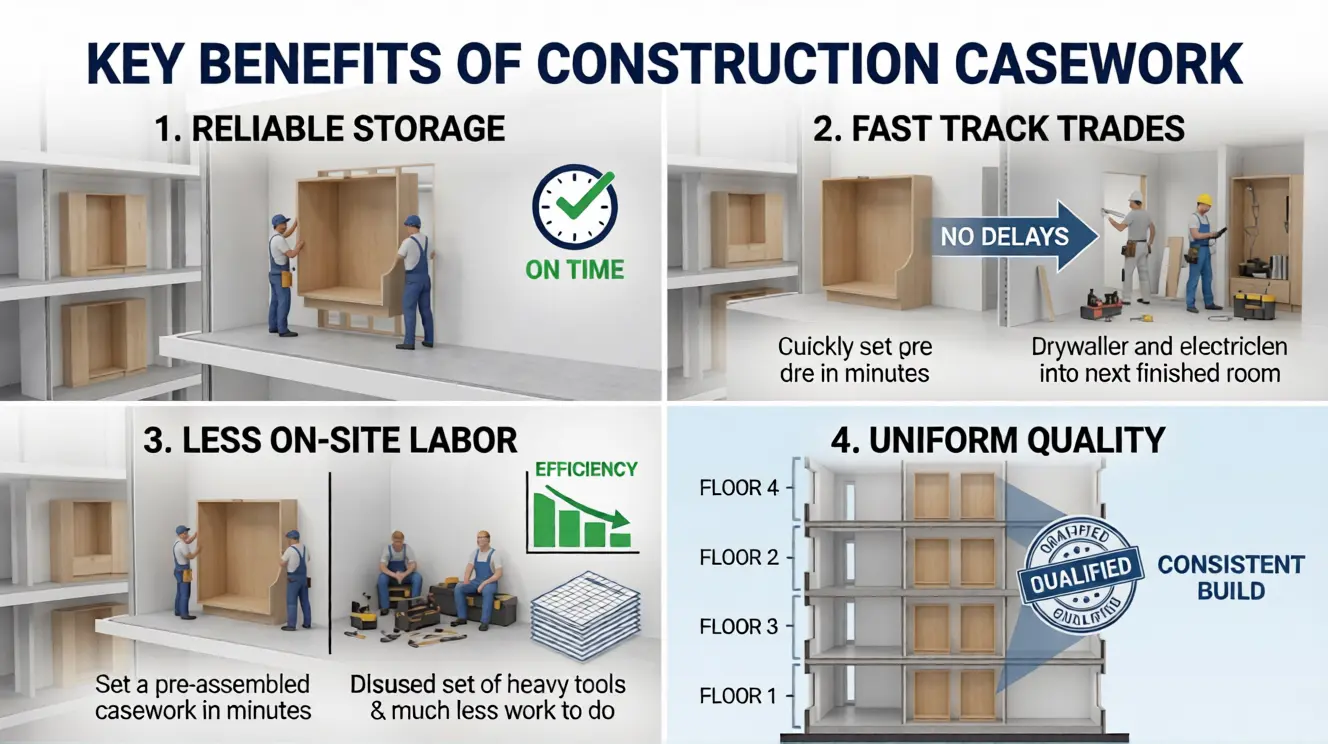
Casework construction keeps your labor productive, and you can avoid delays when teams stay creative through every phase of the project. They are easy to install; therefore, subcontractors install these units fast and keep projects on track. So, you can count on it to deliver quick storage solutions, particularly when working on tight commercial builds where time equals money.
Below are the roles of casework in construction:
- Delivers reliable storage units on schedule
- Let’s you move to the next trade without waiting
- Reduces on-site labor hours dramatically
- Maintains uniform quality across every floor
What are the Types of Casework?
There are 3 main types of casework in construction:
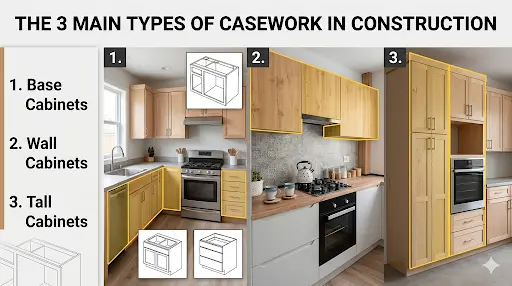
● Base Cabinets
They are used in kitchens, bathrooms, or areas where lower-level storage solutions are required. Considering kitchen casework, it gives base cabinets, wall units, and islands built to standard depths so plumbers and electricians slide right in without rework.
Overall, the base cabinets are set on the floor with counter tops for multiple functions, like household item placement, food preparation and essential housing utilities.
● Wall Cabinets
As the name shows, these cabinets are mounted on the walls. They are commonly used in kitchens, bathrooms, and utility rooms, as they provide storage space at eye level. When easy reach is a necessity, going with wall cabinets is a good option; they provide space for those items that are frequently used.
● Tall Cabinets
Tall means high; these cabinets start from the floor and touch the ceiling of the room, hence called tall cabinets. As they provide ample storage vertically, they are commonly used in pantries, walk-in closets, and garages. It is the best option for heavy items and long-term storage.
Features of Construction Casework
- Factory teams use CNC machines for repeatable quality in every order of casework.
- They are the engineered panels that resist warping.
- You get pre-finished surfaces that are ready for installation.
- They feature modular hardware that can be swapped in minutes.
Pros & Cons of Casework
| Pros | Cons |
| Saves money upfront | Limited design flexibility |
| Installs in 3–7 days | Needs filler strips on uneven walls |
| Uniform quality every time | Harder to modify after delivery |
| Low labor hours on site | Standard sizes only |
What is Millwork in Construction?
Millwork changes everything when you need a perfect match. Millwork covers custom wood pieces shaped in specialty shops. You can see it in trims, paneling, and built-in features that turn ordinary spaces into signature work. Subcontractors trust millwork construction for those high-end finishes that owners notice immediately.
What is the Role of Millwork?
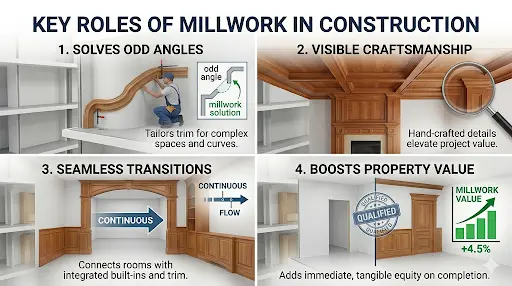
Millwork construction creates architectural details that impress project owners right away. By choosing it, you can solve irregular spaces and deliver lasting beauty. This means that millwork enables you to elevate the whole project when standard pieces fall short. Therefore, it fits historic retrofits or luxury homes perfectly.
Below are the roles of millwork in construction:
- Solves odd angles and crooked walls
- Adds visible craftsmanship that owners pay for
- Creates seamless transitions between rooms
- Boosts property value on day one
What are the Types of Millwork?
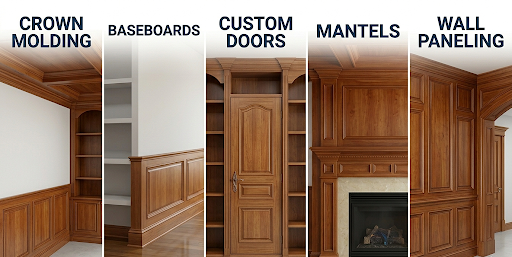
There are 5 major types of construction millwork:
● Crown Molding
It is a decorative, high-level finish millwork installed at the intersection where the top of a wall meets the ceiling. This type of millwork frames ceilings with precise profiles that hide drywall gaps and add instant elegance. It is best for aesthetics and value addition.
● Baseboards
They are made up of PVC, solid wood, MDF, or finger-jointed wood, and perform best when your focus is on concealment, protection, structural integrity, and aesthetics. Baseboards hide floor-wall junctions while protecting trim from kicks and vacuums.
In addition, they come in different types, including flat stock, colonial, ornamental two-piece base board, and quarter round (each shows different features).
● Custom Doors
Custom doors feature solid cores, raised panels, and hand-rubbed finishes that swing smoothly for years. And they come in different types, such as stile & rail doors, entry systems, specialty doors, and panel styles. You can choose the one as per your project requirements.
Coming to its features, they are different from others because of tailored design and sizing, premium material, engineered stability, and artisanal joinery.
● Mantels
Mantels frame fireplaces with hand-carved details that become the room’s focal point. Its key components include mantel shelf, legs, header, and overmantel. Regarding its types, you have 4 options: traditional, modern, rustic/farmhouse, and custom.
● Wall Paneling
Board and batten, shiplap, raised panel, flat panel (shaker style), beadboard, slat wall panels, and wainscoting are types of wall paneling.
Full wall paneling turns plain drywall into rich wainscoting or board-and-batten that absorbs sound and adds warmth. They are good for durability, protection, thermal insulation, aesthetics enhancement, and versatility.
Features of Construction Millwork
- Contains solid hardwoods or premium veneers.
- Hand-cut dovetails and mortise joints
- Custom stains and distressed finishes
- Exact field measurements for a perfect fit
Pros & Cons of Millwork
| Pros | Cons |
| Matches irregular walls perfectly | Higher cost per linear foot |
| Increases property value fast | 1–3 week lead time |
| Delivers visible craftsmanship | Difficult to retrofit later |
| Creates signature spaces | Requires skilled install labor |
Difference Between Casework & Millwork
| Aspect | Casework | Millwork |
| Procurement | Factory mass production with quick stock | Custom shop fabrication with skilled labor |
| Fit | Standard sizes need filler strips | Exact measurements match irregular walls |
| Installation time | 3–7 days | 1–3 weeks |
| Architectural drawing | Minimal standard patterns | Detailed custom drawings required |
| Materials | Engineered woods like MDF and plywood | Solid hardwoods and premium veneers |
| Customization | Limited options | Full client-driven design |
| Retrofitting | Easy modular swaps | Permanent and difficult to modify |
| Cost (US 2026) | $120–$280 per linear foot | $180–$550+ per linear foot |
When to Choose What: Casework Vs Millwork
Scan the construction plans and ask one question: Does the owner want speed and savings or custom beauty? Considering the answer, choose casework or millwork based on the project budget and timeline.
Examples:
1. School Building
Consider a new school built with 20 classrooms and a hard 6-month deadline. You must choose casework because casework construction lands on site in days and keeps the GC satisfied.
2. Boutique Hotel Lobby Renovation
Now, picture a boutique hotel lobby renovation where crooked historic walls must meet luxury finishes. In this example, you should go with millwork construction, so every panel fits as it grows there.
Once you have made the right choice, next shift your focus to accurate takeoffs and estimates to prevent unforeseen expenses during installation. That is where reliable millwork estimating services from the industry experts change the whole game. The experts provide color-coded sheets and bid with real-world construction scenarios, enabling you to execute the project without going over budget and time.
Plan smarter, bid confidently, and deliver your project on time without budget surprises.
Conclusion
Making a smart choice between millwork and casework will make you experience fewer change orders, a well-controlled budget, effective time management, and improved client satisfaction. So, always start with a clear note on millwork vs casework and estimate both so you can meet your clients’ needs while keeping your profit higher.
FAQs
Are casework and cabinets the same thing?
No. Cabinets form one part of casework, and you can find shelves, racks, and storage units under the same umbrella every time.
What are the three types of cabinetry?
Contractors usually see stock, semi-custom, and full custom cabinetry. Remember that each level changes your cost and lead time dramatically on-site.
What is the difference between cabinetry and joinery?
Cabinetry focuses on storage boxes for daily use, while joinery creates precise connections like dovetails in millwork construction. You need both in a construction project, but they serve different roles completely.