Estimating the hourly rate for masonry work in 2026 is not a quick lookup job anymore. You don’t just take a number from a sheet and move on. The price comes from how the work actually gets built on site, not what looks simple on paper.
A mason today follows engineered drawings, checks alignment, handles reinforcement, and works under strict safety rules. It is not only brick or block placement.
Codes like TMS 402/602-22 set the structure requirements. ASTM C90 controls the quality of masonry units. OSHA 29 CFR 1926.706 adds safety zones on taller walls. None of these is optional in real projects.
Then location changes everything. Coastal work needs moisture control and flashing details. Urban sites force slow material movement and tight working space. In hot regions, workers stop more often because of safety breaks. So when masonry contractors prepare a bid, they are not just thinking about hourly pay. They are calculating conditions, delays, and compliance steps.
To better understand how these labor rates affect your total timeline, check out our breakdown on how many hours it takes to build a block house.
How do Masonry Costs Build Up on Site?
Total masonry cost is not one fixed price. It builds up step by step as the work moves forward. From moving heavy blocks at the start to finishing the joints at the end, every task takes time. That time adds to the cost because the work must stay organized and follow all required codes.
1. Work Sequence That Shapes Daily Cost
A normal masonry cycle includes layout marking, mortar mixing, unit placement, alignment checks, and reinforcement setting. These tasks are simple to list but not simple to manage in real conditions.
They overlap during execution. A small hold on material delivery or marking work slows everything after it. Nothing runs in isolation on a live site. That is where time starts to stretch, and cost starts to rise.
2. Output per Day Decides the Real Price
Daily output has more impact than hourly rates. Contractors track how many blocks or bricks a crew installs in one working day. That number defines efficiency more than anything else.
A fast worker reduces total labor hours even if their hourly rate is higher. A slow crew increases total cost even when the rate looks cheaper on paper. This is why productivity matters more than unit price. In real estimating, output tells the truth. Hourly numbers alone do not.
3. Site Conditions Change Everything Without Warning
Working conditions control how smoothly the job moves. A wide open slab allows steady progress. Tight access or uneven ground slows down every movement on site.
Material distance also matters. If workers travel more between storage and the wall, time increases. Weather adds another layer, especially when moisture or heat interrupts normal workflow. These conditions are not always visible in drawings. But they decide how many units actually get completed in a day, and that directly shapes total masonry cost.
The layout phase is also heavily influenced by the specific dimensions of the materials used; learn more about technical specs in our guide to understanding CMU block sizes and finishes.
Masonry Hourly Rates in 2026: What You Actually Pay
Masonry costs vary with the worker’s skills and the specific job. Masonry cost does not come from labor alone. It builds up step by step as work moves forward on site. Every activity connects with another, so one delay affects the whole flow.
1. Entry and Skilled Labor Rate Structure
At the basic level, entry workers usually fall between $40 and $55 per hour. They handle support work like mixing mortar, moving materials, and keeping the site ready for skilled masons. They do not take responsibility for structural placement or detailed installation.
Journeyman masons sit in the $60 to $85 per hour range. Most standard brickwork and blockwork fall under this category. Residential walls, small commercial structures, and routine layouts are usually handled at this level. Their speed and accuracy directly affect project timing. Even small mistakes here can slow down the entire crew.
2. Advanced Masonry Work and Specialized Rates
Experienced masons usually charge about $90 to $130 per hour. The rate can go higher on difficult jobs. They work on strong structures, repair old buildings, and handle reinforced walls that follow detailed drawings. These jobs need more care and accuracy. Small mistakes are not allowed. There are also more checks during the work. Inspectors review different stages before the job moves forward. This adds time, so the cost goes up.
That increases responsibility and reduces room for error. The higher rate reflects both skill and risk control on-site. At the support level, labor helpers usually earn $25 to $40 per hour. They manage setup, material movement, and general site support that keeps production flowing.
3. Why Rates Increase on Certain Projects
Base rates change quickly when site conditions become more demanding. Seismic zones, moisture control requirements, and strict safety enforcement all increase labor effort. In those cases, crews spend more time on reinforcement, inspection coordination, and protective installation. That reduces daily output, which raises the effective cost per hour. So the final number is never just a wage. It reflects skill, risk, and how difficult the work becomes in real conditions.
How Masonry Labor Rates Really Work on Site
Labor rates depend on different factors such as skill, responsibility, and the type of work. When each role is clearly understood, it becomes easier to estimate costs and avoid confusion during bidding.
| Skill Level | Hourly Rate | Focus Area |
| Apprentice / Entry-Level | $40 – $55 | Basic support tasks, mortar prep |
| Journeyman | $60 – $85 | Bricklaying and standard masonry |
| Master Mason | $90 – $130+ | Structural and specialized work |
| Laborer | $25 – $40 | Material handling and setup |
The term masonry labor rates includes more than wages. Also, it reflects how efficiently each worker performs their tasks. Although a skilled mason may charge a higher hourly rate, they often complete work faster and with better accuracy. This reduces delays and minimizes the need for rework. Labor mix also affects cost. A team usually includes a combination of skilled workers and helpers. Contractors calculate a blended rate based on the entire team. This average rate provides a more realistic estimate of total labor cost.
Key Factors Affecting Hourly Rates
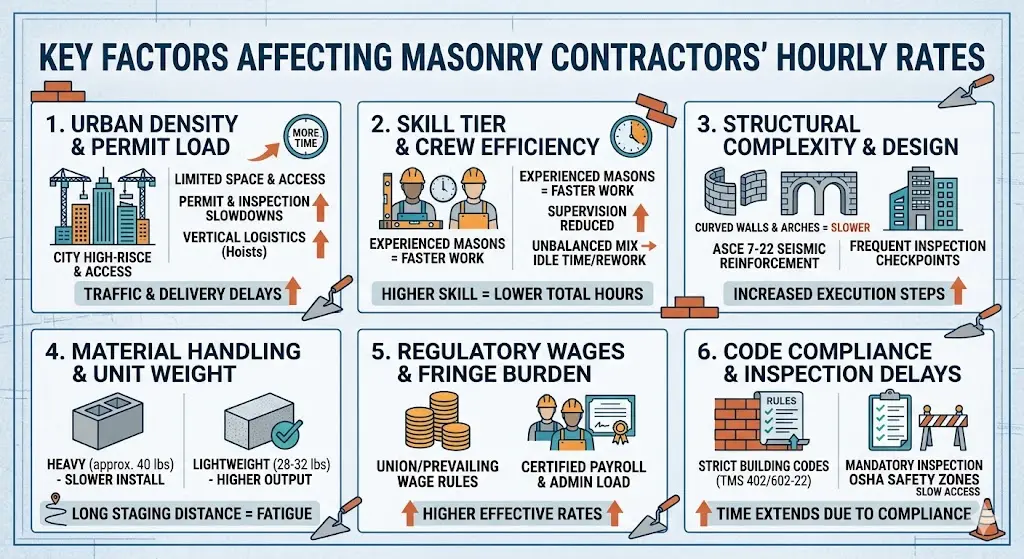
1. Urban Density & Permit Load Pressure
Projects in busy city areas often cost more. Work slows down because of permits, inspections, and limited space. Crews cannot move freely like they can on open sites. In high-rise areas, contractors deal with strict approvals and staging limits. There is often very little space to store materials. Bricks and blocks must be moved using elevators or hoists, not by hand from nearby stacks. This slows down daily work. Fewer units get placed in a day. In estimating, this is known as a “vertical logistics constraint.” It means more time is needed, so the hourly cost goes up.
Traffic delays and restricted delivery windows also affect scheduling. When work pauses for inspections under local building authority rules, labor continues, but productivity stops. That lost time increases the effective labor cost per unit. Even simple blockwork becomes slower due to coordination with other trades. In practice, urban complexity raises both risk and time consumption, which directly increases labor pricing.
2. Skill Tier Efficiency & Crew Composition Impact
Experience level directly controls productivity in masonry work. Skilled masons complete layout, bonding, and alignment faster while maintaining tolerance limits defined under TMS 402/602-22. Less experienced workers often require supervision, which increases labor hours per task. Organizing the team’s structure also matters because a balanced mix of journeymen and helpers improves workflow efficiency. An unbalanced labor mix only leads to idle time, rework, and inspection failures.
In seismic zones, experienced workers are critical because they handle reinforcement placement and grout sequencing correctly. From an estimating perspective, higher skill reduces total duration even if the hourly wage is higher. That is why productivity-weighted pricing is more accurate than simple hourly comparison in masonry cost planning.
3. Structural Complexity & Design Geometry Load
Project geometry has a direct effect on labor intensity. Straight CMU walls follow predictable installation cycles, but curved walls, arches, and reinforced shear systems require constant adjustment. Under ASCE 7-22 seismic design requirements, reinforcement spacing and bond beam placement add extra execution steps.
Engineers may also specify multi-stage grouting, which slows down wall elevation. Every deviation from the standard layout increases cutting, measuring, and alignment time. This reduces units installed per hour and increases overall labor cost. Complex masonry also demands more frequent inspection checkpoints, especially in commercial or government projects. In estimating, complexity is treated as a multiplier on base labor rates because it directly reduces production efficiency.
4. Material Handling & Unit Weight Economics
Material weight and type significantly influence labor speed and cost. Standard-weight CMU blocks (approx. 40 lbs) significantly slow installation cycles due to lifting strain. In 2026, many contractors favor lightweight aggregate CMU (approx. 28–32 lbs) to reduce the physical labor burden and maintain higher daily output.
On the other hand, lightweight systems like Autoclaved Aerated Concrete (AAC) improve speed but require thin-bed mortar application rather than traditional thick-bed joints. This changes labor skill requirements. Adhered thin brick veneer systems are estimated differently, as they are classified as exterior wall cladding rather than structural, load-bearing masonry. Handling also includes staging distance, which becomes critical on large sites.
Longer material travel paths increase fatigue and reduce output. In cost estimation, this is tied to material costs because transportation, storage, and handling time directly affect labor productivity and overall masonry work efficiency.
5. Regulatory Wage Structures & Fringe Burden Effects
Union and prevailing wage projects introduce a structured labor system where pay is divided into base wage and fringe benefits. These fringes include healthcare contributions, pension funds, and training allocations. Under public contract requirements, contractors must follow certified payroll rules, which increases administrative load. This structure raises the effective masonry labor rates compared to non-union work.
However, it also ensures consistent skill levels and compliance with labor law standards. In many states, Davis-Bacon style requirements apply to government-funded projects, which standardize minimum wages. While this increases upfront cost, it reduces the risk of labor disputes and rework. For estimators, fringe burden must always be included in the total hourly calculation.
6. Code Compliance and Inspection Delays on Masonry Work
Masonry work runs under strict building codes, and those rules directly affect how fast a project moves. Nothing gets built without checks in between. That is where time starts to stretch.
Standards like TMS 402/602-22 and OSHA 29 CFR 1926.706 set clear steps for how work must be done. Wall ties have to be placed correctly, grout has to be verified, and wall height limits trigger safety zones that slow down access. These are not optional pauses.
In seismic regions, ASCE 7-22 adds more reinforcement demand. That means extra steel, tighter spacing, and more time spent inside each wall section. Coastal areas often bring moisture control rules, too. Flashing, barriers, and sealing steps become part of the workflow, not an extra option.
Hourly vs Per Square Foot Comparison
Contractors pick a pricing method based on how clear the work is. If the job is simple and easy to measure, one method works better. If the job can change, another method is used. Both ways are correct, but they calculate cost differently.
1. Hourly pricing
This pricing is used when the scope is not clear. This is common in repair work, restoration, or custom masonry. Things change during the job, so workers are paid for the time they spend. It gives flexibility, but it can make costs harder to control if the work slows down due to site issues or delays.
2. Per square foot pricing
It works better for repetitive and clearly defined work. Straight walls, standard block layouts, and uniform elevations allow accurate output calculation. This method reduces uncertainty for both contractor and client. The brickwork cost per square foot usually ranges between $10 and $30. The variation depends on material type, design detail, reinforcement needs, and site conditions. Complex finishes always push pricing toward the higher end.
Below is a simple comparison used in estimating practice:
| Pricing Method | Best Use Case | Cost Behavior | Risk Level | Accuracy |
| Hourly Rate | Repairs, custom work, unclear scope | Changes with time spent on the site | Higher for the client | Medium |
| Per Square Foot | Standard walls, repetitive layouts | Based on measured output | Lower for the client | High |
| Hybrid Model | Large commercial projects; Unit price for main scope + T&M for change orders | Fixed costs for known quantities with flexible hourly buffers | Balanced between contractor and client | Very High |
Each method has a clear role in estimating. Hourly pricing offers flexibility, while per square foot pricing provides structure and predictability. Many masonry contractors use a hybrid approach on complex jobs to balance risk and productivity.
Choosing the wrong system can distort the masonry work cost and create budget gaps later in the project.
Don’t leave your numbers to chance. Whether you need a simple square foot estimate or a complex hourly breakdown, our tools help you bid with confidence.
Types of Masonry Work
There are different types of masonry, and each one is used for a specific purpose based on strength, design, and structure.
1. Brick Masonry
Brick masonry is common in houses and small structures. Bricks are placed in a fixed pattern. The joints between them must stay even. Workers follow proper bond patterns and keep the lines straight. The strength of the wall depends on good alignment and proper mortar use.
2. CMU Masonry
Concrete Masonry Unit (CMU) work is used for strong walls that carry loads. These walls often have steel bars inside and are filled with grout. The work follows codes like TMS 402/602 for safety and strength. CMU blocks are heavier than bricks, so they need more effort to place. Grouting also makes the work slower than brick masonry.
3. Stone Masonry
Stone masonry uses natural stones that are not the same size or shape. Each stone must be fitted by hand. Workers adjust each piece during placement. This takes more time and reduces speed because no two stones are the same.
4. Veneer Systems
Veneer systems are not load-bearing. They are attached to a wall using anchors or ties. These systems are used for the outside finish. Work here focuses on moisture protection, flashing, and proper alignment instead of structural strength.
How Material Costs Influence Labor Rates
Material choice has a big effect on labor work. It changes how fast or slow the job moves. In many cases, it affects cost more than people expect.
- Heavy materials like concrete blocks take more effort. Workers must lift each block, place it correctly, and adjust alignment. This slows down the work and increases total working hours.
- Light materials such as AAC blocks are easier to handle. They reduce physical strain and help work move faster. But they need special adhesive methods instead of normal mortar. That means workers need proper training for correct installation.
- Special materials increase labor costs even more. Custom stone and thin brick veneer need careful placement. Each piece must be adjusted by hand, so the work takes more time and skill.
- Material cost is not only about the buying price. It also includes transport, storage, and handling on-site. All of this affects how much labor is needed.
- The grouting method also changes the working speed. Low-lift grouting needs repeated filling, which slows work. High-lift grouting reduces repetition but needs more setup and inspection before pouring.
How to Check Masonry Contractor Rates
Checking contractor rates is not just about comparing prices. A low hourly rate does not always mean a low total cost. Work speed and quality matter just as much. A masonry contractor should be judged by how much work they complete in a day. Ask how many blocks or bricks they can install in one shift. A contractor who charges more per hour may still finish faster and cost less in the end.
Experience also makes a big difference. Contractors who understand building codes and inspection rules make fewer mistakes. This helps avoid delays and extra work. The team organizing setup is also important. A balanced team with skilled workers and helpers works better. If there are too many helpers and not enough skilled masons, the work can slow down.
It also helps to check past work. Similar projects show how well the contractor performs in real conditions.
Final Cost Insights That Matter
Masonry labor costs keep changing because rules and project needs are becoming stricter. Knowing this helps in making better budget decisions. The mason’s cost per hour is not just payment for work. It also includes safety rules, weather conditions, and structural needs. All of these slow down work at different stages.
Location also affects cost. Hot weather reduces working hours because of safety breaks. Coastal areas need moisture protection and extra sealing work. In seismic zones, extra reinforcement is required to make buildings stronger. These conditions change how fast work can be done. When work slows down, labor hours increase, and the total cost goes up.
If these factors are ignored, budgets often go wrong. A clear understanding of site conditions helps control cost and reduce risk. Good estimation is always based on both speed and efficiency.
FAQs
- How do masonry contractors calculate hourly pricing on real projects?
They don’t rely on a single rate. Contractors calculate labor based on crew size, production rate, site access, and code requirements. A job with slow access or heavy reinforcement always changes the final hourly calculation. - Why does the cost change between residential and commercial projects?
Commercial work usually follows stricter inspection cycles, seismic detailing, and heavier CMU systems. Residential work is simpler in layout and access, so labor moves faster and overall cost stays lower. - Does weather really affect masonry labor rates?
Yes, it does. Cold conditions slow curing time, while extreme heat reduces working hours due to safety limits. Rain and moisture also delay mortar work and surface bonding, which lowers daily output. - What is included in masonry labor rates besides installation work?
Labor rates include setup, material staging, alignment checks, scaffolding movement, and cleanup between work stages. These tasks are part of the workflow, even though they are not always visible in estimates. - How can I reduce masonry work cost without lowering quality?
Better planning helps more than cutting rates. Clear drawings, steady material supply, and correct contractor selection improve production speed. When crews avoid delays, total labor hours drop naturally.