Data center construction always comes with complexities. As a trusted construction estimating company, we provide accurate insights and data center estimating services for complex mission-critical projects.Consider a situation: RFPs are on your table, and you are thinking about the project cost that’s going to be harder than usual. More systems are getting entered, more unknowns are showing up, and more chances of leaving money on the table.
Plus, the global war condition is also affecting the materials and labor prices. This means there is no room for mistakes in the bid, and you must submit an impressive bid. So, let’s understand how to prepare a competitive bid for data centers, taking a start with some basics.
Why is Data Center Construction Bidding More Complex in 2026?
Data center construction is no longer a specialty niche. However, it’s one of the most active construction sectors in the US, driven by AI-ready facilities, cloud expansion, and enterprise computing demand that is increasing day by day. And that addition has made bidding more competitive and more complex technically.
How AI Demand, Power Constraints, and Scale are Making Bidding More Complex?
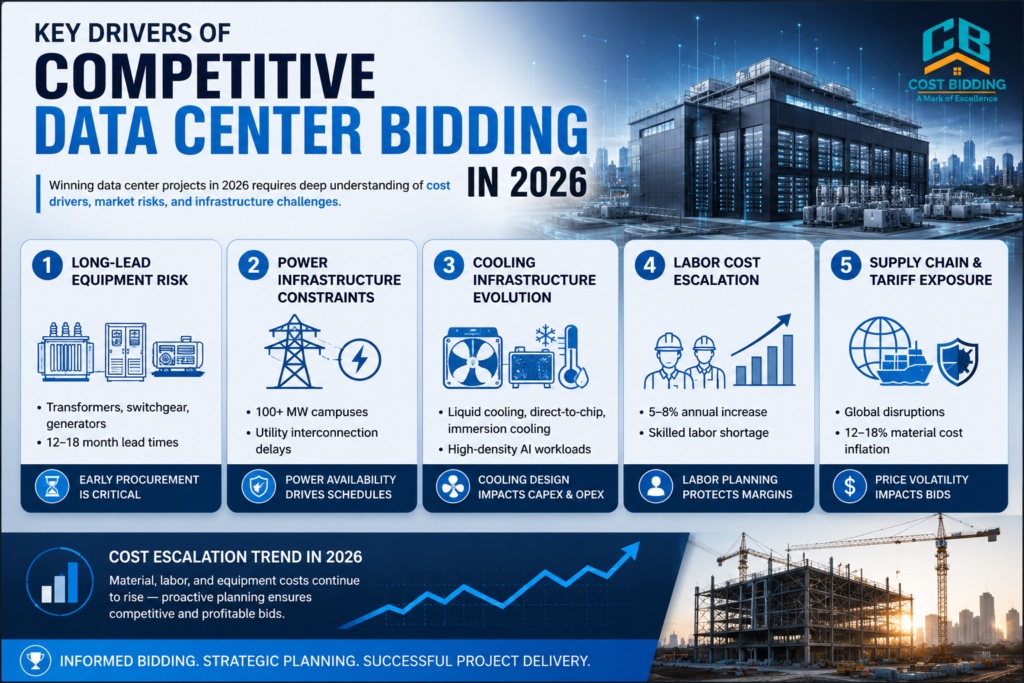
A competitive bid for a data center project today must account for cooling infrastructure (that didn’t exist 5 years ago), power infrastructure (that scales to 100+ MW campuses), and equipment lead times (that stretch 12 to 18 months). At the same time, project owners and GCs have increased their qualification standards. They expect detailed documentation, clear coordination strategies, and commissioning plans that prove the project can actually perform the way it was designed.
Why Standard Commercial Bid Templates No Longer Work for Data Center Bidding?
If your bid structure still uses a standard commercial build, you’re already behind. Why? Because the standard templates are for standard constructions, and you know that data centers need some extra features, like massive power loads, complex MEP systems, and rigid hardware alignment. The contractors winning data center bids in 2026 consider the estimate as a technical document, one that details the project’s systems, risks, and delivery logic, not just its square footage. This means that the operational planning now plays a major role in competitive bidding.
What Operational Factors are Essential for Data Center Bid Accuracy?
-
Secure Long-Lead Equipment
Many just rely on estimates in bids; however, it has become essential to use hard delivery risk. “>Reuters reported that in some U.S. regions, grid connection can take 3–7 years, while the data center itself can take 18–24 months to build. And this makes early release of transformers, switchgear, and generator packages a bid-critical issue. According to “>JLL, the average global data center construction cost increased from $7.7M/MW in 2020 to $10.7M/MW in 2025. And in 2026, it is raising towards $11.3M/MW.
-
AI-Ready, High-Density Infrastructure
The scale of AI demand is pushing power and cooling assumptions higher. According to a recent report of IEA“>IEA, the global data center electricity consumption will double to about 945 TWh by 2030. This might be the reason behind theUptime Institute“> Uptime Institute‘s report, which found that 52% of owners/operators are upgrading power distribution systems and 51% are upgrading cooling systems to support AI workloads.
-
Labor Shortages and Cost Escalation
The time has gone when GCs consider labor a side expense. Today, it can impact a data center bid like materials. According to Reuters“>Reuters, 41% of the current U.S. construction workforce is projected to retire by 2031, and about 507,000 additional workers will be required in transmission, grid, and energy construction by 2030. Therefore, labor productivity, workforce availability, and market-specific wage escalation must be estimated, ensuring bid accuracy.
-
Real-Time Controls and Digital Tracking
Static reporting is too slow for data center bidding. Manual data entry slows real-time analysis, delays notifications, and decision-making. Therefore, you must use RealCONs (Real-Time Data-Driven Construction Project Analysis Framework) to improve estimates accuracy and manage cost & time efficiently. Plus, you can rely on the digital twin; it is a physically accurate virtual model used to test power, cooling, and control strategies before, during, and after construction.
-
Align Contract Requirements with Commissioning Plans
Today, your contract has to match the commissioning plan. According to ASHRAE“>ASHRAE, your data center commissioning should follow the Owner’s Project Requirements (OPR) and the Cx Plan, with:
- Project-specific checklists
- Test procedures
- Named responsible parties
- Final reporting
Simply put, commissioning is a structured process that covers design documents, specifications, procedures, documentation, and training for continued system performance. Therefore, you must consider it during bidding on a data center project.
How To Read/Review a Data Center Bid Before Estimating Costs?
Avoid jumping from drawings to estimates since it can lead to a bundle of mistakes due to missing items and confusing details. Before you start working on takeoffs or outsource construction takeoff services to an expert, read the bid package like a pro risk manager. Let’s understand how to read the bid!
-
Start With Specifications, Not Drawings
This means put aside the plans and first focus on the data center project specs. Carefully read Division 26 (electrical) and Division 23 (mechanical) because they carry the most scope issues that can double labor hours if you misinterpret them. Plus, look specifically for commissioning requirements to identify who owns pre-functional testing, functional testing, and retesting if systems fail.
-
Verify Long-Lead Equipment Ownership Early
Next, confirm who owns long-lead equipment, including switchgear, transformers, generators, and liquid cooling systems; they all carry owner-furnished designations. And if something goes wrong, it can shift installation, testing, and warranty coordination in the rework sheet. Therefore, you must check the responsibility matrix early; if you ignore it, it’s a red flag that can be raised during the pre-bid meeting.
-
Review the Construction Schedule for Phased Energization
Also, review the construction schedule for phased energization requirements. A data center project with staggered power-on milestones creates coordination dependencies between electrical, mechanical, and controls trades that affect sequencing and labor productivity significantly. Relying on outsourced construction bid estimating services is a smart move full scope review before budget analysis.
How Construction Cost Escalation Impacts Data Center Bids in 2026
Above, we mentioned that you must consider cost escalation in bids. Here, a question arises: How does construction cost escalation affect the data center bids this year? Here’s what’s different in 2026.
-
Tariffs and Material Inflation
The time has gone when contractors and builders managed material price risk from domestic inflation. Today, tariffs have changed the game. Now, you have to manage tariff-related material exposure from ongoing US trade conflicts with multiple manufacturing partners. Why? Because this customs duty is affecting almost all construction materials, including steel, aluminum, copper, as well as specialized electrical components. Some categories have seen material cost escalation of 12–18% year-over-year when import exposure is factored in. Get more below!
-
Hitting War in Ukraine
The war in Ukraine and broader geopolitical instability are affecting European transformer and switchgear manufacturing capacity. Several major suppliers have extended lead times because their component supply chains run through Eastern European and Asian production networks that are disrupted. That disruption directly affects the construction schedules, and if you don’t factor them in early, they show unfavorable outcomes in estimates.
-
Local Labor Cost Escalation
Annual labor cost escalation is running 5–8% in high-demand markets, like Northern Virginia, Phoenix, and Dallas. Regional wage rates in union markets carry Davis-Bacon multipliers (Labor Burden multipliers) that increase all-in electrical labor to $115–$145 per hour in some jurisdictions. If your bid includes national average labor rates for a Northern Virginia data center project, you’ll lose on price or on margin.
How to Add Escalation Clauses into Your Bid Correctly?
Like unprofessional bidders, avoid hiding escalation in the contingency. Instead, build construction cost escalation assumptions explicitly into your bid. Today’s project owners and managers look for escalation clauses, added separately in the bid. It becomes more essential when a data center project is expected to wind up within 18 months.
If you ignore escalation clauses, you will most probably see cost and time increases during construction. Construction budget estimating services from the industry experts can change the game here totally. Leveraging their expertise in estimation and considering current, local market trends, they bring estimates that make your bids more professional, competitive, and impressive for your clients.
How to Manage Supply Chain Risk in Data Center Bidding
You have learned that the current war condition is affecting the supply chain, making it a bid strategy problem, especially for data center projects. You can handle supply chain issues using the following proven method.
- Identify and Document Long-Lead Equipment Items
- Use CM-at-Risk Delivery for Equipment Risk
- Document Tariff and Import Exposure
Continue reading to get “How”.
-
How to Identify and Document Long-Lead Equipment Items?
Perform this assessment during bid review and add all items, including:
- Generators
- Switchgears
- Transformers
- Cooling distribution units
- UPS systems
- Specialty bus ducts.
After that, get written lead-time confirmations from at least two suppliers. Also, build a procurement milestone schedule and attach it to your bid as a clarification. It shows the owner you’ve thought through the delivery sequence, and it puts responsibility for equipment release decisions where it belongs.
-
How to Use CM-at-Risk Delivery for Equipment Risk?
For projects using CM-at-risk delivery, the owner mostly retains procurement authority on major equipment. This doesn’t eliminate the risk; however, it changes where the equipment comes from. So, confirm exactly what you’re responsible for:
- Storage
- Insurance during storage
- Receiving inspection
- Installation
Each of those items carries a price that belongs in your bids. If you miss any one of them, it will cost you later.
-
How to Document Tariff and Import Exposure?
As already mentioned, tariff-related material exposure needs its own line in your bids. Identify which materials carry import tariff exposure and at what percentage basis. This is now standard practice on competitive bids for mission-critical projects, and owners now look for it in the bid.
How to Estimate Data Center Electrical and Power Infrastructures?
As a contractor, you know that electrical and power infrastructures have a critical place in data center projects. Therefore, you must estimate them carefully, using the following strategies.
- Assess utility power availability.
- Don’t use RS Means for switchgear estimates
- Backup generation on AI-ready facilities
- Consider BESS installations
See details on each point below.
-
Why Evaluate Utility Power Availability?
It is the first constraint on any data center project. Before you estimate the electrical elements, confirm the utility interconnection status. If a project with a 30 MW power commitment has no clear utility’s interconnection points now, it’ll lose its schedule later.
-
Why Not Use RS Means for Switchgear Estimating?
In 2026, experts providing electrical estimating services rely on direct vendor engagement, not RS Means benchmarks. Why? Because the budgeting numbers from historical data can miss the current market by 20–30%. You must:
- Get live quotes and get them early.
- Build a 30-day post-award deadline for switchgear into the schedule.
This year, medium-voltage switchgear for a 20 MW facility is currently costing $800K–$1.4M, depending on configuration, manufacturer, and delivery time. So, if you rely on outdated data here, it will cost you money and time on-site.
Why Backup Generator Design and Cost Implications in Data Center Facilities?
AI has changed the operation in data centers. Many project owners now spec N+1 or 2N generator configurations with automatic transfer switching and on-site fuel storage for 48–72 hours of runtime. This demand adds structural loading, civil grading, fuel systems, and electrical coordination. And if you don’t add them to the estimates, it’ll obviously hit your project cost.
-
Why Rely on BESS Installations?
BESS means Battery Energy Storage Systems. You can use it for projects where specified. This installation ranges from 5 MW to 50 MW to introduce fire suppression design, structural loading, and sequencing dependencies that affect your critical path. Missing them in estimates will lead to change orders later.
How Liquid Cooling Systems Impact Data Center MEP Bidding?
In addition to electrical systems, liquid cooling systems also need strategic MEP estimation for data center bidding. If we go back three years, most data center contractors estimated traditional CRAC (Computer Room Air Conditioner) or CRAH (Computer Room Air Handler) cooling and called it done. In 2026, this approach doesn’t work anymore. Why? Because of high-density builds, which demand liquid cooling systems for smooth operations.
This system includes direct-to-chip and immersion cooling and is now standard spec on AI-ready facilities where rack densities range 30–100 kW per rack. Let’s explore the impacts of these advanced cooling systems.
How Advanced Cooling Systems Affect Data Center Estimates?
Advanced cooling systems change your bid in 4 specific ways.
-
Tight Piping Tolerances
Piping tolerances tighten significantly when you run deionized water or dielectric fluid through cooling distribution units. And it is done at pressures that require testing above standard HVAC specs. Budget your mechanical labor accordingly.
-
Expanded Commissioning Plan
Liquid cooling systems require more detailed commissioning than traditional air-cooled setups. Therefore, you must verify thermal performance under live operating loads, test coolant flow stability, validate control responses, and confirm the system can maintain safe temperatures during peak rack demand.
-
Defined Cooling System Responsibility
One of the biggest scope gaps in high-density data center projects is coordination between mechanical trades, controls teams, and the IT vendor. Who handles the final connection to the server rack manifolds? Who is responsible for commissioning the CDU controls interface? If these questions are not clearly answered in the bid documents, they mostly become the contractor’s problem during construction.
-
Roof, Structural, and Civil Coordination
Cooling infrastructure projects mostly trigger roof and structural work that you don’t find on the mechanical drawings. Cooling tower pads, piping penetrations, and equipment platforms all need coordination with civil and structural trades. You must know how to estimate construction costs to assess their prices together, since a mechanical drawing alone doesn’t tell the whole story on a high-density build.
How to Build a Winning Data Center Bid Structure?
Tell now, you have understood that a data center bid doesn’t only mean estimates; however, its work as your secret document that shows your clients that you understand the projects. To create a winning bid, you must know its essential components.
What are the Core Components a Data Center Bid Must Have?
Your bid should include the followings:
- A clear scope inclusion and exclusion list tied to the specification sections
- Your construction schedule, at a minimum, should include a milestone summary
- Plus, a clearly defined long-lead equipment assumption, especially for generators, switchgear, transformers, and cooling systems
- Above all, commissioning notes
How to Present a Commissioning Strategy in a Bid?
Demonstrating how your team will manage risk, validate system performance, and ensure 99.999% uptime without costly delays is required when you present a commissioning strategy in a data center bid. Use the following methods to do so:
- Align with Uptime Institute Tier Standards
- Use and showcase automated commissioning software, such as Facility Grid or Bluerithm
- Detail a comprehensive load bank strategy
- Add independent 3rd-party Commissioning Authority agents
- Provide a 5-level testing framework
How to Decide Whether to Bid on a Data Center Project?
Not every data center opportunity is worth bidding. Remember that your estimating team’s time is an actual cost. And spending time on worthless projects is a complete loss. So avoid that and ask some questions before you invest time in creating a bid.
What Questions to Ask Before Bidding?
Rely on a bid/no-bid evaluation process, getting answers to the following questions:
- Can you satisfy the qualification requirements?
- Have you done comparable work: similar MW capacity, similar cooling infrastructure complexity?
- Do you have the right subcontractor relationships in the market where the project sits?
- Can you actually support the construction schedule, given your current backlog?
After having answers to these questions, evaluate the project profile before you allocate resources.
How to Evaluate Project Risk?
It is essential because projects with incomplete drawings, confusing or missing commissioning scope, and problematic liquidated damages provisions become projects with a bundle of budgeting issues on site. Use the methods below to review the project profile:
- Analyze grid capacity and power availability
- Audit the supply chain and long-lead equipment
- Scan regulatory and NIMBY (Not In My Backyard) opposition
- Review technical and tier classification
- Check geopolitical and macro-economic tariff risks
Note: Before finalizing your bid, cross-reference state-specific constraints via the US EIA“>Energy Information Administration (EIA) for regional power data, and review recent infrastructure finance reports from agencies to understand current credit risks and lease protections.
Conclusion
In 2026, data center competitive bidding demands deep focus to expertly deal with power constraints, increasing construction costs, long-lead equipment delays, extreme cooling requirements, and above all, geopolitical pressure. And obviously, it will take a long time that many contractors can’t afford.
If you’re one of them, outsourcing services to Cost Bidding is the solution. The teams provide precise and accurate estimates to ensure you win the bid, including all intricate features of the data center project. Engage us in your bidding process and experience seamless winning!
Contact us for Data Center Estimates!
Commonly Asked Questions
What qualification documents should data center contractors prepare before bid submission?
Prepare a mission-critical project experience summary listing project types, MW capacity, and your specific scope on each. Include safety history (EMR for the past three years), current bonding capacity with a letter of intent from your surety, and trade licenses for each jurisdiction in the project. Some project owners also require commissioning experience documentation separate from general construction references.
How can I calculate escalation clauses in a data center bid?
- First, identify material categories with price fluctuations. This can include copper, steel, aluminum, and imported electrical components.
- Then, apply a monthly escalation rate tied to a published index, such as PPI for electrical equipment.
- Next, build the clause with a base date (typically bid date), a trigger threshold (e.g., cost increase exceeding 5%), and a cost-sharing split.
What is the difference between design-bid-build and CM-at-risk for data center projects?
In design-bid-build, teams estimate a complete set of documents, and their bid defines the contract scope. And in CM-at-risk, experts get engaged during design, provide preconstruction services, and establish a GMP against a design that may still be under process.
What commission documentation should I include in a data center bid?
You should include the following documents:
- Basis of Design (BOD)
- Owner’s Project Requirements (OPR)
- Master Commissioning Plan (Cx Plan)
- Functional Performance Testing (FPT) Checklists
- Integrated Systems Testing (IST) Scripts & Deliverables
What’s the right contingency percentage for a data center construction in the US?
Contingency depends on design completeness and project complexity. On a 100% construction document set for a standard colocation facility, 3–5% is appropriate. However, on a design-build or early GMP where drawings are 60–70% complete, you can consider 8–12%. And for projects with significant liquid cooling systems or novel cooling infrastructure, add a separate technical risk allowance of 2–3%.