2026 construction prices are more uncertain than ever. The fast-moving material changes, labor shortages and supply chain uncertainty now present challenges to contractors, developers and estimators. A bid that looked accurate last month can turn into a loss today.
That is why construction cost escalation is now an important subject for all construction professionals. The consequences of not paying attention to escalation can lead to underbidding, revenue loss, and client mistrust. When you strategize about escalation then you safeguard margins and establish more robust project predictions.
Increasing construction costs, delays by suppliers and sudden surges in the prices of steel and cement are issues that many companies struggle with nowadays. Such problems bring about severe budget uncertainties on residential, commercial and infrastructure projects.
This guide will teach you what causes cost increases in 2026, which indices are the most important and how to update estimates with the help of the best-proven forecasting techniques.
What Construction Cost Escalation Means in 2026?
Construction cost escalation can be defined as a gradual surge in the project costs over a period of time as a result of the escalation of labor, material, equipment and contractor prices.
Before we move forward and explain escalation, you must understand that inflation is not the same as escalation. Inflation refers to the overall rise in the price of goods and services within the economy. Escalation concentrates on the construction sector. The rate of construction escalation tends to increase more than the standard inflation since the sector is largely reliant on commodities, logistics and availability of skilled labor.
In 2026, the effects of escalation are experienced in all levels of planning, including conceptual budgeting and ultimate procurement. In calculating project cost escalation, you raise the prices to reflect anticipated costs in the future, instead of current rates.
This complicates the construction cost evaluation as compared to stable years. Smart techniques, new indices and enhanced risk buffers are what estimators require now.
What Is Driving Construction Cost Escalation in 2026
There is no single factor that would contribute to the escalation in 2026. Various pressures push the costs upwards.
Labor and Contractor Pricing Pressure
One of the greatest contributors to increased budgets is labor. The problem of skilled labor shortages persists throughout the U.S. construction market, particularly in trades such as electrical, mechanical, steel erection, and concrete work.
Most contractors are finding it difficult to fill craft positions, as reported by the Associated General Contractors of America several times, thus forcing their wages to be raised. Most companies are raising wage rates only to retain skilled employees.
This forms an upward pressure on the overall construction costs since the labor is 30% to 50% of the project cost in most commercial constructions.
The bids of subcontractors also vary due to the risk taken in their bids. They increase prices on the spot in case they anticipate delays in the delivery of materials or schedule disruption.
Large metro areas are also affected by union wage agreements. Rise in wages spreads out project budgets as unions renegotiate contracts.
Supply Chain Delays and Procurement Risk
The lead times of electrical components, HVAC equipment, elevators, and specialty steel products continue to be affected by supply chain upheavals.
Delivery schedules tend to remain unstable even after the stable prices of materials. Delays expose the costs since extension of schedules exposes the general conditions, equipment rentals, and labor standby costs. This is the reason why escalation cannot be attributed solely to the construction material prices.
In 2026, early procurement strategies play a huge role. Early locking contractors tend to decrease their exposure to escalation.
Commodity Market Shocks and Global Demand
The materials based on commodities are still very sensitive to global demand and geopolitical occurrences. Steel, cement, copper and fuel-based materials respond fast to supply limitations.
Structural steel, rebar, decking, framing and fabrication costs are prone to impact from a sudden steel price increase. Also, the slightest cement cost increase can cause foundation and slab prices to shoot up, particularly when doing large infrastructure projects.
Material production is also affected by energy prices. Due to an increase in fuel prices, trucking and logistics have become more costly. That price is passed on to the construction costs in a matter of weeks.
Construction Materials Cost Trends That Impact 2026 Budgets
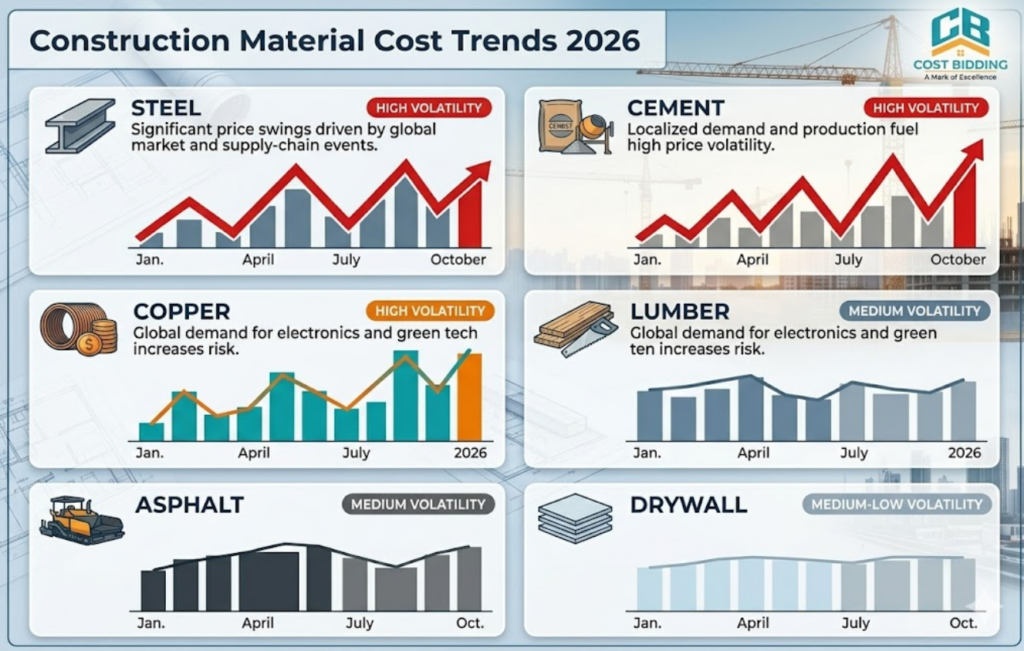
As never before, modern estimating is influenced by material costs. When you buy and predict at the right time, a project can be profitable or it can be a disaster.
Materials comprise 40%-60% of the overall expenditure in most constructions. The change of a single steel or cement by 5% can alter the overall project cost by tens of thousands of dollars.
The following is a realistic breakdown of materials that contractors ought to keep an eye on in 2026.
| Material | Why It Impacts Costs | Trend Risk Level 2026 |
| Cement | Drives concrete foundations, slabs, paving | High |
| Steel | Impacts framing, rebar, structural components | High |
| Lumber | Drives residential framing and interiors | Medium |
| Copper | Impacts wiring, plumbing, and MEP systems | High |
| Asphalt | Affects roadwork, paving, and civil work | Medium |
| Drywall | Impacts interiors and finishing | Medium |
The most sensitive materials are steel and cement. Framing budgets can be increased quickly by a large steel price rise. An increase in cement price impacts nearly all structural aspects.
The regional aspects are also important. There are higher transport prices and a lack of supply in some areas, so that local prices soar even when the national prices are even.
Why Standard Estimating Methods Fail During Escalation Cycles?
There are a lot of contractors who continue to use old estimating habits. Such a style does not work in turbulent markets.
The square-foot rate estimate is simply a cost assessment that can only work when the price is not changing. In 2026, the growth will alter expenses at a rate exceeding generic standards.
Old cost books and out-of-date databases lead to errors on bids since they do not keep track of actual market changes. You can update on an annual basis, and still miss monthly movements. This poses a grave danger during construction cost evaluation.
Supplier quotes are another significant issue. Most quotes come with short validity windows of as little as 7 to 14 days. When you construct a budget based on quotes from the previous month, your budget becomes inaccurate.
Escalation also impacts contingency planning. Quite a few contractors continue to use a flat contingency percentage, such as 5%. That is not the level of risk in modern times. As volatility increases, contingency planning should integrate the real risk types.
That is why many companies have a problem with uncertainty in budgets, even in the case of the use of conventional estimating techniques.
Best Construction Cost Indices to Track Escalation in 2026
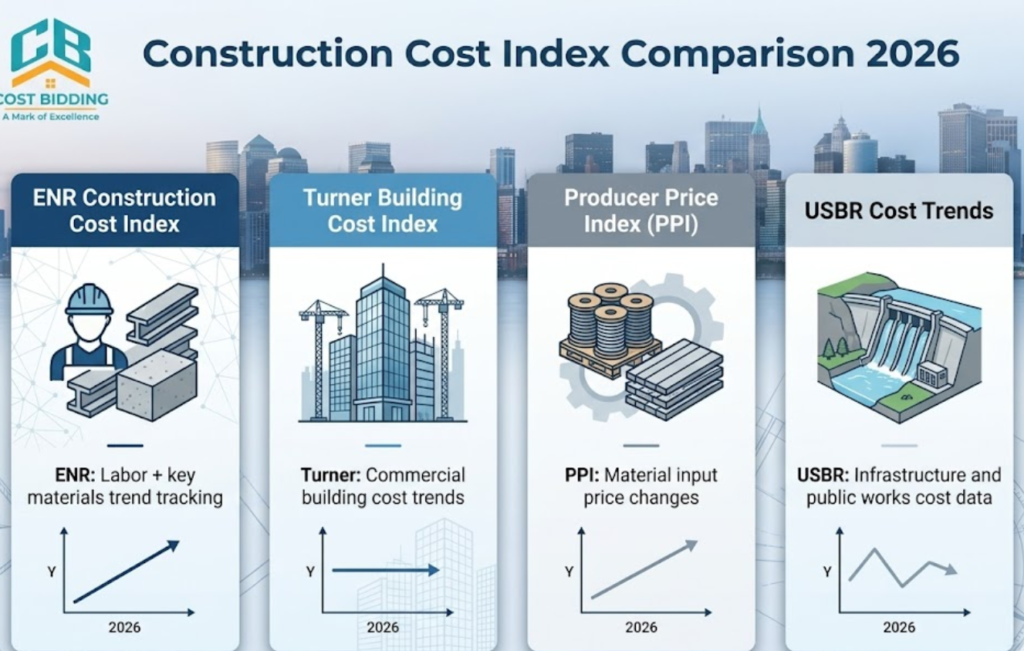
In order to estimate properly in 2026, you need to follow the appropriate cost index. Cost indices assist you in gauging the changes in pricing over time.
Various indices are followed on different aspects of construction. Some track labor and material inputs. The final project costs are tracked by others. Smart estimators are those that compare a number of indices instead of using a single source.
| Index | What It Measures | Best For | Limitations |
| ENR Construction Cost Index | Skilled labor + key materials | General construction trend tracking | Limited material scope |
| Turner Building Cost Index | Building cost changes in key U.S. cities | Commercial building budgets | Less useful for heavy civil |
| PPI Construction Inputs | Producer-level material pricing | Material cost trend tracking | Does not reflect the installed cost |
| USBR Cost Trends | Government-based index sets | Public works and infrastructure | Data can feel technical |
ENR Construction Cost Index Explained
The ENR Construction Cost Index is an index that monitors changes in costs utilizing a basket of construction inputs like labor and key materials. ENR is used by many contractors as it gives them consistent comparisons with the past.
ENR is effective in planning high-level escalation and early budgeting. It is also useful in clauses concerning contract escalation in situations where owners demand known index sources.
Turner Building Cost Index Overview
The Turner Building Cost Index concentrates on the costs of building construction of non-residential buildings in the key cities in the United States. This index is published by a company named Turner to indicate the movements of costs over a period of time.
Turner index assists commercial contractors to estimate offices, hospitals, schools and mixed-use developments. It is also useful when you compare the trends of cost escalation at the metro level. Turner does not have the infrastructure-intensive projects such as dams, bridges and water treatment plants.
Government and Infrastructure Indexes for Public Projects
Public works projects are usually characterized by special indices due to the use of special materials and equipment in government infrastructure projects. The US Bureau of Reclamation offers construction cost trend references to the large-scale infrastructure categories. These tendencies aid in monitoring the increase in civil construction by the public agencies and engineering companies.
How to Update Construction Estimates for Inflation in 2026?
The discipline and structure are needed to update estimates in 2026. Underbidding occurs as a result of guesswork. This is a step-by-step procedure that contractors should follow to make proper plans in escalation.
Step 1: Identify the Base Estimate Date
- Any estimate should have an initial date of estimation. Time is important in terms of the costs of materials and labor.
- Without defining the baseline date, you are not able to measure the escalation properly.
- A budget developed in January 2026 can be out of date by April 2026 in case of steel and fuel moves.
Step 2: Choose the Right Index for Your Project Type
Choose indices based on project category:
- Lumber price is more responsive to residential projects.
- Commercial projects have trends in terms of labor and structural steel.
- Equipment, concrete and asphalt trends in infrastructure projects are very important.
The wrong index leads to wrong assumptions of escalation and poor forecasts. This action enhances the accuracy of construction cost evaluation.
Step 3: Apply Escalation Rate Using the Midpoint Method
The midpoint method assists you in fairly escalating in a project timeline. You do not increase the total cost to the final date but to the halfway point of construction expenditure.
The basic midpoint formula takes the form:
Escalated Cost = Base Cost × (1 + Escalation Rate)^(Duration ÷ 2)
This technique is effective with concept and design-development estimates. It also minimizes extremes of over-escalation.
Step 4: Adjust Labor and Equipment Separately
- Do not consider labor and material escalation as a single number.
- The increase in labor is often gradual as a result of wage contracts. There is a tendency for materials to spike abruptly because of the disruption of the market.
- The cost of equipment rental is also dependent on the fuel prices and demand.
- You have more credible project cost escalation predictions when you separate categories.
Step 5: Recheck Supplier Quotes Before Final Bid
Check supplier quotes before submitting your bid. The volatile markets have many suppliers changing pricing every week. This measure will cushion your estimate against unexpected events and minimize budget uncertainties.
Construction Cost Escalation Calculation Example for 2026
We will use escalation as a basic example. The base budget of a commercial project that is planned by a contractor is $2000000. The project will last 12 months. The contractor anticipates 6% yearly increase.
Using a midpoint method:
Midpoint duration = 6 months = 0.5 years
Escalation factor = (1 + 0.06)^0.5 = 1.0296
Adjusted cost = $2000000 × 1.0296
Adjusted cost = $2059200
It implies that the contractor ought to estimate an additional sum of around $59200 to cover escalation.
Mini Table Example
| Base Cost | Escalation Rate | Duration | Adjusted Cost |
| $2,000,000 | 6% annually | 12 months | $2,059,200 |
This will enhance cost forecasting and eliminate procurement surprises. It also helps in better planning of construction costs when owners demand an updated budget.
Cost Forecasting Strategies Contractors Should Use in 2026
Predicting provides you with power. Proper forecasting of contractors leads to more lucrative projects. Successful bidders and risky contractors in 2026 will be distinguished by good cost forecasting.
Short-Term Forecasting for Bids Under 6 Months
- In the case of short-term projects, concentrate on supplier quotes and real-time local pricing.
- Use new subcontractor quotes, validate lead time and look at new project awarded prices.
- Assumptions on fuel adjustments should also be taken into consideration in short-term forecasting in case the trucking has any effect on deliveries.
Long-Term Forecasting for Multi-Year Projects
- Use indices and escalation provisions in the case of multi-year projects.
- Long projects are usually received by indexed escalation models by their owners. This shields both parties, and it minimizes legal wrangles in contracts.
- Scheduled procurement planning is also helpful. The steel and cement can be contracted to be locked at an early date to be free of escalation.
Scenario Forecasting Best Case vs Worst Case
Apply a three-scenario forecast:
- When the market is stable (low escalation scenario).
- Medium escalation scenario (anticipated trend)
- High escalation scenario (worst case risk)
This approach enhances the decision-making process and minimizes budget uncertainty. It also instills confidence in the owners since you demonstrate open planning.
How to Protect Your Project Budget Against Escalation Risk?
The market is something you can not manage, but you can manage your risk reaction. These are the strategies that have been proven to be employed by contractors to deal with the escalation of project costs.
Use Escalation Clauses in Contracts
- Escalation clauses enable the contractors to modify the price in accordance with the published cost index.
- This minimizes conflict and helps the contractors to avoid taking up undesirable material spikes.
- This practice is usually embraced by owners of public projects and major private developments.
Strengthen Contingency Planning
Flat contingency is not to be applied to all projects. You ought to use contingency depending on risk categories in 2026:
- High risk: steel, copper, cement, equipment
- Medium risk: lumber, drywall, finishes
- Low risk: stable supplier items
Lock Pricing Early Through Procurement
When material spikes are sudden, early buyouts safeguard against them. Structural steel, concrete and MEP equipment are commonly contractor locked at an early stage as these items are the most prone to escalation.
Use Alternate Materials Where Possible
As the cost of steel soars, some projects move towards engineered wood construction or other framing methods. With an increase in cement prices, contractors consider mix optimization techniques as a means of minimizing cement consumption. This will minimize vulnerability to fluctuating prices of construction materials.
2026 High-Risk Materials List Contractors Must Watch
Certain materials are riskier as they are subject to demand and the price of energy in the world. Contractors ought to keep a check on the following:
- Cement and ready-mix concrete due to rising cement costs
- Structural steel and rebar are due to frequent steel price increases
- Copper wiring and electrical components
- Fuel-based products like asphalt, roofing materials, and plastics
- Electrical panels and specialized HVAC equipment with long lead times
These groups frequently contribute to the largest escalation surprises in 2026. By closely following them, you can cut estimated risk by a long way.
Regional Differences in Construction Cost Escalation in 2026
Not all regions are affected by construction escalation. There are more in-demand and labor-short areas and some more stable supply chains.
United States Market Trends
The demand for labor is high in the key metro markets in the U.S. Greater commercial and residential demand is experienced in high population growth areas. This increases the construction cost, particularly in rapidly expanding states.
Middle East Demand Effect
The Middle East is still investing in mega-projects, and this is boosting the world demand for steel, cement, and skilled labor. The demand has the capacity to increase international material costs.
Asia Manufacturing Impact
Asia has continued to be a manufacturing center for construction elements. Any delays in shipping or alterations in trade policies can affect the prices in the global market.
Europe Energy Pricing Effect
Cement and steel production are greatly affected by energy costs. The volatility of the energy market in Europe has the potential to affect the prices of commodities. These differences on a regional basis add to budget uncertainty, particularly for contractors who source materials worldwide.
Common Mistakes in Construction Cost Evaluation During Inflation
Most contractors do not make money due to poor performance but also due to poor estimation. These are some of the pitfalls to avoid when construction cost evaluation:
Using Outdated Cost Books
Cost books are usually out of touch with the actual market pricing. Always check with the actual supplier and subcontractor bids.
Applying One Escalation Rate to Every Trade
Steel, labor and equipment do not soar at the same pace. You must have trade-based escalation.
Ignoring Labor Escalation
Most contractors are concerned with materials only. Unless you take the issue of labor inflation seriously, it will ruin your profit margins.
Ignoring Schedule Delays
Slip in the schedule raises overhead, equipment leasing and labor standby.
Skipping Cost Index Validation
Cost index can only be effective when it corresponds to your project category. Always ensure that the index matches either residential, commercial or infrastructure work.
Tools and Data Sources for Construction Cost Tracking in 2026
A good estimate needs good data. Contractors are advised to use various sources in 2026. The following are the best tools to use in monitoring escalation.
Bureau of Reclamation Trend Data
The government trend references are used to assist the infrastructure estimators in analyzing the cost increase in heavy civil work.
Producer Price Index Data
PPI assists in monitoring the prices of materials manufactured before reaching the suppliers.
Supplier Portals and Live Quotes
The real-time pricing can be best obtained through supplier systems.
Estimating Software and Databases
The use of modern estimating software assists contractors in monitoring cost history, escalating and revising unit rates in a short time. This combination fosters forecasting and enhances the accuracy of the bid.
How Professional Estimators Reduce Budget Uncertainty in 2026
In 2026, owners want more strict budgets and fewer surprises. Professional estimating has never been more valuable than it is now.
An estimator who is professional does not just guess at the escalation. They use systematic forecasting, trade-based adjustments and credible indices. This is where professional construction estimating services come in handy. Estimators assess the risks of labor, materials, equipment and subcontractor risks individually.
They also use the models of escalation with the known indices and realistic project schedules. Better reporting is also done by professional teams. They demonstrate to the clients the location of risks and the way they can be minimized.
The firms that apply the advanced cost estimating solutions tend to win more bids due to the fact that they are able to offer realistic prices and minimal change orders.
The Bottom Line: Smarter Estimating Wins in 2026
The construction markets in 2026 are volatile. Cost pressure is still exerted by steel, cement, fuel, and labor. Contractors who overlook escalation risk will keep experiencing loss in profit and incorrect bids.
The smartest firms now treat construction cost escalation as a core part of planning. They employ indices, forecasting models, and structured risk strategies to safeguard project budgets. By using the midpoint technique, monitoring high-risk materials and following the right index sources, you enhance the accuracy of estimates and minimize the number of surprises.
When you have plans to enhance the precision of bidding and minimize the risk of a project, professional construction estimating services can enhance your planning process. At Cost Bidding, you can manage the exposure to escalation and secure profitability in 2026 and beyond with effective price estimating solutions.
FAQs
What is the escalation in construction cost in the year 2026?
Construction cost escalation is the increasing cost of labor, material, and equipment, incurred over a period of time, particularly in a project that takes a number of months or years. The supply chain delays, wage increases, and fluctuation of commodity prices continue to escalate in 2026.
Which cost index would be the best to use in construction forecasting?
The optimal cost index is based on the type of project. The ENR Construction Cost Index is suitable for tracking general construction trends. The Turner Building Cost Index is more effective in estimating the cost of commercial buildings. Government-based indices are usually needed in infrastructure projects.
What is causing the increase in the costs of construction materials in 2026?
The prices of construction materials increase as a result of world demand, oil prices, production costs, and delays in the supply chain. Steel, copper, and cement are very sensitive to economic changes.
What is the effect of the steel price increase on my project?
To determine the effect of a steel price increase, calculate the quantities of steel in your takeoff, apply a realistic percentage of steel loss, and provide updated pricing based on supplier quotes or accepted indices. Volatility in structural steel projects necessitates regular updates.
What do contractors do to minimise budget uncertainty on long projects?
Early locking of procurement, scenario forecasting, and employing escalation clauses by contractors minimises budget uncertainty. In contrast, up-to-date estimates using current indices and supplier quotes help reduce the uncertainty associated with a budget.