Creating a residence from scratch is a major decision. It is likely the largest check you will ever write. If you want a 4 bedroom house, you need to know the real numbers. The price depends on many things. It’s not solely about the room dimensions. Your land, the wood you choose, the pipes inside, and the workers you hire all change the total price. This guide shows the normal cost for building a four-bedroom home in 2026. We use easy words to explain the hard parts so you can plan your future without any bad surprises.
What Are You Actually Paying For? The Real Cost Breakdown
Many people look at the price for each square foot. That is only one piece of the story. The complete cost for constructing a four-bedroom residence originates from numerous financial pools. In the year 2026, the vast majority of individuals will disburse an amount ranging from $350,000 to $1,100,000. This middle price usually buys you a house that is 2,000 to 2,400 square feet.
Expected Prices to Build a Home in 2026
| Build Type | Estimated Cost | Details |
| Budget Build | $300,000 | Basic items, standard land, and a simple roof |
| Mid Range | $450,000 – $650,000 | Normal home, 2,000 to 2,400 square feet |
| High End Custom | $800,000 or more | Special land, custom plans, and smart tech |
| Cost Per Square Foot | $165 to $450 | Changes based on your area and worker pay |
Understanding Construction Costs from the Groundwork to the Roof
The foundation is the most important part of your 4 bedroom house. It is the heavy base that keeps the house from sinking into the dirt. Workers look at several important things before they tell you the cost to build a 4-bedroom house.
1. Understanding Soil and Dirt with Geotechnical Reports
Before you pour concrete, you need a dirt doctor, called a geotechnical engineer. They dig holes in your land to see what is under the ground.
Expansive Clay
In regions such as Texas or Colorado, the earth behaves like a natural absorbent. When precipitation occurs, the soil expands. When arid, the soil contracts, quite similar to a kitchen sponge. This movement can break a foundation in half. To fix this, you need a post-tension slab. This uses steel cables pulled very tight inside the concrete. It adds $10,000 to $20,000 to your budget.
Bedrock
If your land has hard rock just under the grass, you cannot dig with ease. Workers have to use giant jackhammers or even small explosives. This can add $20,000 to your site costs.
Water Table
If the underground water goes up a lot, your basement could fill up like a swimming pool. You will need pricey pumps and thick plastic covers to keep the water out.
2. Foundation Types and Technical Specs
The footing is the base that holds up your whole house. Picking the right one depends on the weather where you live and the type of dirt on your land.
Slab-on-Grade
This describes a concrete blanket, with a thickness generally between four and six inches. It includes rebar, which are long steel bars, used to uphold its structural soundness. The estimated cost for 2026 is forecast to fall in the range of $10,000 to $28,000. This method is most effective in locations where the earth’s warmth remains above zero all year long.
Crawl Space
This uses “piers” or small concrete legs to hold the house up. This makes a 2-foot to 4-foot space under the floor. It is great for wet areas because it keeps the wood away from the damp dirt. It costs $10,000 to $30,000.
Full Basement
This entails excavating a pit 8 to 10 feet down. The vertical surfaces are constructed from cast concrete or substantial masonry units. Due to seasonal ground frost in the Northern regions, the base support (the floor of the structure) needs significant depth to prevent heaving from the ice. This procedure incurs expenses ranging from $35,000 to $85,000.
3. Seismic and Coastal Rules
Houses in places with shaky ground or deep water must follow very tough building rules. These laws help make sure the home stays up even when the weather or the earth gets bad.
Seismic Zones
You need metal bolts that tie the wood walls to the concrete base. You also need special metal braces to hold the walls down. These stop the house from moving off its base during an earthquake.
Flood Zones
By the seashore, the base flood level indicates the maximum water height possible. You may need to construct your dwelling with four bedrooms on stilts. These are massive posts driven twenty feet into the sand. This can cost $60,000 extra.
Framing, Roofing, and Shell Costs
The load-bearing structure is like the skeleton of a house. It is the frame that holds everything up. For a home with four bedrooms and 2,200 square feet, this part usually costs between $45,000 to $85,000. This price covers the wood or metal used to build the shape of the house.
1. Advanced Framing Details
New builders put a wood stud every 16 inches. This means each board is the same small jump from the next one. This makes the wall very strong. If you put them 24 inches apart, you spend less on wood, but the house may not feel as stiff.
LVL Beams: These are Laminated Veneer Lumber. They are like super-strong wood made of many layers glued together. They are used for big open living rooms where you do not want a pole in the middle of the room.
2. The Roof System
The roof does more than stop rain. It keeps the house cool and strong.
Trusses
Most homes use factory-built trusses. These are wood triangles made by machines. They are cheaper and faster to put in than building the roof by hand.
Sheathing
This is the plywood that goes over the wood sticks. In 2026, many people use radiant barrier plywood. It has a shiny foil side that pushes the sun’s heat away from your attic.
Internal Infrastructure and MEP System Standards
MEP stands for Mechanical, Electrical, and Plumbing. These are the guts of your home, with 4 bedrooms. You should plan to pay $75,000 to $130,000 for these three systems combined.
1. Plumbing Technicals
Rough-in plumbing work utilizing PEX-A generally costs between $12,000 and $22,000. Although the supplies for PEX-A are a bit pricier compared to PEX-B, the reduced time spent on labor due to quicker connections made with the expansion tool frequently brings down the overall initial plumbing quote. Many constructors favor PEX-A tubing. Unlike PEX-B, PEX-A uses an expansion fitting method that is more freeze-resistant and has thermal memory, allowing it to be repaired with a heat gun if kinked. It is the professional standard for 2026 residential builds.
2. Electrical Technicals
For every four-bedroom residence, a load calculation is necessary. This involves a mathematical process to determine the required electrical power. Should you possess a spacious kitchen and an electric vehicle, a 200-amp or 400-amp service will be needed.
3. Mechanical Technicals
Machinery manages the air quality you experience and the temperature within your dwelling. The typical expense for this ranges from $18,000 to $35,000. Constructors install sizable conduits, crafted from metal or polymer, termed ducting, within structural partitions and overhead surfaces. These channels transport conditioned air from the heating unit or cooling appliance to all living areas.
By 2026, a significant number will employ heat pumps, given their capability to both warm and chill residences via electrical power. Obtaining a Manual J, S, and D assessment is mandatory. Manual J calculates the load, Manual S verifies the equipment selection matches that load, and Manual D designs the ductwork. Without all three, a system in 2026 will likely fail local energy code inspections.
Climate Zone Requirements and Local Site Impacts on Budget
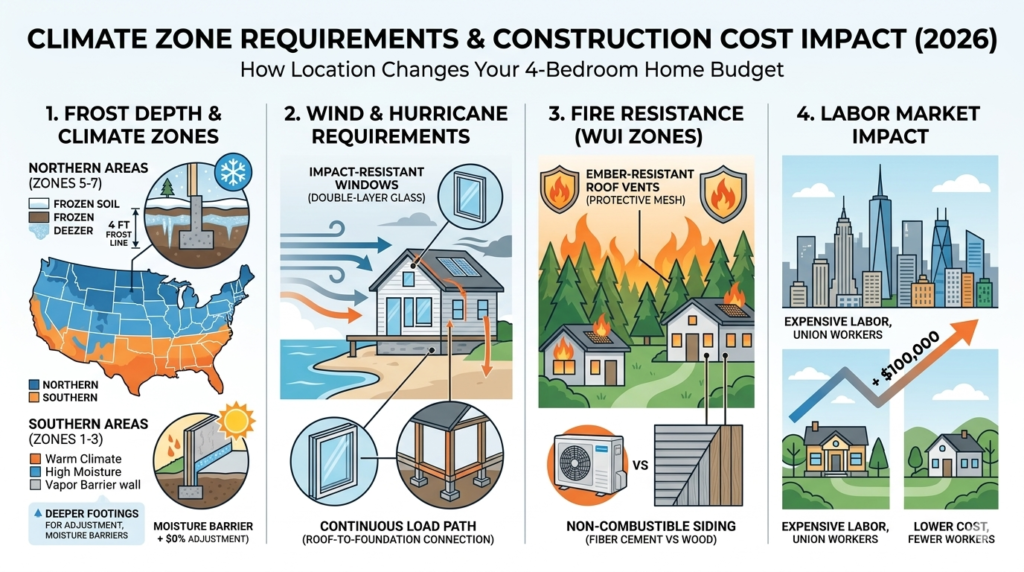
Where you put your house is the biggest thing that changes the price to build a 4-bedroom house. This section looks at the key reasons why your location changes your budget.
1. Frost Depth and Climate Regions
The “Frost Line” denotes how deeply the ground freezes during the colder season.
Northern Areas (Zones 5-7)
In places like Minnesota, the frost penetration goes down 4 feet. Footings need to be placed beneath this frozen level to stop the building from jacking up (undergoing upward displacement). Also, overhead spaces must have R-49 thermal protection. The R-value shows how well a material stops heat from moving; higher numbers mean it keeps heat out better, but costs more money.
Southern Regions (Zones 1-3)
The focus moves away from frost penetration toward significant moisture content. A vapor barrier, which is a specific plastic sheeting, is necessary to prevent moist air from causing deterioration within wall structures.
2. Wind and Hurricane Requirements
If you build in Florida or along the Gulf Coast, the average cost to build a 4-bedroom house goes up because of wind.
Impact Windows
These have two layers of glass with a piece of plastic in the middle. They are so strong that a big piece of wood flying in a storm cannot break them. They cost $1,500 to $2,800 each, while normal windows cost $400.
Continuous Load Path
This indicates a firm linkage of the roof to the vertical sections, those sections to the base framework, and the base to the underlying structure, all achieved via metallic fasteners. This integration creates a unified structure that resists wind forces from separating it.
3. Fire Resistance (WUI Zones)
Across the Western US, numerous residences are constructed close to natural, undeveloped lands. This area is called the Wildland-Urban Interface. Because there is a high risk of fires, these houses must use special parts.
Vents Designed to Resist Embers
These are special holes in the roof that let air move in and out. They are built to stop tiny bits of fire from getting inside. This helps keep the house safe from fire.
Non-Combustible Siding
You cannot use cheap plastic or wood for the outside of the house. You must use brick or fiber cement. Fiber cement is made from sand and concrete. It looks like wood, but it will not catch fire. Using this material adds $12,000 to $25,000 to the total cost.
4. Labor Markets and Unions
In big cities like New York or Chicago, many workers are in a union. Unions make sure workers get good pay and have health plans. This is good for the workers, but it means the price to build a 4 bedroom house might be $100,000 higher than in a small town in South Carolina, where labor is cheaper.
The Impact of Interior Finishes on Your Total Budget
Finishes are the things you see and touch. This is the paint, the floors, the lights, and the cabinets. This is the part of the average cost to build a 4 bedroom house that can grow very fast. If you pick basic items, you stay on budget. If you pick fancy items, the price can double.
Drywall
This helps make your walls look smooth and clean. Plan to spend between $12,000 to $22,000 for this work. If you want your walls to look perfect with no bumps, it will cost more. This is because the workers must spend more time on them.
Flooring
Luxury vinyl plank is a great pick for your home. It looks just like real wood but stays safe from water spills. Putting this in every room costs about $15,000. Real wood floors are much more expensive and can cost $40,000 or even more.
Cabinets & Counters
The kitchen is the part of the house that costs the most money. Buying very nice cabinets and strong stone tops like quartz is pricey. You should expect to pay between $45,000 to $100,000 for these items in a large kitchen.
| Category | Budget Tier | Mid Range Tier | Premium Tier |
| Flooring | $12,000 (LVP) | $30,000 (Mixed) | $50,000 (Hardwood) |
| Cabinets | $10,000 (Stock) | $25,000 (Semi-custom) | $60,000 or more (Custom) |
| Counters | $4,000 (Laminate) | $12,000 (Quartz) | $30,000 or more (Stone) |
| Interior Paint | $4,000 | $9,000 | $15,000 or more |
| Lighting | $3,000 | $7,000 | $20,000 or more |
Permits Professional Fees and Management Expenses
The price to build a 4 bedroom house includes many fees you may not think about. These are called “soft costs.” They include permits from the city, fees for architects, and the cost to connect to the power lines. These usually add 15% to 25% to your total bill.
Building permits in a small town might cost only $1,500. In a big city like Los Angeles, that same paperwork could cost $50,000. You also have to pay the city to connect your home to water and sewer lines. If you build in the country, you will need to dig a well for water. You will also need to put in a septic tank for waste. These two things together can cost between $20,000 and $50,000.
General contractors (GCs) also take a fee. This is usually 15% to 25% of the total build. They are the bosses of the job site. They make sure the plumber shows up on time, and the wood gets there correctly. This is a fair price for the hard work they do for you.
Smart Home Technology and Energy Efficiency Standards
By 2026, almost all four-bedroom homes will include some degree of clever functionality. A basic package usually provides a linked climate control unit, a video doorbell, and fast web connectivity everywhere. This configuration generally costs between $3,000 and $8,000. For a completely automated residence with automated blind operation, the expense might climb to $50,000.
Solar panels are now a big part of the budget. A solar system for a large house costs about $20,000. The good news is that the government gives you a 30% tax credit. This means you get a big cut on your taxes. In California, solar is now required by law for all new homes. Better insulation and solar can save you $2,000 a year on your power bills.
Strategic Budget Allocation for Residential Construction
You must never spend all your money on the plan. You must keep extra money saved for surprises. This is called a contingency. For a 4 bedroom house, you should save 10% to 15% of your budget for things that go wrong.
If the builder starts digging and hits a giant rock, it might cost $10,000 to blast it away. If the price of wood goes up fast, you need extra cash. Over 60% of people who build a home go over their first budget. Having this “cushion” keeps you from running out of money before the house is done. Do not treat this as optional money. It is a vital part of your plan.
| Cost Category | Percent of Budget | Mid Range Dollar Amount | Notes |
| Site and Foundation | 12% | $55,000 | Digging and concrete work |
| Framing | 18% | $95,000 – $110,000 | The wood skeleton of the house |
| Exterior Shell | 12% | $55,000 | Windows, the roof, and siding |
| MEP Systems | 16% | $75,000 | Plumbing, electrical wires, and AC |
| Interior Finishes | 30% | $160,000 – $185,000 | Kitchen, floors, and wall paint |
| Fees and Permits | 8% | $38,000 | City fees and design plans |
| Contingency | 10% to 15% | $55,000 – $90,000 | Emergency reserve fund |
Working With a Builder vs. Doing it Yourself
Some people want to be their own boss to save the 20% contractor fee. This task is quite challenging. You need proficiency in interpreting architectural plans and selecting suitable personnel. Should an error occur, perhaps misplacing a partition, the correction could incur a twenty-thousand-dollar expense. Unless you possess expert knowledge, engaging a specialist is advisable. When employing a contractor, verify their credentials initially. Every state has a board that tracks builders. Make sure they have insurance. This keeps you safe if a worker gets hurt on your land.
Get three bids from different builders. If one bid is much lower than the others, be careful. They might use cheap materials or charge you more later with “change orders.”
Building a home usually takes 8 to 18 months. You will also need a “construction loan.” This is a special loan from the bank. You pay interest on the money as the builder uses it. In 2026, interest rates are a bit higher for these loans. Make sure to count this interest as part of your Cost to Build a 4-Bedroom House.
Frequently Asked Questions
How long does it take to build a 4-bedroom house?
It often takes 8 to 18 months to finish the work. Homes with special plans take more time, sometimes up to 24 months. Waiting for city papers or bad weather can also slow down your building project.
Is it cheaper to buy an old home or build a new one?
Buying a home that is already built is usually cheaper right now in 2026. But building a new home lets you save money on power and pick a floor plan you like. You also do not have to pay for big repairs for many years.
What is the most significant financial error people commit when undertaking new home construction?
The primary pitfall is setting low monetary “allowances” instead of finalizing material selections upfront. Always decide on your cabinetry, flooring, and fittings prior to finalizing your agreement to prevent expensive cost escalations during the build phase.
Do I require an architect if I opt for a builder’s standard design?
Not invariably. Standard plans often include necessary engineering approvals. Nevertheless, if alterations to the floor plan are made, securing an architect or engineer to re-certify the blueprints for your municipal authority becomes necessary.
How does the total area influence the construction expense?
As the footprint of a residence increases, the expense allocated per unit of area tends to lessen. This phenomenon occurs because fixed expenditures, such as permits and utility connections, are distributed across a greater overall inhabitable space.
What reserve amount should I set aside when planning to construct a new house?
It is advisable to keep between 8% and 12% reserved for unforeseen events. These funds address subterranean complications, postponements due to weather, or fluctuations in material costs. It serves as an essential buffer for your undertaking.