Cinder blocks have been used for several construction purposes over the years. These are built using Concrete Masonry Units (CMUs). The components used for cinder block include water, cement, and aggregates. These blocks are frequently used for building walls and foundations.
Cinder block has attained significant value over the years. They have been proven to be more durable, affordable, and easy to install than clay bricks or other masonry units.
Understanding the right size of cinder walls is crucial. This makes your construction more stable and maintains building code compliance. It also allows you to make smart material choices and achieve long-lasting structural stability.
For a deeper understanding of masonry materials and how different construction methods impact structural performance, explore our detailed guide on what is masonry and the types of masonry construction.
What Is a Cinder Block?
Cinder blocks are made of cement, water, and aggregates. Common aggregates for cinder walls include sand, gravel, crushed stone, expanded clay, and slag. Cinder is also called a concrete masonry unit or CMU.
These blocks are hollow. This makes them less heavy and easier to install. Moreover, cinder blocks are much easier to add insulation and reinforcement to, due to the internal cavities. They come in various sizes and shapes, allowing contractors to achieve versatile designs and construction flexibility.
Standard Cinder Block Sizes in the U.S.
In the U.S., cinder blocks come in several standard sizes. The most common size is 8″ x 8″ x 16″. The following wall sizes are also in use. Each type has a different application and cost.
Most Common Nominal Sizes
4” x 8” x 16”: Used for these partition walls and non-load-bearing applications.
6” x 8” x 16”: Also used for interior partitions or moderate strength walls.
8” x 8” x 16” (most widely used): Most widely used blocks. They are used for load-bearing and exterior walls.
10” x 8” x 16”: This cinder block size is heavy and used for stronger walls. They are difficult to handle and install.
12” x 8” x 16”: These blocks are used in multi-story construction to build high-load walls.
Nominal vs. Actual Dimensions: Why the 3/8-inch Gap Matters
The nominal size of a cinder block is 8″ x 8″ x 16″. The actual size is 3/8 inches shorter than the nominal size. This means an 8” x 8” x 16” block actually measures about 7 5/8” x 7 5/8” x 15 5/8”.
Why is there a size difference? To accommodate mortar joints at the top, bottom, and sides. This allows proper fitting and structural accuracy of the wall.
Cinder Block Wall Cost Breakdown
Budgeting a cinder block wall is crucial for controlling construction costs and avoiding material shortages. This helps the contractor plan blocks, mortar, reinforcement, and labor more effectively. You stay on schedule and can complete the project without unwanted and costly surprises.
| Cost Element | Estimated Cost (USD) |
| Cinder Blocks (per block) | $1 – $5 |
| Rebar (per piece) | $10.00 |
| Mortar Mix (per bag) | $15.00 |
| Permit | $50 – $500 |
| Labor Cost (per square foot) | $10 – $17 |
| Delivery Cost | 5% – 10% |
Current Cost of Cinder Blocks
The current cost of cinder blocks is $1 – $5 per block. This cost is influenced by the block size, type, strength, and use. Moreover, the manufacturing quality and location impact prices heavily.
| Cost Component | Cost Range in USD |
| Per Block | $1 – $5 |
| Per Square Foot | $15 – $30 |
| Per Linear Foot | $60 – $240 |
| Average Price for 25 ft. Long Wall | $1,500 – $6,000 |
How to Calculate Total Project Cost
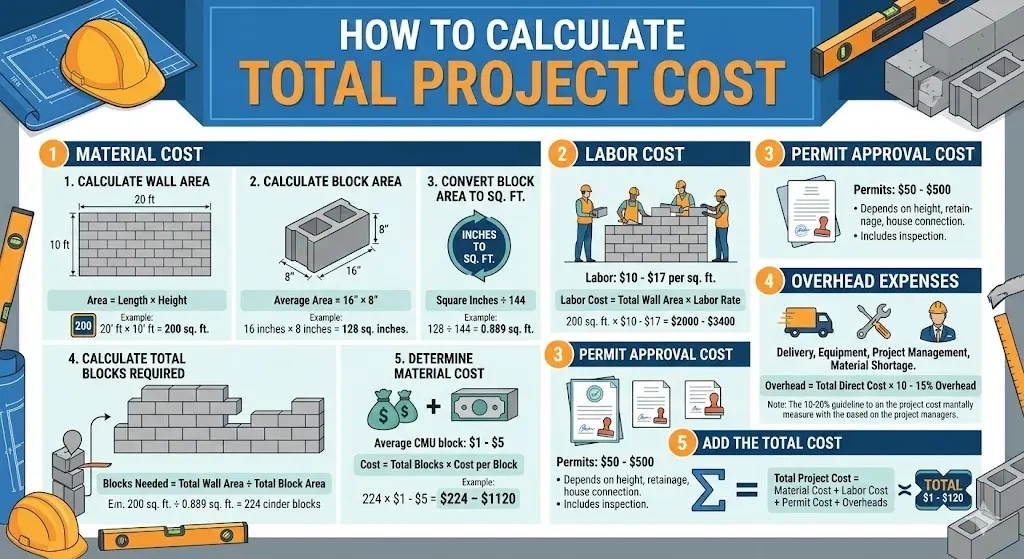
Material Cost
To calculate the total cost of the project material, you need to know the area of the wall.
- Formula to Calculate the Wall Area
Area of the wall = length of the wall x height of the wall
For example, a wall is 20’ feet wide and 10’ feet high. The area of the wall would be 200 sq. ft.
Area of the wall = 20 feet x 10 feet = 200 sq. ft.
- Area of The Block
Now you have to calculate the area of a cinder block. The average cinder block is 16 inches x 8 inches.
Average area of cinder block = 16 inches x 8 inches = 128 sq. inches.
- Convert Inches to Sq. Ft. for Block Size
Total sq. ft. = total square inches / 144 = 128 sq inches / 144 = 0.889 sq. ft.
- Calculate The Total Blocks Required
Formula for the total blocks required = total area of the wall / total area of the blocks
Blocks needed = 200 sq. ft. / 0.889 sq. ft. = 224 cinder blocks needed
- Determine the Material Cost
The average cost for an 8” x 8” x 16” CMU block ranges from $1 to $5 per block.
Cinder block Cost = total blocks x $1 – $5 = $224 – $1120
Here’s a breakdown of the project material cost
| Step | Formula | Example |
| 1. Calculate Wall Area | Length × Height | 20 ft × 10 ft = 200 sq. ft. |
| 2. Calculate Block Area (sq. inches) | Block Length × Block Height | 16 in × 8 in = 128 sq. in. |
| 3. Convert Block Area to Sq. Ft. | Square Inches ÷ 144 | 128 ÷ 144 = 0.889 sq. ft. |
| 4. Calculate Total Blocks Needed | Wall Area ÷ Block Area | 200 ÷ 0.889 = 224 blocks |
| 5. Determine Block Cost | Total Blocks × Cost per Block | 224 × $1 – $5 = $224 – $1120 |
Labor Cost
Now you will need to add the labor cost to install the cinder wall. Labor cost is $10 to $17 per sq. ft. of wall. The labor cost for a 200 sq. ft. wall would be $2000 to $3400.
Permit Approval Cost
Permits will cost you about $50 to $500 to install a cinder wall. Local permits are required depending on your wall height, retaining wall, or if it is physically connected to a house.
An inspection is also carried out to make sure that the wall is installed as per regulations.
Overhead Expenses
Project overhead expenses must be considered while calculating the total cost of cinder block installation. It includes delivery charges, equipment, project management, etc.
Moreover, you need to have an amount in case of a material shortage. Overhead expenses cost about 10 – 20% of the total project cost.
For a 200 sq. ft. wall, the overhead cost could be determined by the following formula;
Overhead Cost = Total Direct Cost × 10 – 15% Overhead
Add The Total Cost
Now add the total material cost, labor charges, permit cost, and overheads. This will give the total cost for the project.
If you want a more detailed understanding of how professionals calculate material quantities, labor expenses, and overheads, explore our complete guide on construction cost estimating.
Types of Blocks Used in Cinder Block Construction
Different types of blocks can be used in cinder block construction. Understanding these types allows you to make the right choices that align with your project scope.
Each block is different in composition, weight, strength, and thermal properties. These differences make certain walls better for specific applications. The following are the different blocks that can be used.
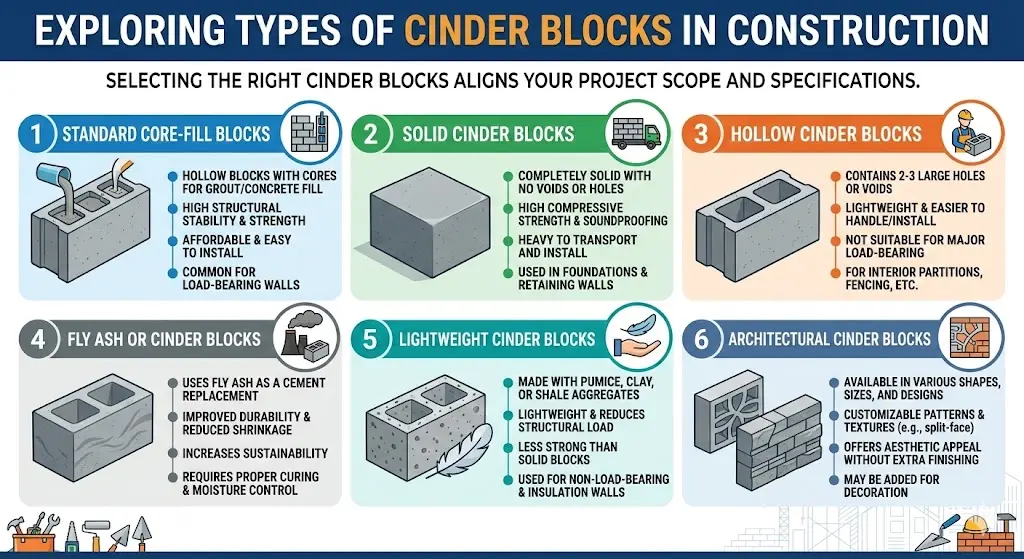
- Standard Core-Fill Blocks
- Hollow Concrete Blocks
- Solid Cinder Blocks
- Fly Ash or Cinder Blocks
- Lightweight Cinder Blocks
- Architectural Cinder Blocks
Standard Core-Fill Blocks
These cinder blocks are hollow concrete blocks with two to three holes. These holes can be filled with concrete or grout. This gives the wall greater structural stability. Standard core-filled walls are much more affordable, easy to install, and reach high strength. They are often used in load-bearing walls.
Solid Cinder Blocks
These cinder blocks are completely solid with no holes or voids. Solid cinder blocks are heavy to transport and difficult to install.
However, they possess good soundproofing capabilities. These walls have high compressive strength and are used in retaining and foundational walls.
Hollow Cinder Blocks
These blocks contain 2-3 holes or voids in them. Hollow cinder blocks are lightweight, easier to handle, and install. They are used for interior partitions, fencing, etc., of a house.
Lightweight Cinder Blocks
Lightweight cinder blocks are made of lightweight aggregates. Materials like pumice, expanded clay, or shale are used. These are not as strong as solid or standard core-filled blocks. Lightweight blocks are used for non-load-bearing walls and insulation walls.
Architectural Cinder Blocks
These blocks come in different shapes, sizes, and designs. This provides customization flexibility for distinct patterns and textures. Architectural blocks are also called decorative or split-face blocks. They could be added for aesthetic appeal, without any need for finishing.
Cinder Block Wall Thickness and Applications
Cinder blocks come in different sizes. The thickness of the block directly impacts its structural strength, efficiency, and durability. Here’s a breakdown of the different types of cinder block thickness, structural role, and application.
Load-Bearing Walls
Load-bearing walls support the upper loads on the wall. They distribute the loads towards the foundation. Vertical loads are carried from upper stories, like the roof, upper floors, and ceiling joists. These walls are essential to maintain the structural stability of the entire building.
The average thickness of a load-bearing wall is 8 inches for a single-story structure. Load-bearing walls are used in exterior walls for their high compressive strength and fire-resistant capabilities.
Partition Walls
These are the type of walls that provide a partition between different building sections. They are not strong enough to bear structural loads. Partition walls are lightweight and affordable. They are commonly used in office room division, interior house walls, or commercial building interiors. Its thickness is about 3 – 6 inches.
Foundation Walls
Foundation walls are walls that transfer loads to the building footing. This supports the entire structure. These walls also hold back the soil around the basement.
This prevents the soil from falling into empty spaces and collapsing the basement. It offers high structural stability, with a thickness of 8 – 12 inches. Their most common usage is in basement walls, crawl space foundations, and retaining soil around low-grade structures.
Retaining Walls
Retaining walls are designed to hold back soil. They are resistant to lateral earth pressure. They also prevent soil erosion and slope failures. The thickness is similar to that of a foundation wall.
Retaining walls are used in landscape elevation control, slope site stabilization, and boundary support walls.
The thickness of a cinder block wall significantly impacts material quantities and overall project budgeting. To better understand how structural elements affect your total cost, explore our guide on estimating construction costs.
How Block Size Affects Construction Cost
The size of cinder blocks directly impacts the cost of the wall. Larger blocks cover more area. Hence, fewer blocks would be required. Moreover, larger blocks have bigger spaces between them. This allows reinforcements like steel, cement, etc., to be added. This makes the wall stronger and load-bearing.
Smaller blocks, on the other hand, are easier to handle but need more blocks to cover the entire area. This increases the project cost. More labor and mortar will require you to pay more.
Choosing the right block size helps you balance structural strength, work speed, and cost.
Why Accurate Takeoff Is Critical for Contractors
Accurate takeoff is the process of calculating the total amount of cinder blocks, mortar, and reinforcement needed. This is crucial to ensure the project completes within the budget. Even small errors can be troubling. Not conducting a takeoff can cause material shortages, cost overruns, and project delays.
With cinder walls, accurate takeoff helps with the following.
- Correct quantities of blocks
- Proper mortar and reinforcement estimates
- The amount of labor needed
- Reduces waste and unwanted expenses
Therefore, conducting an accurate analysis helps you to cut costs. This allows contractors to bid more competitively on cinder block wall installation jobs.
Role of Professional Cost Estimation Services
A professional cost estimation service can provide the right amount and cost of cinder wall installation for your home. Large projects have complex requirements. You need the right cinder block type for different components. Moreover, market price fluctuations and labor charges heavily influence your project cost.
Hiring a professional estimator saves you from all these risks. They provide accurate takeoffs, scheduling, and cost estimates. This allows you to complete the project on time and as per the estimated budget.
Looking for quality cinder wall estimates for your home? Cost Bidding has got you covered with professional estimation services across the USA.
Conclusion
This blog provides a clear guide on cinder block installation. Cinder block, also known as CMU, is made of water, cement, and a composition of different aggregates. There are several distinct shapes and cinder block sizes.
Each block type affects the wall’s structural performance, soundproofing, and insulation. Applying accurate dimensional knowledge enables contractors to understand quantity, cost, and labor requirements more effectively.
FAQs
What is the size of a cinder block?
The standard size for a cinder block is 8 inches (height) × 8 inches (depth) × 16 inches (length). These are also known as 8 x 8 x 16 CMU blocks. Cinder block has been the foundation for several residential and commercial construction projects.
How to build a cinder block wall?
To build a cinder wall, first calculate the wall dimensions to determine the total number of blocks required. Use high-strength mortar for bonding. Now make the concrete footing twice as wide as the wall. This helps maintain support. Add cap blocks for neat finishes. You may include rebar if the wall is tall or carries large loads.
How to build a cinder block retaining wall?
Building a cinder block retaining wall is similar to building a regular cinder block wall. Use standard core-filled blocks or solid blocks for durability and strength. The blocks can be reinforced with concrete or rebar. It also involves a deeper and compacted gravel base to prevent soil pressure.