When it comes to large and complex construction projects, cost certainty holds significant importance. The clients want to avoid cost overruns and protect themselves from runaway expenses. On the other hand, contractors need a contract structure to keep their projects profitable. That’s where Guaranteed Maximum Price (GMP) comes in handy to solve all these problems. It is also known as a Not-to-Exceed agreement.
In today’s landscape, GMP in construction has become one of the most trusted frameworks for balancing risk, cost control, and transparency. You must be thinking of What Is GMP Construction? The GMP contract is defined as a framework in which the maximum price for a construction project is set, beyond which the contractor absorbs additional costs. The contract is often used for complex construction projects.
Whether you are a contractor, builder, or estimator, understanding how GMP works can help you resolve financial disputes and safeguard your budget. This blog will explain everything you need to know about GMP construction contracts, including their working, benefits, and disadvantages. Let’s explore the different aspects of GMP construction.
What Is a GMP Contract in Construction?
A GMP contract is defined as a contract between a construction project owner and the contractors to set a maximum limit on the total cost of the project. The price is negotiated between contractors and the owner so that the owner will not end up facing cost overruns.
The contractor manages the responsibility of purchasing the materials and financing labor. This maximum price includes all project expenses, capping the financial exposure for the owner while giving contractors flexibility to manage costs.
GMP is often established when both parties collaborate to understand and define the scope of the project. It is different from a lump-sum contract, as GMP in construction offers both cost clarity and transparency, making it the most favored choice for the construction project.
GMP construction contracts are often used across both public and private sectors. Private developers often choose GMP contracts for high-budget projects, such as hotels, resorts, office buildings, shopping centers, and mixed-use buildings. On the other hand, government agencies also use GMP for hospitals, schools, universities, municipal buildings, and transportation.
How GMP Construction Contracts Work
A GMP in construction is defined as a contractual agreement between the project owner and contractor. The owner sets the maximum cost for the project, and the contractor is committed to completing this project within the prescribed cost timeline. A GMP contract consists of all the direct costs involved in the project, the contractor’s fee, and the Guaranteed maximum price.
The first step of the GMP contract consists of the completion of the project’s design. As a result, the contractor participates in value engineering, budget estimating, design reviews, and construction scheduling.
The second step involves setting the GMP. For this purpose, the contractor prepares a detailed cost estimate, allowances for undefined items, contingencies, and a clear breakdown of costs. Once both parties agree, the GMP is signed into the contract.
The third step revolves around cost transparency. The project owner can audit subcontractor bids, invoices, and payroll based on the documentation of all costs.
If the actual cost surpasses the GMP, the contractor covers the excess at no additional charge to the owner.
A GMP contract also covers the unexpected by including a contingency fund. This fund serves as a financial buffer for unexpected expenses or minor scope adjustments, protecting both the project owner and contractor from cost overruns. Spending from this fund typically requires approval to ensure alignment with costs and contingency funds, only when necessary.
Components of GMP
| Component | Description | Purpose | Inclusions |
| Scope of work | A clearly defined outline of the project tasks, deliverables, materials, and responsibilities. | Establishes what is and isn’t included in the project, reducing disputes and cost ambiguity. | Drawings, specifications, schedules, performance standards, materials list.
|
| Project costs | The contractor’s breakdown of the projected cost for labor, materials, equipment, and subcontractor | Helps the owner understand how the GMP was developed and what costs are included | Quantity takeoffs, unit costs, subcontractor bids, material pricing, and labor rates.
|
| Contractor fee | Charges, as a percentage of the total project cost that account for the general contractor’s profit and overhead. | Ensures transparency in the contractor’s earnings and prevents hidden markups. | Overhead rate, profit percentage, and administrative costs |
| Contingency funds | It is defined as a percentage of the GMP that provides the contractor with a financial buffer to account for unforeseen conditions. | Helps manage risks without increasing the GMP unless major changes happen. | Construction contingency (contractor-controlled), design contingency (owner-controlled)
|
| General conditions | It includes costs associated with the construction project that cannot be directly attributed to labor, materials, or equipment. | It brings cost clarity to the construction project | It includes indirect costs. |
| Allowances | Pre-set budget amounts for items not yet fully designed or selected at the time of contract signing. | Allows the project to move forward while decisions are still pending. | Fixtures, finishes, equipment, and specialty materials with price ranges. |
| Change order process | A formal procedure for modifying scope, timeline, or budget. | Ensures changes are documented, priced fairly, and approved before execution. | Pricing methods, approval steps, and documentation requirements.
|
| Risk allocation | Defines responsibility for risks such as design errors, material price escalation, and site conditions. | Prevents disputes and clarifies which party bears each type of risk | Site condition clauses, escalation clauses. |
| Project schedule | Timeline for completing milestones, inspections, and final delivery. | Aligns expectations and ties payments to progress.
|
Critical path schedule, start/finish dates, milestone targets |
| Quality control | The contractor must follow to ensure acceptable workmanship. | Protects the owner from poor construction quality or shortcuts. | Testing requirements, material standards, and inspection procedures. |
Inclusions and Exclusions in GMP Construction
In GMP construction contract, multiple things are included and excluded. Here is the detail!
Inclusions
- The contract contains defined scope of work characterized by the documents and specifications. It often includes both prime contract work and certain subcontract packages.
- It also include direct construction costs, including labor, materials, equipment, and subcontractor costs required to perform the scope.
- Contractor’s overhead and fee are also the part of the GMP construction.
- Amounts for items not fully detailed and allowances are also included. The contract must specify how allowances are adjusted to actuals.
- Contractor’s contingency for unexpected minor items that fall within expected risk profile.
Exclusions
- The GMP contract does not cover the following items:
- Owner-furnished equipments and materials
- Unknown site conditions, such as subsurface issues, contaminated soils, and underground obstructions
- Changes in permit fee and regulations
- Major climatic disasters, such as earthquake, floods, and pandemics
- Cost caused by incomplete and errors in design are not included in GMP
- Cost enhancement beyond GMP for items is excluded
- Third-party fee, such as impact fees and permits are excluded
Pros and Cons of GMP Contracts
There are several pros and cons of construction GMP. Here is the detail!
Pros
| For Contractors | For Owners |
| Remarkable cost control
The contractor’s responsibility to manage the costs and schedule of the project gives them greater control over the entire construction project. |
Budget Clarity
When the contractor takes care of your project’s finances, the project owner experiences cost clarity at every step of the project. |
| Incentive-oriented
Some GMP contracts involve performance incentives to encourage lower costs, such as split sharing. |
The owners experience reduced risks associated with cost overruns and project delays as contractors are responsible for managing the costs. |
| Reduced the risk of losing a bid to a low competitor. | The contractor is responsible for ensuring that the project meets the owner’s requirements, thereby leading to quality control. |
| It offers the opportunity for contractors to earn a savings share. | Shared savings encourage cost-efficient decisions for owners. |
| The general contractor is involved earlier in the project; they have greater influence over the design and approach, enabling them to develop a realistic GMP. | Early contractor involvement improves budgeting and constructability. |
| Early collaboration with designers and stakeholders helps the contractors to foster trust throughout the process. | GMP is a collaborative process between the owner, architect, and contractor, creating a more holistic approach to decision-making and often delivering a higher-quality project. |
Cons
For Owners
- GMP may include hidden padding in the case of undefined scope, thereby leading to cost uncertainty.
- Frequent approvals of the budget can slow down the project’s progress.
- The owner must review detailed cost estimations.
- Without a trusted partner, owners can get tangled up in the inflated costs or try to cut corners to increase their profit, resulting in poor-quality work.
- As the construction project involves several stakeholders, the potential for dispute can arise in the case of costs that fall behind GMP construction contracts.
For Contractors
- High financial risks if the cost of the project is underestimated.
- Burden of cost documentation and record-keeping
- Contractors must review the contract carefully to ensure profitability, as not all costs are considered the owner’s responsibility.
- Potential disputes over what counts as reimbursable costs because the contractor should have accounted for all costs in the GMP.
Uses of GMP Contracts
Here are the different uses of GMP contracts according to different scenarios!
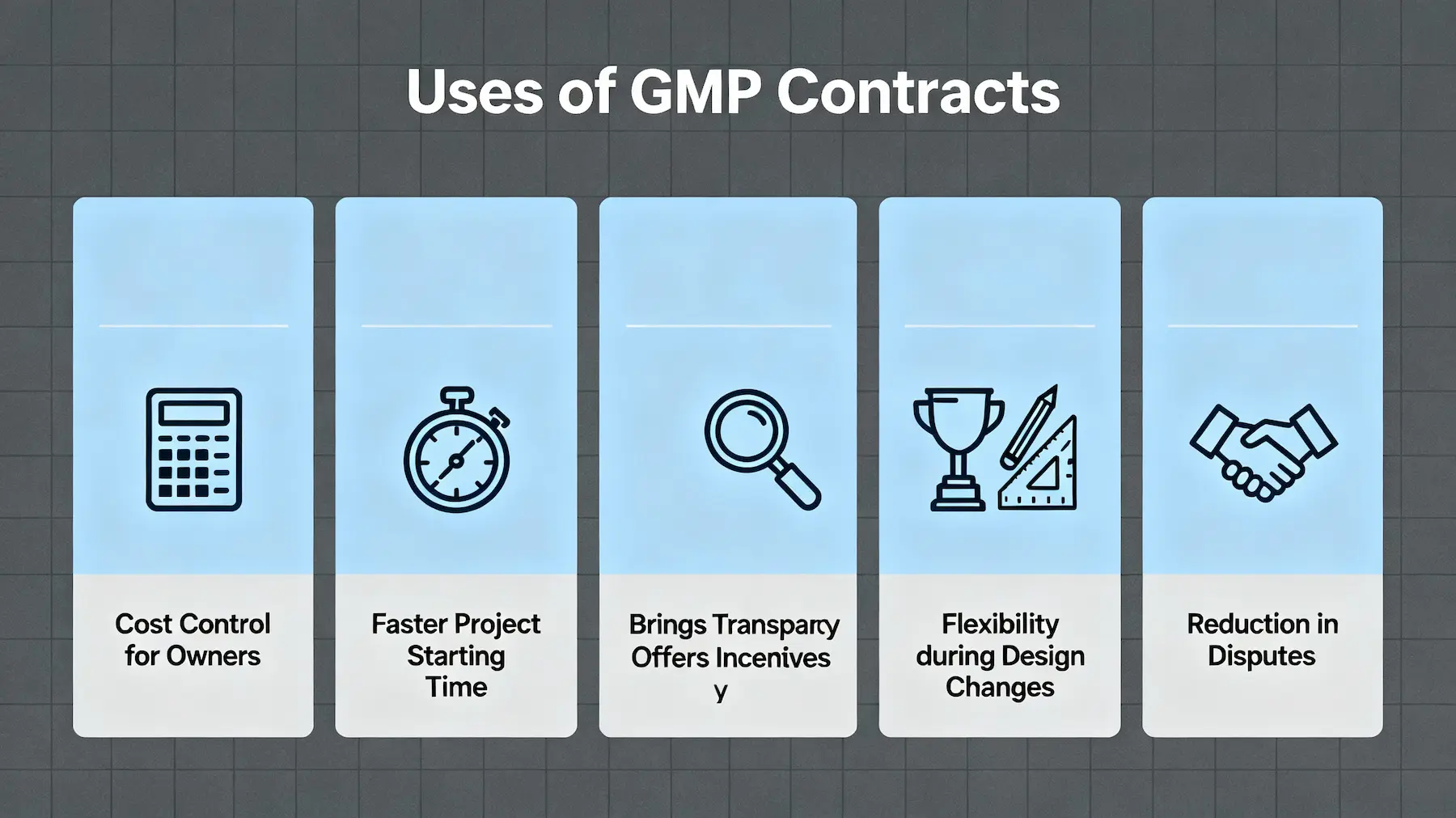
Cost Control for Owners
Being an owner of the project, it is a difficult task to control the costs. Therefore, GMP contracts come in handy in this matter. One of the primary uses of GMP contracts is to limit the financial risk of project owners. After setting the maximum price for the project, the owners can plan a budget with confidence, specifically for large-scale projects, by avoiding cost overruns.
Faster Project Starting Time
GMP contracts are helpful when the project owners want to start the construction before the completion of the design. By utilizing this model, they can ensure fast-track delivery. Contractors can begin procurement and early work packages beforehand. Details can easily be finalized without delaying the whole project.
Brings Transparency in Costs
GMP contracts also bring transparency to the costs. The owners can review actual invoices, labor costs, and subcontractor bids. On the other hand, the contractor is reimbursed at actual cost in addition to a fee.
Offers Incentives for Contractors
As the contractors help to control project costs, they are incentivized to improve efficiency, avoid waste, and negotiate better subcontractor pricing.
Gives Flexibility during Design Changes
These contracts can accommodate design refinements more smoothly than lump-sum contracts. It also allows adjustments to specifications, change-order options, and value-engineering options.
Reduction in Dispute Chances
As GMP brings transparency to the costs, claims related to quantity changes are minimized. Moreover, pricing disputes are also reduced, leading to more collaborative relationships among stakeholders.
Comparing GMP Contracts vs. Lump-Sum and Cost-Plus
| Categories | GMP | Lump-sum | Cost-Plus Contracts |
| Definition | Contractors are paid for actual costs plus a fee, but total payment cannot exceed a guaranteed maximum price. | Contractors agree to deliver the entire project for a once fixed price. | Owners pay the contractors for actual costs plus a fee, with no cap unless GMP is added. |
| Cost certainty for contracts | High costs are capped at the GMP | Very high, as the price is fixed regardless of actual costs | Low as the final cost is unknown |
| Cost risks for owners | Moderate to low, as the owner is protected above the GMP | Low | High as owners bear almost all cost overruns. |
| Cost risks for contractors | High, as the contractor absorbs overruns beyond GMP. | Moderate, as the contractor absorbs the cost overruns due to errors. | Low, as the contractor typically gets paid for all costs. |
| Flexibility during construction | Moderate | Low | Very High |
| Transparency | High | Low | Very High |
| Incentives for contractors | Strong, saving below GMP may be shared between the owner and the contractor. | A strong contractor keeps any savings but also bears overruns. | Weak as a contractor is reimbursed for all costs. |
| Owner’s control over the project | Moderate to high | Low | High |
| Risk of Disputes | Moderate | Low | High |
| Schedule Flexibility | Good as it allows early works even if the design evolves. | Limited | Excellent |
Best Practices for Success with GMP Contracts
- Owners should ensure:
- Scope clarity to minimize costly change orders because a clearly defined scope with complete drawings and specifications reduces uncertainty, ensuring contractors price the work accurately and stay on budget track.
- The contractor must have expertise and hands-on experience with GMP agreements. Not every contractor can deal with managing GMP contracts. Owners should verify the contractor’s track record in budgeting, forecasting, and risk management under GMP terms.
- Contractors must:
- Provide accurate estimates to the project owners. The success under GMP contracts in construction depends on the contractor’s ability to develop detailed and realistic cost projections using historical data, subcontractor quotes, and current market pricing trends.
- Take into account the sufficient contingencies because unexpected conditions can derail budgets. Smart contractors include contingency line items that reflect the project’s complexity and risk assessment
- Have clear communication with other stakeholders to align expectations. Trade contractors need to understand their scope, schedule, and pricing to avoid budget mismanagement that can cause cost overruns and conflicts.
Take control of your GMP project success—connect with industry experts today
Conclusion
No one can deny the importance of GMP contracts for better construction projects. A GMP contract is defined as a contract between a construction project owner and the contractors to set a maximum limit on the total cost of the project. The price is negotiated between contractors and the owner so that the owner will not end up facing cost overruns.
The contractor manages the responsibility of purchasing the materials and financing labor.
If you are looking for a professional company that can help you with GMP contracts in the construction industry, look no further than Cost Bidding. For more details, visit our website.
Faqs
What does GMP mean in construction?
The GMP contract is defined as a framework in which the maximum price for a construction project is set, beyond which the contractor absorbs additional costs. The contract is often used for complex construction projects.
How is a GMP contract different from a lump-sum contract?
In the GMP contract, the final price is capped, but the owner pays the actual cost and the additional costs as well. In GMP, costs are transparent and adjustable. On the other hand, a lump-sum contract is a fixed-price upfront, regardless of actual costs. There is no transparency or adjustment regarding costs.
What happens if costs exceed the guaranteed maximum price?
If the costs exceed the guaranteed maximum price and there are no scope changes, it is the responsibility of the contractor to cover these costs.
When should you use a GMP construction contract?
- You should use a GMP construction contract when:
- The owner wants cost clarity and certainty
- The project design is partially prepared
- In the case of transparency in the project
- When you want early contractor involvement due to a tight schedule
How can I estimate project costs under a GMP contract?
You can estimate project costs under a GMP contract through the following:
- Quantity takeoffs
- Detailed early-stage design review
- Subcontractor quotes
- Contingencies
- Allowances
- Contractor’s fee