IBIS World studies the plumbing industry in the U.S. to be $121.5 billion. The installation is crucial for health and safety in homes and commercial buildings. Plumbing benefits with a consistent and clean water supply and proper waste disposal. It also maintains adequate water pressure for daily usage.
Now, most people wonder what the average cost is for plumbing a new house. The national average is $4.55 per sq ft. This expense depends on several factors, such as supply lines, pipe quality, fixtures, appliances, and labor charges.
Estimating plumbing costs enables contractors to make better plumbing decisions. They make better material. This helps to account for the budget and quality material options accurately. This blog provides a complete guide for plumbing costs and the procedures to estimate them.
What Does Plumbing Installation Include?
Plumbing installation means putting new plumbing systems in your home or building. It includes installing systems like water supply, drainage, waste disposal, and venting. These systems are connected with different fixtures like bathrooms, sinks, laundry, etc.
It is completely different from repairing, where damaged plumbing systems are fixed to reach previous and optimal conditions. Repairs are less costly than installing a new system.
To better understand how plumbing fits into early construction stages, read our guide on what is rough-in plumbing
Average Cost of Plumbing Installation
The national average for plumbing cost is $4.5 for per sq ft of installation. At the same time, you can expect to pay $45 to $200 per hour for plumbing installation. Here’s a cost breakdown for plumbing systems.
| Plumbing System | Typical Cost Range |
| Water Supply System | $2,000 – $5,000 |
| Drain, Waste & Vent (DWV) System | $4,000 – $12,000 |
| Plumbing Fixture Installation | $100 – $1,000 |
| Hot & Cold Pipe Installation | $2,000 – $15,000 |
| Rough-Ins vs Final Connections | $4,000 – $12,000 |
Step-by-Step Method to Estimate Plumbing Cost for New Construction
Reviewing Construction Drawings
First, you need to analyze plumbing drawings. Understand how many fixtures there are and how the system is connected. Look into the number of rooms that need plumbing work. Check where the components connect bathrooms, toilets, and more.
Look into the layout and unique design challenges. Also, check if there are some extra parts to install. The purpose is to analyze every small material and component that needs to be added.
Counting Plumbing Fixtures
To count the number of fixtures, simply look in the plumbing drawings for every part that uses water. Count the things like toilets, sinks, showers, and faucets.
Add the total number to remember the exact amount of fixtures required. This helps you to estimate plumbing fixture installation costs more easily.
Here’s a list of different fixtures plumbing would need and their cost.
| Appliances | Estimated Budget |
| Sink | $350 to $500 |
| Water heater | $400 to $1,800 |
| Furnaces (gas line) | $700 to $1,700 |
| Clothes washer | $300 to $1,500 |
| Dishwasher | $400 to $650 |
| Gas stove | $400 to $1,200 |
Estimating Pipe Installation Quantities
Estimating pipe installation involves calculating the quantity of pipes required for the entire building. Check the pipe lengths, sizes, routes, joints, and different connections.
Include all pipes, whether for water supply or drainage systems. This allows you to calculate the exact amount of pipe without wastage or shortage.
You can use software that can directly detect pipe sizes from drawings. This makes estimating pipes easier and more efficient.
Calculating Rough-In Plumbing Cost
Rough-in plumbing refers to the installation of material before laying the wall or floor. Rough-in plumbing is carried out before adding the fixtures.
All the pipes, vents, valves, and fittings are installed. Everything is laid in position before connecting the fixtures.
Skilled labor adds up to the rough-in plumbing cost so that the plumbing system is perfectly connected and functions smoothly.
Adding Plumbing Fixture Installation Costs
Now you have to calculate how much it will cost to install the plumbing in place. This includes all the toilets, sinks, bathtubs, and more. Each is crucial for bathing, cleaning, laundry, and waste disposal.
Check the fixture quality and the time needed to install each. The cost for installation at every location needs to be calculated separately. Also, check for some extra work if required.
Applying Average Plumber Cost
You will need labor for the excavation, rough-in plumbing, fixture installation, and finishes.
Each task will cost differently depending on the time and labor experience. Typically, you need to pay $50 and $150 per hour for labor for plumbing installation.
Moreover, you can expect to pay $9000 to $12000 for a house plumbing job in the USA. It’s always better to get quotes from your local plumber for a more exact estimate.
Including Permits & Inspection Fees
Permits mean getting permission from the local authority to continue the plumbing work. This is to make sure that you follow the plumbing standards. You will need to pay for the permits. Generally, these permits will cost $50 to $500.
Sometimes the city sends an inspector to check that everything is safe and correct. The inspection adds up the overall plumbing cost.
Adding Contingency for Hidden Issues
When working on plumbing, unexpected issues and surprises sometimes pop up—for example, broken pipes or late permit approvals.
You have to set aside 5-10 percent of your cost for it. This way, plumbing remains within the budget. For an average house, the overhead allowance would be estimated to be $500 to $1200.
Note: The exact cost of your house would vary depending on your location. Consulting multiple local contractors would always give a more accurate plumbing installation price.
For detailed guidance on estimating construction project costs and planning materials efficiently, check our blog on construction cost estimating
Plumbing Installation Cost Breakdown: What Affects Your Budget?
Estimating your plumbing project starts by knowing all the factors involved. This enables the right decisions before plumbing installation.
Here’s what impacts plumbing cost.

Project and Building Size
Plumbing cost is directly affected by your project scope and size. Greater size means more material and labor needed. Hence, more cost is paid.
Plumbing for a house can cost $9000 to $12000. Similarly, commercial and industrial plumbing projects can reach thousands of dollars.
Project Location
Some places offer lower prices for materials than others. West coast and northeast cities like California, New York City, and Boston have high demands and living costs. This increases the material prices for plumbing. At the same time, cities in the southern and midwestern regions offer much cheaper installation costs.
Similarly, in Hawaii and Alaska, shipping cost increases the overall expense. Several of these costing variables may differ in plumbing prices in these areas.
Fixtures and Appliances Cost
Counting the number of fixtures is most important. Different fixtures like bathroom, laundry, sinks, clothes washer, etc cost differently.
Even minor plumbing fixture installation should be included. Here’s how different fixtures would cost on average in the U.S.
| Fixtures | Estimated Budget |
| Sink | $199 – $469 |
| Water Heater | $1,600 – $2,400 |
| Furnaces (gas line) | $4,000 – $8,000 |
| Clothes Washer | $50 – $2,000 |
| Dishwasher | $500 – $1,200 |
| Gas Stove | $1,150 – $1,650 |
| Toilet | $225 – $375 |
| Bathroom Faucet | $463 – $673 |
| Shower System | $390 – $16,875 |
| Bathtub | $350– $2,500 |
| Garbage Disposal | $100 – $400 |
| Water Softener System | $200 – $6,000 |
| Tankless Water Heater | $2,400 – $5,400 |
| Pressure Booster Pump | $200 – $2,200 |
| Backflow Preventer Valve | $135 – $1,100 |
| Sump Pump | $500 – $1,000 |
| Faucet | $97-$369 |
| Bidet / Bidet Seat | $500 – $1,500 |
| Ice Maker (plumbing line) | $300 – $900 |
| Laundry Sink / Utility Sink | $150 – $600 |
| Water Filtration System | $1,044 – $3,266. |
| Recirculation Pump | $200 – $400 |
Types of Piping Material
Plumbing pipes come in 3 main types of material. Copper Pipes, PEX pipes, and PVC pipes. The quality of the material and the company also increase the plumbing pipes. Among these material copper is the most expensive and lasts the most longer.
| Factor | PEX | Copper | PVC |
| Composition | Cross-linked polyethylene | Metal | Polyvinyl chloride |
| Flexibility | High | Low | Medium |
| Installation | Easy | Tougher | Easy |
| Ideal Use | Indoor plumbing | Outdoor plumbing | Drainage & cold water |
| Cost Per Linear Foot | $0.50 to $1.50 | $3 to $8 | $0.40 to $2 |
| Lifespan | 25-50 years | 50-70 years | 25-40 years |
Labor and Excavation Cost
Plumbing needs an underground piping network. This is to connect the main water supply with the building plumbing system. Clean pipes bring water inside the home.
Site excavation and labor for passing the pipes through the ground are expensive. Plumbing excavation costs around $1,500 to $6,000.
Plumbing labor is also costly to hire. Consider the employee’s experience level in employee quality installation. This significantly impacts plumbing prices in the U.S.
Permits Approval
Each plumbing permit will take time and cost. Plumbing permits ensure safe and compliant installation. It ensures that all the plumbing is carried out as per the local codes.
Permits take 5-10% of the plumbing installation cost.
Cost Guide for Major Plumbing Installations
Bathroom Plumbing Cost
The bathroom is the most expensive plumbing fixture. Bathroom consist of several small components like sinks, a bathtub, a shower, a toilet, etc. Considering the number of bathrooms installed and the distance between them increases the cost.
We provided a breakdown of bathroom plumbing costs.
| Number of Bathrooms Installed | Plumbing Cost Required |
| 1 | $1,500 to $3,000 |
| 2 | $3,000 to $6,000 |
| 3 | $4,500 to $9,000 |
| 4 | $6,000 to $12,000 |
Pro Tip: Moving pipes or fixing hidden damage also increases the average plumber cost. Always hire a professional for a quality process.
Toilet Plumbing Installation
The average cost to install a toilet is $225 to $375. The toilet plumbing installation price depends on your location and the material. Different materials like porcelain, vitreous, china, or stone would make it luxurious and increase the cost.
Pro Tip: Some installers provide a much lower installation price when you buy a toilet from them. Therefore, reducing your overall cost. Always opt for such an option.
Installing Sink Drain Plumbing
Sink drain plumbing means connecting the pipes that contain dirty sink water to the sewer lines. It includes paying for the P-trap, fittings, drain pipes, and seal.
The cost to install a sink drain pipe is $324 – $406 per drain in the USA.
Plumbing Installation for a New House vs Renovation
The cost for plumbing a new house is quite lower than renovating. Installing from the start when even floors or walls are not installed is much easier. While renovation requires removing the existing feature. This adds up to the total cost.
Renovating is 10-15% more costly than new house plumbing systems. The average cost for plumbing renovation is $10,000 to $13,200.
Tips to Reduce Plumbing Installation Costs Without Sacrificing Quality
Plumbing installation can be expensive. Knowing the right ways you can reduce this cost. Implementing cost-saving strategies helps you avoid draining your budget and prevent overhead.
These tips provide easy ways you can reduce your plumbing installation cost.
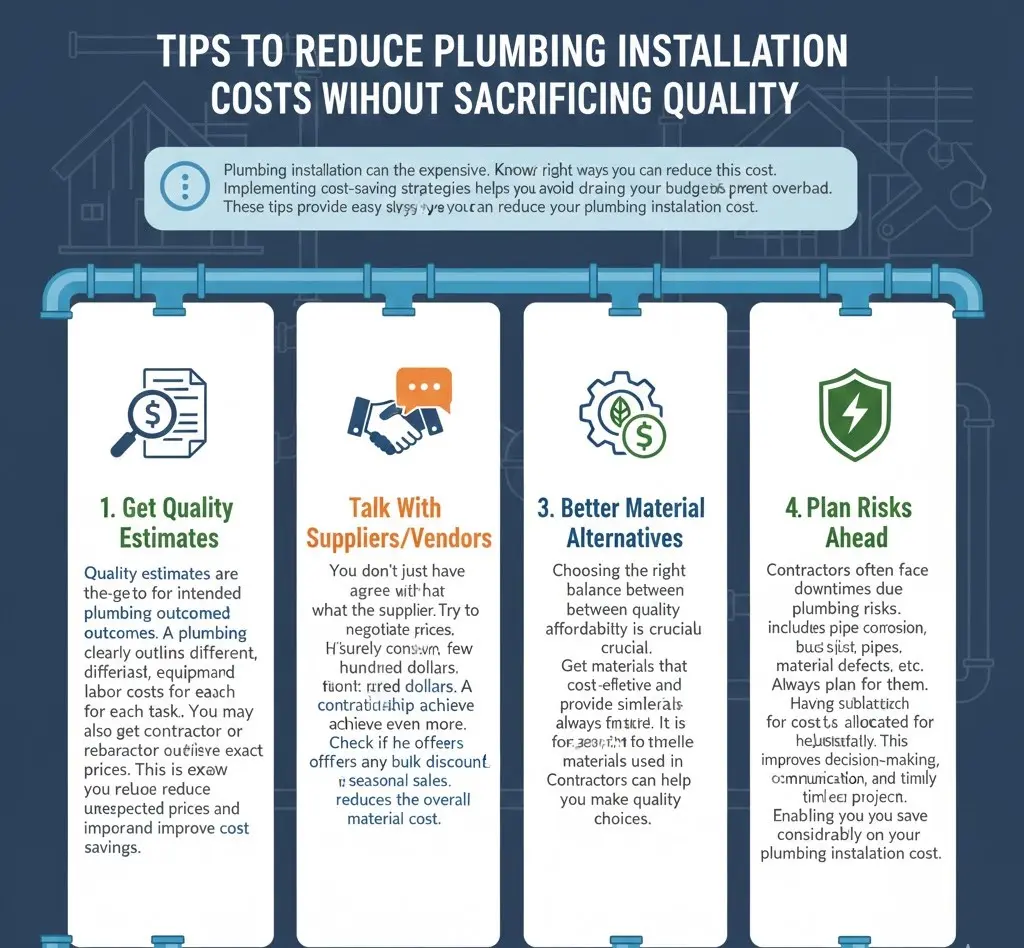
1. Get Quality Estimates
Quality estimates are the go-to for intended plumbing outcomes. A plumbing cost estimate clearly outlines different materials, equipment, and labor costs for each task.
You may also get contractor or subcontractor quotes for more exact prices. This is how you reduce unexpected prices and improve cost savings.
2. Talk With Suppliers/Vendors
You don’t just have to agree with what the supplier says. Try to negotiate for better prices. He’ll surely come down a few hundred dollars. A contractor can use their relationship to achieve even more.
Check if he offers any bulk discounts or seasonal sales. This reduces the overall material cost.
3. Better Material Alternatives
Choosing the right balance between quality and affordability is crucial. Get materials that are cost-effective and provide similar quality.
It is always beneficial to search for the different materials used in a fixture. Contractors can help you make quality choices.
4. Plan Risks Ahead
Contractors often face downtimes due to plumbing risks. This includes pipe corrosion, burst pipes, material defects, etc. Always plan for them. Having a cost allocated for such mishaps can help substantially.
This improves decision-making, communication, and timely project completion. Enabling you to save considerably on your plumbing installation cost.
Why Professional Plumbing Installation Matters
A professional plumber is a must-have. Doing it right from the first time saves you from water damage and costly repairs later on. They have the experience to leave no issue.
Moreover, a plumber has the tools that maintain system integrity. He keeps the plumbing system within the code and brings long-term results.
Ready to save on your plumbing project and ensure professional results? Get expert cost estimates and plan your installation with confidence today!
Conclusion
Plumbing needs proper planning. This blog explains how to estimate plumbing costs. Understanding the cost breakdown is crucial. It helps you with better budgeting. An estimate provides a well-coordinated process. Also, you prevent surprises and save plumbing costs.
Cost Bidding offers an accurate plumbing cost estimate across the USA. So wait no longer. Connect with our experts now.
FAQS
How much does a plumber charge to install a toilet?
A plumber charges $225 to $375 to install a toilet. This cost varies depending on the type of material and labor charges. Common toilet seat materials include vitreous China, enameled wood, and plastic/vinyl.
How to install a kitchen sink plumbing ?
Follow the steps below 9 steps to install a new kitchen sink plumbing.
- Shut off the water supply
- Clean the Installation Area
- Attach faucet, sprayer, and other sink accessories
- Place the sink
- Connect the drain basket and tailpiece to the sink hole
- Attach water supply
- Test for leaks
- Apply silicon seal and finishes
How to estimate plumbing costs?
To estimate plumbing cost, start by understanding the project scope. Analyze the drawings and plumbing components. Measure the pipes and count fixtures. Now estimate the labor cost, permits, and overheads. Add it all up to get a complete budget for your plumbing.