The manufactured homes market has reached 14.6 billion in the U.S. This is growing at a rate of 6.28% every year. The demand has increased. The reason is that these homes provide secure single-storey designs with customization options.
Moreover, these homes are more affordable than site-built homes. They can cost an average of $90,000 to $250,000, depending on the complexity. Understanding its benefits and how it’s better than double-wide homes makes the housing decision easy.
Here’s a triple-wide mobile home guide for homeowners. Explaining the different floor plans and layouts these manufactured homes have to offer.
Before choosing a layout, it’s important to understand the overall cost to build a house and how manufactured homes compare financially.
What Are Triple Wide Mobile Homes?
Triple-wide homes are homes built in factories. They are manufactured there. These homes consist of 3 sections built separately. They are then bought on site and connected to form a single home layout.
These are a suitable choice for kids and retirees looking to avoid stairs in single-storey homes. Homeowners looking for affordable options also opt for these homes.
Triple-wide modular homes need to be built according to HUD standards. However, based on your location and specifications, modular built codes can also be followed.
Triple-wide homes are factory-built and transported in three sections to be assembled on-site into one large layout. Review detailed construction plans before installation to ensure proper setup
Triple Wide Size & Dimensions
The dimensions of a triple-wide home are 40-60 feet in width, while 60 to 90 feet in length.
The total triple-wide home sizes range from 1,600 to over 4,500 square feet. On average, they are 3,000 sq ft.
Triple-wide homes are fully customizable and allow you to add more amenities. Let’s define what rooms a triple wide homes include.
| Room Type | Range |
| Bedrooms | 3 – 5 |
| Bathrooms | 3 Bathrooms |
| Living Room | 1 |
| Dining Room | 1 |
| Kitchen | 1 |
Popular Layouts & Floor Plan Styles
Triple-wide homes come in different layouts. It depends on the move, working, and ease of navigation you want. Additionally, your home maintenance, safety features, and comfort also greatly impact the layout. Here’s what layouts you can choose.
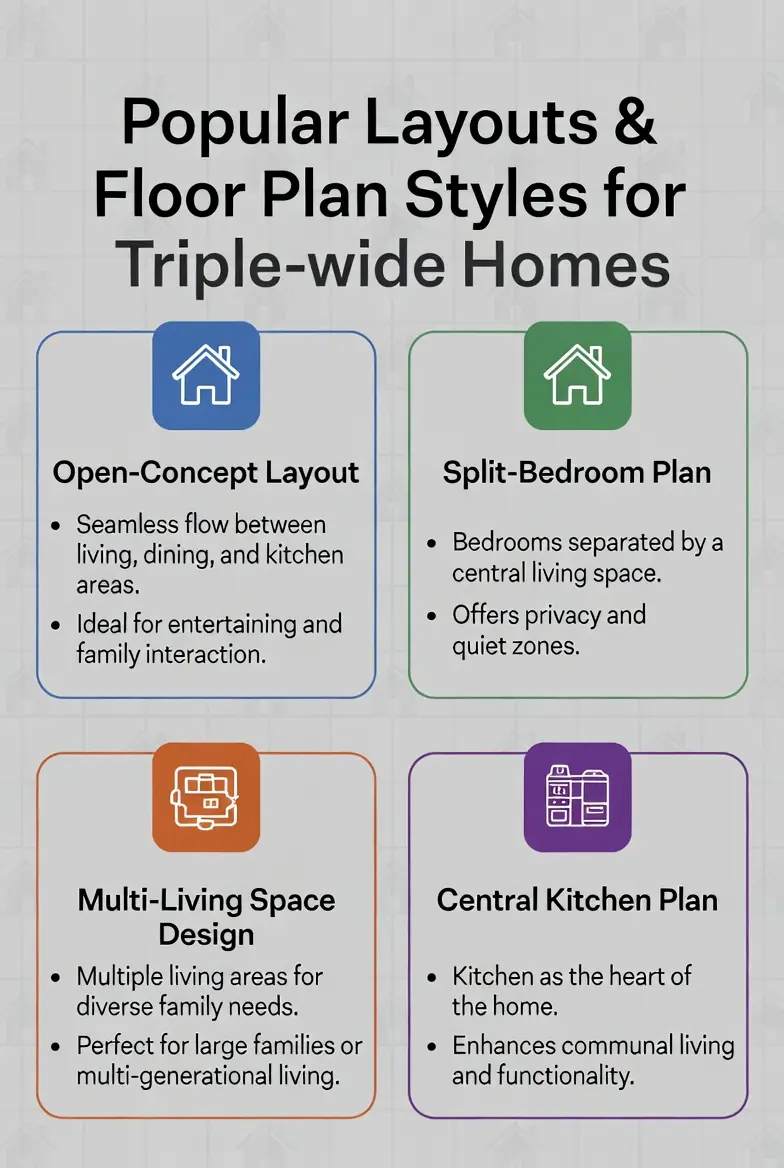
1. Open-Concept Layout
An open concept layout plan for a house doesn’t have rooms separated by walls. The living room, dining, and kitchen are open. This forms a long continuous space. This makes functioning easier.
Families love this layout due to the connected living style. The home feels larger, wide and more comfortable.
2. Split-Bedroom Plan
In this layout concept, bedrooms are on the opposite side. One bedroom suite is located at one corner, while the other bedrooms are located on the other end. The living room is in the middle. This layout consists of a hallway that gives easy access to all rooms.
The layout is suitable for privacy. It gives an easy time for families with different working schedules. You are peaceful and relaxed, under one roof.
3. Multi-Living Space Design
These layouts provide additional rooms. This might include the office, dining room, kids’ room, or a den. The home feels bigger and quieter. The added spots can serve as a place to relax and enjoy.
In multi-living rooms, each space is used for a different purpose—a great layout for family and guests alike.
4. Central Kitchen Plan
The kitchen is at the centre of the home in the central kitchen plan. The whole layout is divided adequately, with the kitchen in the middle. Families can enjoy their time chatting, cooking, and relaxing in the kitchen area. The space feels alive, and kids stay in sight.
The kitchen layout plan is great for families looking for a busy and well-connected space.
The Logistics of Moving 3 Sections in Triple-Wide Homes
Triple-wide mobile homes are much more complex than a regular home. It needs 3 different sections of the house transported to your plot. Each section moves through the highway on heavy trucks.
The process needs proper planning, permits, and safety measures during delivery. This impacts the total cost and placement time.
Transport Permits for 3 Separate Units
Each section has seperate length and width. So you will need three different road permits for transporting the house sections. There are several other local and federal-level permitting codes.
Logistics permits the following factors:
- How much width and height of load is allowed on roads?
- What routes avoid bridges and tight streets?
- What is the specific travel time?
The most common travel times are in early morning hours. The permitting fees are also influenced by the state and the distance of the delivery location. When routes are longer and loads are higher, means you need to pay more permitting fees.
Why Escort Vehicles Add To Your Modular Home Bids?
When loads are larger and heavy then escort vehicles must be used. These cars are in front and behind. Guiding the transport trucks and other vehicles about the wide load.
Escort vehicles make sure that your home sections are delivered safely. Most states require escort vehicles for wide manufactured sections. The escort charges you for fuel and wages.
When triple sections are transported, the travel distance increases. Thus, the escorting fees also increase. Escorting homes would cost you about $1.45 to $2 per mile.
Triple-wide mobile homes require transporting three large sections on heavy trucks. Proper construction cost estimating helps you plan for delivery, permits, and transport fees.
Excavation and Site Preparation for Triple Wide Homes
Triple-wide modular homes will require site-clearing, grading, and excavation. Preparing your house site is crucial to making your house secure and sustainable. It reduced utility risks and makes the investment worth it.
Site preparation includes planning for drainage, sewer, water supply, etc. You will also need to inspect the soil. This impacts your choices for foundation and footing size.
Full site preparation and excavation can come at a cost of $4,000 to over $15,000 or more.
Triple Wide Home Installation: What You Will Pay for?
Utility Mapping and Land Survey
A land survey is conducted. The professional makes sure that the boundaries and elevation are defined. He also provides the water supply lines and underground routes for cables. This ensures accuracy and prevents legal disputes.
Clearing Vegetation and Grounding
Now the site is cleared. This involves removing trees, bushes, rocks, and debris. The surface is levelled. This allows the home to be perfectly placed at the position.
Foundation Installation
An engineered foundation is required in manufactured homes. This means adding concrete pipes, runners, backfilling, etc. A professional helps you attain structural stability and resistance against wind, floods, and harsh weather.
Water, Sewer, and Electrical Preparation
Main lines are prepared before placing the house. The final connections are made when the house is placed. This prevent damages during delivery.
Home Delivery and Placement
Home sections arrive separately on trucks. Cranes and labor are required to assemble the house in their location. Sections are joined carefully, preventing errors.
Connecting Utilities and Inspection
This is the final step of connecting all the utilities to the home. Moreover inspection is carried out. This makes sure that the house is built according to local building codes.
A professional survey defines boundaries, elevation, and underground utility routes. These early costs should be included when reviewing your overall foundation cost and site preparation budget.
Breaking Down the Total Cost (The CostBidding Guide)
The cost of triple-wide mobile homes depends on several factors, such as site preparation, customizations, permitting requirements, location, etc. The national average for triple wide house cost is $90,000 to $250,000. This would cost $50 to $100 per square foot.
Knowing the cost variables enables you to make effective budgeting choices. Here’s a complete breakdown of the triple-wide house cost.
| Category | Estimated Range (USD) | What It Covers |
| Base Price | $150,000 – $300,000+ | Structure, foundation, and layout |
| Site-Preparation | $3,000 – $25,000 | Clearing, excavating, grading |
| Delivery & Setting up | $5,000 – $20,000 | 3 sections delivered separately, escorting fees |
| Foundation & Utilities | $10,000 – $30,000 | Water supply/sewer, plumbing, electric wires, and utility connections |
| Permits & Fees | $500 – $5,000 | Permits for zoning, utility installation, and transportation |
| Taxes | Taxes vary by state | Yearly tax filings on material equipment, and delivery |
| Insurance | $700-$1500 | builder’s risk and workers’ compensation insurances
|
Note: Your location greatly impacts the cost of triple-wide homes. You may need to pay a higher cost in areas like New York or California, while far less in the south or Midwest regions.
Triple Wide vs. Double Wide: Value for Money Analysis
When it comes to the difference between triple-wide and double-wide homes, it’s basically about the size and your housing needs. A larger family would opt for triple-wide houses. Double-wide homes come under 1000 sq ft. They are better for small families, while triple-wide offers a range of lucrative layouts.
Let’s discuss the key difference between both manufactured housing.
| Feature | Triple-Wide Mobile Home | Double-Wide Mobile Home |
| Typical Size Range | 2,000 to 4,500+ sq ft, very spacious | Around 1,000 to 2,200 sq ft |
| Bedroom Capacity | 3 to 5 bedrooms | 1 to 3 bedrooms |
| Bathroom Capacity | 3-4 bathrooms | 2-3 bathrooms |
| Overall Layout Feel | Wide, open flow with large living zones | More compact, space-efficient design, |
| Suitable Usage | Offers a large space and is suitable for large families | Good for small families |
| Design Flexibility | Greater freedom for upgrades, rooms, and luxury features | Fewer customization choices but simpler planning |
| Total Purchase Cost | $90,000 to $250,000 | $80,000 to $150,000 |
A triple-wide trailer homes spread out much wider. They allow much more spacious customization options. However, a double wide homes are easier to install and incurs less cost.
Triple-wide homes can encompass larger families and have higher resale value than double-wide homes. This makes it a preferable consumer choice.
Challenges to Consider
Land Requirements
One of the main challenges in triple-wide mobile homes is land requirements. They are significantly wider than other types. You will need extra space for parking, utilities, and a safe distance from neighbouring houses.
Moreover, preparing the land comes with additional expenses. Not all land is suitable for housing conditions. Therefore, you need to level the ground, which takes more time and costs.
Resale Value
Triple-wide manufactured homes can be hard to sell. Many homebuyers look for traditionally built homes. The concept of manufactured homes isn’t safe for everyone.
However, as the companies started to manufacture better quality homes, the demand has increased. The selling price may grow slowly compared to normal houses.
Zoning Needs
You need to adhere to different zoning rules for your home. This means the minimum lot size and the type of structures allowed. Some areas might require houses made of bricks or concrete, due to floods, storms, or other conditions.
Some states require more permits for wider homes. This takes time, money, and effort.
Quality Perception
Even when modular homes are in use, many assume they are of low quality. These homes are often more stable in structure and energy efficient than many traditional homes.
Financing Issues
Financing options are limited. Not all buyers provide standard mortgages. The loans available have higher interest rates. Therefore, some may avoid modular homes.
Financing options can be limited, and interest rates may be higher. Smart construction budgeting helps buyers plan for loan terms and upfront costs.
How to Compare Contractor Bids for Triple Wide Setup
You need a structured approach for comparing triple-wide home bids. You can’t just look into the final price. Contractors have formatted their bids in different ways, which might make it difficult to read.
For this reason, line-wise itemize all the materials in a list form for all bids. A contractor may have missed out on something. This allows you to make a distinction in material and cost. Make sure all the components are mentioned, like excavation, site preparation, permits, logistics, etc.
After shortlisting that, look for bids that encompass all allowances and overheads. Ask them for similar project references for better understanding.
ProTip: Checking out experienced firms enables competitive pricing. You don’t just need the lowest prices, but a bid that includes everything.
Don’t risk hidden costs or incomplete bids for your triple-wide home. Our experts help you compare contractor bids quickly and confidently.
Final Thoughts
Triple-wide trailer homes are ideal for long-term, spacious living. They bring structural integrity and modern aesthetics. Moreover, it allows a variety of customization options. Understanding the cost for purchasing, logistics, and permits allows you to make timely budgeting decisions and save costs.
Want to estimate your triple-wide home cost? Cost Bidding Services are affordable and comprehensive to assist you.
FAQs
How big is a typical triple-wide home?
A triple-wide home takes up an area of 1,600 to 4,500 square feet. It is large enough to encompass 3-5 bedrooms, 3-4 bathrooms, a kitchen, laundry room, and a dining room.
What is the difference between triple-wide manufactured homes and modular homes?
Triple-wide manufactured homes are a type of modular home. A modular home consists of a house built in different sections at a factory. These sections are assembled on site. At the same time, triple-wide homes are modular homes consisting of 3 sections.
Are triple-wide homes considered permanent housing?
Yes, triple-wide homes offer permanent housing. Modern triple-wide houses are structurally stable and made of high-quality material. They also offer low-cost customization options compared to traditional site-built homes.
How long does installation take?
It can take up to 1-4 weeks to assemble triple-wide homes. This includes site preparation, permit approvals, delivery, assembly, and inspection.
Do triple-wide homes hold their value?
Triple-wide homes keep up their value if they are stationed on a plot and kept at optimal conditions. New models offer high value, while older model housing depreciates.