
When someone asks how much it costs to paint a room, you can’t answer casually. You need a repeatable method that fits real field conditions. In other words, you need detailed, accurate estimates for the project. This guide breaks down room paint cost drivers. Let’s start!
Average Cost to Paint a Room
See the table for a clear understanding!
| Low-end range | $300 |
| High-end range | $1,000 |
| National average | $750 |
So, when you are in the early planning meetings, you can ask how much it costs to paint a room and consider these values. These values reflect wall painting only, unless your project scope changes.
What Factors Affect the Cost to Paint a Room?
Below are the cost drivers you must always consider when working on the cost of painting a room.
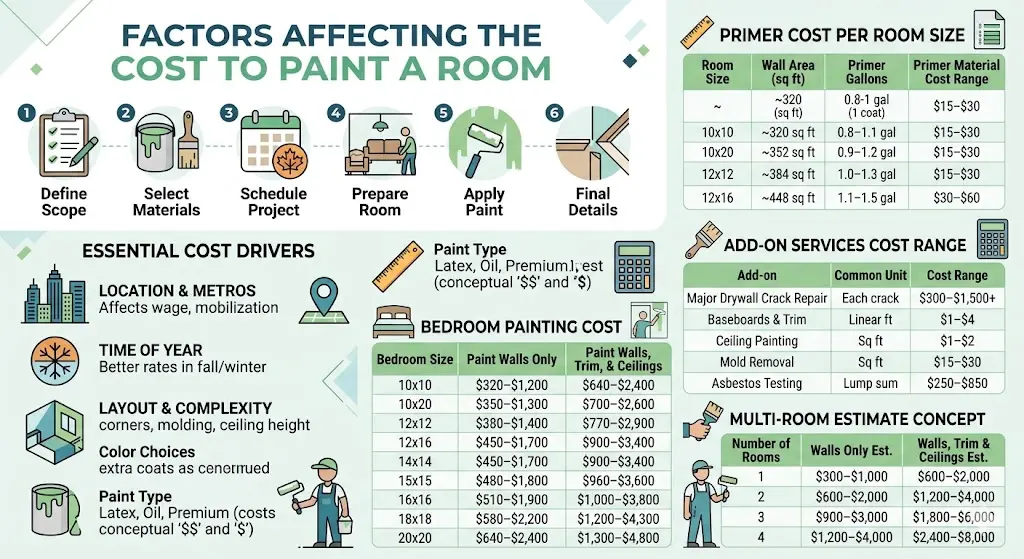
● Location of the Project
Location isn’t just about an expensive city versus a rural county when you estimate the cost of painting a room. However, it also changes wage expectations, mobilization time, and even site parking headaches. That’s why painters typically charge more in major metros with higher living costs.
● Time of Year
Interior repainting competes with exterior season, remodeling cost increase, and holiday schedules. Rates often get more competitive during fall and winter. So, if you can change your project schedule, you can control your budget without cutting corners.
● Room Layout and Complexity
More corners mean more cut-in time and more masking lines. Intricate molding and irregular shapes also slow roller speed and increase touchups. When ceilings exceed 10 feet, costs can jump by 10-50%. In estimating terms, complexity is lost production, not extra paint.
● Color You Choose
Color changes drive coat count, and coat count drives labor. Do you know when you need an extra coat? Switching from light to dark, or dark to light, often needs extra coats. Bright and deep colors can also behave like three coat colors on textured walls.
● Paint Type
Paint decisions affect both material cost and production patterns in the field.
- Latex paint commonly costs around $15 to $50 per gallon.
- Oil-based paint can cost $20 to $70 per gallon and dries more slowly.
- Higher-end finishes often cost more, yet they also show flaws.
That’s why premium paint can reduce repaint cycles while raising bid day totals of the project.
● Customization
Clients love accent walls, textures, and sharp color breaks in photos. However, those details force extra masking and extra line work. Accent walls can cost 20-30% more than other walls. Color changes between rooms also increase labor expense, because setup repeats.
● Primer Cost
Primer commonly costs $15-$30 per gallon at retail. You’ll need it for new drywall, stains, glossy surfaces, odors, or major color shifts. Some paint products include primer, which can save both materials and time.
● Primer Cost Per Room Size
The size of the room significantly affects the cost to paint it. Therefore, you must measure wall area, divide by coverage, and round up for waste. One gallon typically covers 300-400 square feet per coat.
The table below assumes 8-foot ceilings and walls only, before subtracting openings.
| Room size | Wall area in sq ft | Primer gallons for 1 coat | Primer material cost range |
| 10/10 | ~320 | 0.8–1.1 gal | $15–$30 |
| 10/20 | ~352 | 0.9–1.2 gal | $15–$30 |
| 12/12 | ~384 | 1.0–1.3 gal | $15–$30 |
| 12/16 | ~448 | 1.1–1.5 gal | $30–$60 |
● Repairs, Trim, Ceilings, and Mold Treatment
Most rooms need something, even when clients call it a simple repaint. Minor patching usually affects painting bids, but major repairs should not. See this table to separate the base scope from the remediation scope.
| Add-ons | Common Unit | Cost Range |
| Major drywall crack repair | Each crack | $300–$1,500+ |
| Baseboards and trim painting | Linear foot | $1–$4 |
| Ceiling painting | Square foot | $1–$2 |
| Mold removal | Square foot | $15–$30 |
| Asbestos testing | Lump sum | $250–$850 |
● Labor Cost
Labor dominates room painting, even when paint prices increase during busy seasons. Typical labor costs range from $1-$3 per square foot. Many estimates also show $400-$1100 per room. Hourly billing often costs between $20-$50 for small project scopes. At the workforce level, painters show a national median wage of around $48,660 annually.
See the table for a better understanding of the labor demands when you are focusing on how much it costs to paint a room.
| Unit of Labor Cost | Cost Range | Best Fit |
| Per sq ft | $1–$3 | Clean wall takeoffs, standard conditions |
| Per room | $400–$1,100 | Fast bidding, similar rooms |
| Per hour | $20–$50 | Small touchups, unclear scope |
● Minimum Fees, Access, and Furniture Moves
Minimum project fees change small-room estimates. Some painters charge a $250-$500 minimum fee. If the room is packed, prep time increases because labor teams protect and work around items.
Furthermore, some painters move furniture, yet they may charge hourly for that service. Handymen often charge $50-$80 per hour for room painting. So even if paint and labor rates look normal, the total can jump due to some hidden factors, like minimum fee, access, and furniture moves. Therefore, when clients ask how much it costs to paint a room, explain this minimum plus the access fee.
● Size of the Room
Room size drives both surface area and production fatigue for every finisher. Bedrooms give a clean benchmark, because they often have simple geometry. Walls-only bedroom costs range from about $320 to $2,400, depending on size. If you include walls, ceiling, and trim, costs commonly double.
See the table to get the cost of painting a bedroom, depending on the room size.
| Bedroom Size | Paint Walls Only | Paint Walls, Trim, & Ceilings |
| 10/10 | $320–$1,200 | $640–$2,400 |
| 10/20 | $350–$1,300 | $700–$2,600 |
| 12/12 | $380–$1,400 | $770–$2,900 |
| 12/16 | $450–$1,700 | $900–$3,400 |
| 14/14 | $450–$1,700 | $900–$3,400 |
| 15/15 | $480–$1,800 | $960–$3,600 |
| 16/16 | $510–$1,900 | $1,000–$3,800 |
| 18/18 | $580–$2,200 | $1,200–$4,300 |
| 20/20 | $640–$2,400 | $1,300–$4,800 |
● Number of Rooms
Here’s the thing most clients miss about bundling rooms during estimation. The per-room cost often stays similar because labor still drives cost. However, you can reduce mobilization waste when rooms share setup conditions.
Consider this table for quick conceptual budgeting, then refine with takeoffs.
| Number of Rooms | Walls Only Estimate | Walls, Trim, & Ceilings Estimate |
| 1 | $300–$1,000 | $600–$2,000 |
| 2 | $600–$2,000 | $1,200–$4,000 |
| 3 | $900–$3,000 | $1,800–$6,000 |
| 4 | $1,200–$4,000 | $2,400–$8,000 |
● Room Type
Room function changes material choices and prep intensity across your entire labor plan.
- Bathrooms need cleanable, moisture-resistant finishes, so bids rise for labor and materials.
- Kitchens often cost less on walls, because appliances reduce the wall surface.
Here is the table showing the cost of painting a room, considering the type of room.
| Type of Room | Paint Cost Range |
| Bathroom | $150–$400 |
| Primary bathroom | $250–$650 |
| Kitchen | $150–$250 |
| Bedroom | $350–$850 |
| Primary bedroom | $650–$1,400 |
| Living room | $600–$2,000 |
| Dining room/hallway | $300–$1,000 |
| Open-plan basement | $800–$2,500 |
What Factors are Estimated into Painting a Specific Room?
● Cost to Paint a Living Room
Living rooms hide surprises, because they hold windows, doors, and feature walls. They also carry more perfect finish pressure, especially in higher-end work. A typical living room costs about $600-$2,000.
Also, see the table to check the cost of painting a living room, considering the size.
| Size of the Living Room | Paint Cost Range |
| Small, ~200 sq ft | $450–$1,700 |
| Average, ~320 sq ft | $550–$2,100 |
| Large, ~450 sq ft | $650–$2,600 |
● Cost to Paint a Bathroom
Bathrooms cost more per square foot, even when walls feel small. In bathroom paint projects, humidity decides paint choice, plus you need careful cut-in around fixtures. Typical cost range is $250-$650 for an average bath. Primary bathrooms can reach $1,500 or more in high-detail work.
Here is the table, showing the painting cost of a bathroom, considering its size.
| Bathroom Size | Paint Cost Range |
| Small bathroom | $150–$400 |
| Average bathroom or small primary | $250–$650 |
| Large primary bathroom | $300–$1,500+ |
● Cost to Paint a Kitchen
Appliances, cabinets, and backsplashes reduce wall area, so walls cost less. However, cabinet painting changes the entire bid, and it needs its own takeoff.
Here is a table showing the cost of painting a kitchen, walls only and cabinets.
| Kitchen Paint Scope | Paint Cost Range |
| Walls | $150–$250 |
| Cabinets | $900–$3,800 |
● Cost to Paint a Basement
Basements change wildly because moisture and layout change everything from prep to cure. Open-plan basements often cost from $800-$2,500. Multi-room layouts usually cost more, because wall area increases and setup repeats.
● Cost to Paint all Rooms in a House
If you are concerned about how much it costs to paint a house, here are the details. Whole-interior paint pricing matters when owners shift from one room to everything.
Typical interior painting costs from $1,300 to $6,300 for common home sizes. However, higher-end projects often include baseboards, trim, and ceiling scopes for complete coverage.
Below is the table showing the cost to paint a complete house, focusing on its size.
| House Size Per Sq Ft | Paint Cost Range |
| 1,500 | $1,300–$4,400 |
| 2,000 | $1,600–$5,600 |
| 2,500 | $1,800–$6,300 |
Also, see what the average exterior house painting cost is, if you are including outdoor paint, too!
Tips to Save Money on a Room Painting Project
● Measure Accurately
Your takeoff controls everything, so start there before you estimate anything. Measure the room perimeter and ceiling height, then multiply by the wall area. Also, subtract about 21 sq ft per door and 16 per window. That one step keeps your gallons, coats, and labor aligned with reality.
● Choose Wisely
Paint choice isn’t a style debate in estimating when budgets stay tight. However, it’s a durability and touch-up risk decision, which affects future call-backs. Also, higher finishes show surface flaws, so prep time often increases. Therefore, you must align the finish with the traffic level and wall condition before you lock quantities of materials and labor.
● Schedule in Off-Season
If the schedule is flexible, use it as a negotiating lever. Interior rates can be more competitive in the fall and winter months. That seasonal choice helps owners save money and builders smooth workloads.
● Buy in Bulk when Possible
Bulk buying saves money mostly through fewer store runs and fewer mismatched batches. It also reduces pickup time when the office handles purchasing for the labor. Still, you’ll need storage space and a clear sequencing plan for deliveries. Otherwise, you’ll trade small savings for expensive rework later on-site.
● Go for the DIY Option
DIY works best when the project scope is simple and time is flexible. If you’re teaching a homeowner how to paint a bedroom, start with prep boundaries. It works best when the owner can prep carefully and protect surfaces. If you’re advising owners, ensure that you talk through access, safety, and cleanup realities.
How Much Does it Cost to Paint a Room Yourself?
A DIY repaint for a 12/12 room costs between $150-$300. And if you paint alone, it can cost from $30 to $150 for that same room. Ladders and sprayers can increase project expense, especially if you buy instead of renting.
See the table for more cost ranges while you consider DIY.
| DIY Task Category | Paint Cost Range |
| Paint for one room | $30–$150 |
| Surface prep tools and materials | $24–$55 |
| Masking and protection supplies | $10–$40 |
| Roller kit and tray | $12–$30 |
| Ladder purchase | $80–$300 |
| Sprayer rental per day | $30–$50 |
How to Estimate the Cost to Paint a Room?
When stakeholders ask how much it costs to paint a room, use a repeatable sequence. This method keeps your estimate defensible in reviews and change orders.
- Define the scope first. Define whether projects involve walls only or include ceilings and trim.
- Measure wall area using perimeter times height, then subtract doors and windows.
- Set coat assumptions by color shift, finish, and wall condition early.
- Split prep into line items, including cleaning, masking, and minor patching.
- Separate production for cut-in, because angles destroy roller productivity fast.
- Line item primer when you prime and paint walls on porous substrates.
- Estimate materials by gallon coverage, usually $300-$400 per coat.
- Build labor using a per-square-foot or per-room method, then validate hourly.
- Add add-ons explicitly, including trim, ceilings, mold treatment, and testing where needed.
- Finish with overhead, profit, and contingency matched to deal with uncertainty.
Pro Tip: If your project also includes drywall, trim, and cabinets, ask your estimator to add takeoffs in their renovation estimating services.
Ready to lock your next paint estimate without guesswork? Contact Cost Bidding today!
Commonly Asked Questions
How long does it usually take to paint a room?
Most average rooms take 6 to 10 hours with prep and cleanup included. Typically needs 2–4 hours depending on paint type and conditions, so teams plan around dry time. You should expect 24 to 48 hours before you move furniture back safely.
How to measure a room for painting correctly every time?
Measure the perimeter in feet, then measure the ceiling height in feet. Multiply the perimeter by the height to get the wall square footage for the base takeoff. Subtract about 21 square feet per door and 16 per window afterward.
Do painters assist in removing paint & moving furniture on-site often?
Some painters move furniture, while others ask owners to handle it themselves. When painters move items, they often include that labor in the estimate. They also need 2 to 3 feet of clearance from walls for safe access.
How to paint an already painted wall without adhesion issues?
Start by cleaning oils and dust, then sand glossy areas for grip. Patch holes, feather edges, and spot-prime repairs before applying your finish coats. If stains appear, use a primer designed for sealing before you repaint.
How much does a handyman charge to paint a room?
Handymen often charge about $50 to $80 per hour for room painting. That rate can work for small project scopes, but it can cost more for large rooms. For larger work, painters can charge per room or per square foot instead.
How much does it cost to paint a 12/12 room?
For a typical 12/12 bedroom, walls-only pricing often costs from $380–$1,400. If you add ceilings and trim, that same room can cost from $770–$2,900.
How to make a room look bigger with paint quickly?
Use lighter colors to reflect more light and reduce visual edge stopping. Keep trim and ceilings lighter to lift the room, especially in lower ceiling spaces. Also, avoid strong contrast breaks that segment walls and shrink the view volume.
Conclusion
If you’re still asking how much it costs to paint a room, work on the structure. Price walls, ceilings, trim, and prep as separate tasks. Use coverage math, coat risk, and a clear labor method to protect margin. Contractors lose margin when paint projects hide prep and access.
Painting estimating services from Cost Bidding can keep your takeoffs consistent and auditable always. We build itemized line entries for walls, ceilings, trim, primer, and add-ons, ensuring that you can review bids faster, defend changes, and keep schedules on point.