>90% of contractors face the same issues: crushing job pressure, fast-moving tasks, very low profit, and above all, the pressure of precise and accurate estimates. A construction industry business plan is what you can rely on to solve all these issues. If solid and well-structured, it helps stop guessing and start building with the right data. It also gives a clearer path to a good profit, growth, and flawless cash flow. By using it, you can transparently communicate with the lender, partners, and potential clients.
Let’s see what this is, what it should include and how to create a solid one for an unbelievable business boost!
What Is a Construction Business Plan?
A construction business plan is a working document that explains how your company will win jobs, manage costs, and stay profitable. Simply put, it is the paper version of your job site plan. Coming to its key elements, it lays out your:
- Services
- Target market
- Estimates
- Operations
- Financial goals
For contractors, it is not just paperwork. However, it is the tool that keeps your business from shaking when bidding gets tight or labor gets short. In simple words, a business plan is the foundation that guides the structure, growth, and funding decisions of your business.
Why Do Contractors Need a Structured Business Plan?
Suppose you, as a contractor, are working on a construction site without structured plans, while having everything perfect on paper. This is the gap between the paper plans and the job site specifications. The gaps mean your estimates, labor, materials and overheads are not lined up, which will obviously lead to the project failure or the lowest margin.
Thanks to a structured plan that you can use, you decide what jobs fit your project size, margin, and team. By relying on it, you can efficiently track cash flow, staffing, and scheduling before problems increase.
Benefits of a Well-Structured Construction Business Plan
- Helps you spot money leaks before they reduce profit
- Makes bids sharper and more believable
- Gives lenders a clear reason to trust you
- Keeps staffing decisions tied to real demand
- Improves cash flow planning during slow collection cycles
- Clarifies who owns each part of the job
- Helps you choose better-fit projects faster
- Supports stronger marketing and better lead generation
- Reduces stress when deadlines and change orders increase
- Gives your company a clear path to steady growth
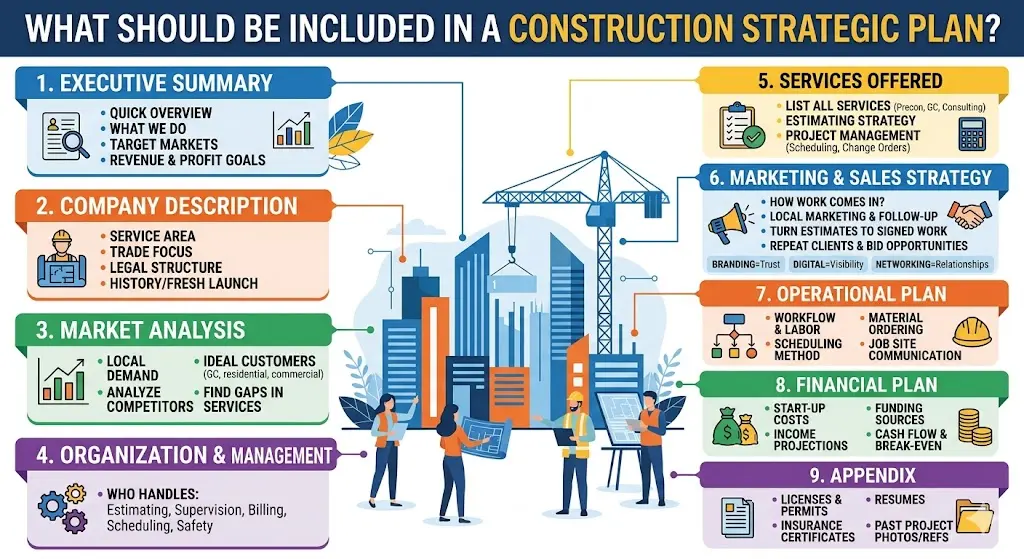
What Should Be Included in a Construction Strategic Plan?
A strong business plan is what is practically and academically sound. It should explain:
- Who are you?
- What do you build?
- Who do you serve?
- How do you estimate the job?
- How do you stay profitable?
The data you have must be capable of helping you explain where the money comes from and where it goes; it is the central goal of a construction operating plan.
Let‘s explore the key elements of a construction roadmap!
1. Executive Summary
It is an executive summary that gives a quick overview of the whole business. In it, you must explain the followings:
- What does the company do?
- Which markets does it serve?
- What makes it dependable?
After answering these questions, add your top goals for the next year or two. Make sure to keep it sharp and practical. Plus, if you need financing, mention the followings:
- Expected revenue
- Profit target
- Growth plans
Tip: Avoid long setup details here because this section should let someone understand your company in one read.
2. Company Description
This section explains who you are and how you work. Here, you need to add the following points:
- Service area
- Trade focus
- Type of projects you work on
Once you have covered the above points, explain the followings in readable and understandable terms:
- Legal structure
- Ownership
- Business history
If you have experience, mention it. However, if you are launching fresh, explain what problem you solve for contractors, owners, or property managers.
Tip: Avoid general “we do everything” language, since it weakens trust.
3. Market Analysis
Market analysis explains where the work is and who competes for it. For this section, start with your local demand, then break down your ideal customer. Answer whether you are working for general contractors, subcontractors, residential owners, or commercial tenants.
After that, analyze competitors, which must be local. Look at their project types, estimating format, response speed, and reputation. By having this data, you can identify the gaps in the services of your competitors and hence fill them in your construction industry business plan.
4. Organization and Management
This is where you show how the business actually runs. Explain who handles everything, including:
- Estimating
- Field supervision
- Billing
- Scheduling
- Safety
- Client communication
If you have a small team, keep it simple. But if you have project managers or estimators, define their roles clearly. Similarly, if you have advisors, bookkeepers, or consultants in the team, include them too.
Contractors often lose money when responsibilities overlap, and nobody owns the consequences. This organization and management section in a construction strategic plan fixes that. By lining up everyone, you can ensure that the job is running fast and flawlessly.
5. Services Offered
List every service you want to sell, then explain each one in understandable terms. Mention whether you handle estimating, preconstruction support, full general contracting, selective trades, or consulting.
Then add your estimating strategy. Some contractors estimate the project by scope, some by unit, and some by markup plus overhead. Whatever you choose, explain it in your construction industry business plan. Also, explain how you manage projects once work starts.
Tip: Focus on scheduling, change management, and quality protection strategies in this section.
6. Marketing and Sales Strategy
This section should answer a simple question: how will the work come in?
A solid construction company business plan needs a realistic shape for leads, referrals, repeat clients, and bid opportunities. Therefore, you must explain the following points here:
- How will you market locally?
- How will you follow up?
- And how will you turn estimates into signed work?
Remember that you do not need a huge budget to start, but you do need a repeatable system.
What Makes a Construction Company Marketing Plan Successful?
● Branding and Positioning
Branding in construction is really about trust. People want to know you show up, communicate well, and finish clean. So your message should match the work you want. If you offer freelance estimating services for general contractors, mention that clearly. If you specialize in fast-turn commercial interiors, highlight that lane.
Plus, your logo matters less than your consistency. The same name, tone, and promise should appear on your truck, website, emails, and proposals. That kind of consistency builds recognition over time. It also helps people remember you when another bid falls apart.
● Building Trust in the Market
Trust grows when clients see proof, not promises. Share real project photos, scope details, testimonials, safety records, and response time. Also, show how you handle change orders and protect schedules.
In other words, make reliability part of your brand. Keep estimates accurate, return calls quickly, and send refined paperwork. That creates a reputation people can describe in one sentence. And in construction, it enables contractors to win more work.
● Digital Marketing Strategies
Your digital marketing should be simple and functional. Start with a fast website, local SEO, and clear service pages. Then make it easy for people to call, request bids, or ask for estimating help.
Remember that you need search visibility in the markets you actually serve. So, add project photos, service areas, and keywords that match how customers search. This type of steady online presence helps fill the gaps between bids.
● Networking and Bidding Opportunities
Profitable jobs still come from relationships. Trade groups, supplier contacts, local builders, and public bid networks can all supply your pipeline. Many companies’ subnet helps large federal prime contractors find small subcontractors, which gives smaller firms another path into work.
So, at the local level, stay active with GCs, architects, property managers, and developers who need dependable support. Also, bid carefully since a selective pipeline protects your margins and reputation.
7. Operational Plan
This section explains how the field side runs from the first call to the final invoice. Here, you need to show the followings:
- Your workflow
- Labor setup
- Scheduling method
- Material ordering process
- Closeout routine
Plus, explain:
- Who checks drawings?
- Who confirms the scope?
- And who handles change orders?
As a contractor, you know that delayed deliveries, confusing work scope, and weak results reduce your margin. Therefore, after the above points, define how you ensure transparent job site communication. In other words, make your construction industry business plan practical by adding how work moves from estimating to execution.
8. Financial Plan
With this data, you get how much money you need, when it returns, and where the risk is, by working on the following details:
- Start-up costs
- Funding sources
- Income projections
- Balance sheet assumptions
- Cash flow
- Break-even points
Tip: Use job costing, overhead targets, and realistic collection timing in financial plans.
9. Appendix
Like professional, modern contractors, you must use the appendix for support documents that back up the plan. Add the followings:
- Licenses
- Permits
- Resumes
- Certifications
- Insurance certificates
- Key supplier contacts
- Past project photos or references (if available)
Note: In construction, trust often comes from proof. A precise appendix shows you are organized and ready to bid or borrow. It also makes it easier for lenders or partners to verify what you mentioned earlier. So, keep it precise and current.
Steps to Write a Construction Industry Business Plan
Step 1: Research and Collect Data
Start by collecting the following details:
- Local data on demand
- Competitors
- Average project sizes
- Standard margins
Plus, look at who wins work in your area and why. Gather estimating patterns, permit requirements, and seasonal fluctuations. This is where you can gather data from past jobs or sample estimates.
Step 2: Set Realistic Goals
Whatever your goals are, they should be practical and measurable. First, set targets for the followings:
- Revenue
- Gross margin
- Lead volume
- Hit rate, backlog
- Data collections
After that, break yearly goals into quarterly targets so they do not feel unrealistic.
Step 3: Estimate the Cost and Make Budget Plans
Next comes budgeting. Estimate the followings:
- Startup costs
- Fixed overhead
- Labor burden
- Equipment needs
- Project reserves
Then separate direct job costs from company overhead to protect your margin.
Note: Construction businesses lose money when they undercount labor, insurance, taxes, or downtime. So, you must avoid this to keep things on track.
Step 4: Risk Assessment and Management
As a contractor, you know that every construction job has risks. Some risk shows up in weather, others in change orders, labor shortages, unpaid invoices, or permit delays. You must avoid them.
How? Write down your top risks and how you will handle them. Then assign ownership.
Tip: Do not leave risk as an unclear warning in the background.
Step 5: Finalize and Present the Plan
Once the estimates and strategy look right, refine the writing and make the plan easy to read. Use short sections, clear headings, and direct language. Following that, tailor the plan version you present.
Build your construction business plan with confidence—research smarter, budget accurately, and plan for growth
Common Mistakes to Avoid in Construction Business Planning
There are some mistakes you must know to avoid when working on a construction company’s business plan. See them below.
● Financial Miscalculations
Inaccurate cost data is one of the fastest ways to lose money. If you miss labor burden, tax load, insurance, or equipment replacement in the construction company strategy, your margin will disappear.
Solution:
Use real job-cost data, add overhead, and review every estimate before it goes out. Then compare estimated versus actual costs after each project. That feedback loop refines future bids.
● Poor Scheduling
A weak schedule creates a mess in the field and the office. Teams wait, materials miss delivery windows, and subs show up at the wrong time. That wastes money and frustrates clients.
Solution:
Build schedules from realistic lead times, not best-case hopes. Include Slack for weather, inspections, and change orders.
● Permitting & Compliance
Permits and compliance issues can freeze a project before it starts. They also create legal and financial risk if ignored.
Solution:
Check permit rules early, assign one person to track compliance, and keep all license records current.
● Subcontractor Vetting
An unprofessional subcontractor can shake project quality, timing, and client trust. One missed deadline often turns into three.
Solution:
Vet every subcontractor for licensing, insurance, references, past performance, and responsiveness. Put expectations in writing before the work starts.
● Undefined Project Scope
When the project scope is confusing, change orders multiply, and arguments follow. That is how contractors’ margin disappears.
Solution:
Define the scope of work clearly, confirm assumptions in writing, and review exclusions line by line. Every estimate should mention what is included and what is not.
● Inadequate Communication
Poor communication slows decisions and leads to rework. Clients feel ignored; the field team gets conflicting directions; and subcontractors make assumptions.
Solution:
Set one communication channel, one point of contact, and one update rhythm. Then document changes as they happen.
● Ignoring Risk Management
A plan without risk management is just optimism in a folder. Weather, supply delays, and financing issues can all hit the job.
Solution:
List top risks, assign responses, and keep contingency funds where possible. Update the risk list as the project changes.
● Weak Safety Management
Safety failures cost more than money. They break client trust, delay jobs, and damage a contractor’s reputation.
Solution:
Build safety into the plan, not just the toolbox talk. Train your team before mobilization, document incidents, and review high-risk tasks before work starts.
● Using Outdated Technology
Old systems slow bids, shake scheduling, and make reporting harder.
Solution:
Use tools that help with cost bidding, project tracking, and document control.
Note: 2026 construction trends point toward more data-driven and AI-supported workflows.
● Poor Quality Control
Quality problems always cost twice as much in a construction project. First in rework, then in reputation.
Solution:
Factor in inspection points into the schedule. Check work at each stage and document it clearly.
What to Add in the Construction Business Startup Cost Plan?
Understanding the construction business startup cost drivers keeps the opening flawless. The following are the points you must add to your business startup budgeting plan.
1. Equipment and Tools
Equipment and tools are the first big expense in any construction strategic plan. Even a simple startup needs the basics:
- Hand tools
- Power tools
- Storage
- Safety gear
- Ladders
- Jobsite tech
For trade-heavy operations, the above list also includes:
- Trucks
- Trailers
- Specialty equipment
Mistake You Can Make:
Many owners plan this category as the biggest fluctuating factor in construction business startup costs. The mistake is buying too much too soon. That ties up cash you may need for payroll or permits.
Solution:
Start with the tools that let you finish the work you already want to sell. Then add more once revenue proves the need. That keeps the budget under control.
2. Labor and Staffing
Labor is not just about wages. However, it also includes recruiting time, training, payroll setup, workers’ comp, and early supervision. If you hire too fast, payroll can disturb your cash flow before jobs stabilize.
So, build staffing slowly and tie each hire to booked work. Note that a small team with clear roles usually beats a bigger team with confusion. Therefore, smart planning is essential.
3. Licensing and Permits
Licensing and permits protect the business, but they also cost money and time. Many small businesses need a mix of federal and state licenses or permits, and the fees depend on the business activity and issuing agency. Coming to their coverage, they include:
- Contractor licenses
- City permits
- Trade registrations
- Insurance certificates.
If you skip this step, you risk fines, delays, or losing jobs you already won. So, consider these costs in your startup budget from day one. It is cheaper than fixing a compliance problem after the construction teams are already on site.
4. Marketing and Operational Expenses
Marketing and operational expenses cover the everyday engine of the business. That includes the following:
- Website
- Domain
- Bid software
- Estimating tools
- Office supplies
- Bookkeeping
- Fuel
- Insurance
Tip: On the operating side, do not forget bank fees, accounting help, and call handling.
Pro-Level Tips to Reduce Construction Business Startup Costs
Keep startup costs under control with the following strategies:
- Buy only what supports booked work.
- Rent equipment before you purchase it.
- Use subcontractors where it makes sense.
- Push nonessential upgrades later.
- Track every dollar spent.
- Calculating startup costs before you launch.
FAQs
What is the purpose of a construction business plan?
A construction business plan shows how the company will win work, control costs, and grow profitably. It also helps lenders, partners, and clients understand the business before they commit.
When to make a construction business plan?
Make it before launch, and update it whenever your market, services, or budget changes. Planning early helps contractors avoid costly guesses and gives them a clearer break-even target.
How to start a construction company?
Start with market research, then choose your services, legal structure, licenses, startup budget, insurance, tools, marketing, and operations plan. After that, work on your first estimates and begin bidding carefully.
What tools can I use for creating a construction business plan?
Use SBA templates, spreadsheet budget sheets, estimating software, job costing tools, and a simple document editor. Start simple, but keep your calculations detailed enough to guide decisions.
Conclusion
A strong plan keeps a construction business from running on hope. It helps estimate work accurately, manage risk earlier, and protect cash when jobs change. It also connects the goals to realistic spending, which is where a reputable growth starts. That is why the construction industry business plan matters in a contractor’s life.