Pocket door installation looks simple from the outside, but the actual game drifts when it comes to its cost. No doubt, it effectively supports space-saving. You can save 9-12 square feet per door with a pocket door option. But, everything can only be done right if you start with an accurate pocket door installation cost. Otherwise, you can spend more than needed.
In this blog, we will break down the cost to install a pocket door, factors that affect its costs, pro tips to save money, and how early estimates make the whole project efficient.
Average Cost to Install a Pocket Door in 2026
It depends on whether you target new installs or rework. Unlike other tasks, where renovation costs less than new construction, retrofit costs more due to the need for wall opening, framing shifts, and finishing restoration. See the table for details in numbers.
| Project Scope | Particular Needs | Pocket Door Installation Cost |
| New build pocket door | Cleaner framing, fewer finish repairs | $550–$1,800 |
| Mid-range retrofit | Wall opening, framing, drywall, trim | $800–$2,500 |
| Complex remodel | Utilities, structural changes, premium finishes | $2,500–$3,500+ |
All these are ranges; for the exact estimate, you must explore the factors that significantly affect the pocket door installation expense.
What Factors Affect the Cost of Pocket Door Installation?
Not only a single factor, but there are many cost drivers that determine the final budget of the door installation. You must understand them all so you can manage them better to keep your project costs as low as possible.
● Location of the Project
Labor, material prices, project schedules, and permit needs everything is affected by the location of your project. For example, a project in a high-wage market usually costs more, even when the door and frame are the same.
Similarly, remote or weather-challenged markets add another layer of expense because laborers lose time on access, travel, and coordination. This means that two identical openings can carry different totals depending on the ZIP code.
See the table below for location-specific pocket door installation costs.
| Location | Cost Drivers | Pocket Door Installation Cost |
| California | Higher carpenter rates and finish labor | $1,150–$3,100 |
| Florida | Lower labor costs than coastal high-cost states | $850–$2,300 |
| Austin, TX | Metro pricing beats statewide averages | $900–$2,350 |
| Colorado | Mid-to-high labor market pricing | $950–$2,600 |
| Alaska | Logistics and labor both push higher | $1,300–$3,400 |
| Texas | Competitive labor, strong supply access | $800–$2,100 |
| Washington | Strong labor market and higher trade rates | $1,100–$3,000 |
Pro Tip: Consider the zip code of your area when estimating the project cost, since it determines the actual spending out of your pocket for installation projects.
● Labor Wages
This is something that varies from place to place. As already mentioned, labor demands are lower in rural areas than in the coastal ones. Plus, every professional charges differently, depending on the nature of their job. For example, national carpenter pay is around $59,310 a year, or $28.51 an hour, while others charge differently. This means that field rates fluctuate significantly once you add layout, demo, framing, drywall, trim, and finish work.
Therefore, door estimators who provide budget estimating services always play with labor by task or trade, like
- A carpenter handles opening prep and pocket framing.
- A drywall finisher closes the wall cleanly.
- And, a painter handles the final surface match.
The bids that contain all this data seem more realistic, increasing the winning chances for contractors and keeping the margin high.
● Materials Used
When it comes to a pocket door material, a basic frame kit can start very low, but a better kit with soft-close hardware, a jamb kit, and a finished slab costs more. For example, a Johnson Hardware 1500 Series pocket door frame costs $114, a soft-close frame costs $147, and a 36-inch jamb kit costs $47.86. Meanwhile, a 24-inch by 96-inch steel frame kit costs $480, and a 36-inch by 96-inch steel frame kit costs $445.17.
Remember that a practical pocket door installation kit budget should cover the frame, track, hangers, guides, pulls, and privacy lock. According to a recent report, a pocket-door lock pricing ranges from about $10 to $40, while pulls and lock combos often fall in the low-to-mid $20s.
● Type of Pocket Door
There are 6 types of pocket doors available in the US market: Single pocket door, Double pocket door, Telescopic/double-double pocket door, Framed pocket door, Frameless/flush pocket door, and Fire-rated pocket door. All costs differ depending on their make, unique characteristics, installation methods, and hardware.
- Simple single-panel setups are easier to frame and finish.
- However, double and telescopic systems need more track work, more alignment, and more patience from the installer.
- Fire-rated units add code-driven hardware and sealing details, which makes them cost more than standard interior doors.
Below is the table showing their installation cost range.
| Type of Pocket Door | Pocket Door Installation Cost |
| Single pocket door | $800–$1,900 |
| Double pocket door | $1,600–$3,400 |
| Telescopic/double-double pocket door | $2,300–$5,000 |
| Framed pocket door | $850–$2,300 |
| Frameless/flush pocket door | $1,200–$3,000 |
| Fire-rated pocket door | $1,800–$4,200 |
Note: The pocket door installation cost increases with the addition of custom track lengths, heavier slabs, or tighter finish tolerances, particularly when you consider sliding pocket doors.
● Size of Pocket Door
Architects, interior designers, builders and contractors decide the door size according to the area’s needs. For example, 24″ x 80″ is best for small rooms and closets, while 36″ x 96″ is best for tall, modern layouts. So the door size depends on the nature of the room.
When the door size fluctuates, the need for materials and labor also change that ultimately affects the project’s total cost. For example, a smaller opening keeps framing simple, while wider or taller doors demand stronger headers, larger slabs, and more careful alignment. Taller doors also push hardware and finishing costs upward because the system must handle more weight and more visible surface area.
See the table below for estimates for different pocket door sizes.
| Pocket Door Size | Pocket Door Installation Cost | Best Fit for |
| 24″ x 80″ | $750–$1,750 | Small rooms, closets |
| 28″ x 80″ | $800–$1,900 | Tight utility spaces |
| 30″ x 80″ | $850–$2,050 | Standard passage |
| 32″ x 80″ | $900–$2,250 | Common for bathrooms |
| 36″ x 80″ | $1,000–$2,500 | ADA-friendly access |
| 36″ x 96″ | $1,300–$3,400 | Tall, modern layouts |
Pro Tip: Keep the slab small and the pocket narrow to reduce the overall project spending.
● Wall Structure
Wall structure decides whether the job is clean or becomes a remodel-heavy work. Non-load-bearing walls make the work easier because the installer can open the cavity, set the frame, and close the wall with less structural correction. However, load-bearing walls need a proper header to transfer the load, and that adds design, labor, and inspection expense. Also, any wall with plumbing, electrical, or HVAC in the pocket zone demands extra coordination.
For contractors and subcontractors, the big issue is cavity depth and obstacle mapping. A pocket door needs a clear wall bay, straight studs, and enough space for the door to retract fully. If the existing wall cannot provide that, the team often removes drywall on both sides, reframes the opening, and then rebuilds the finish layers. All these tasks increase the pocket door installation cost.
● Pocket Door Installation Challenges
You have explored the types of pocket doors above. Among them, retrofits create the biggest headaches. It demands the installer to open the wall, check for hidden systems, frame the pocket, set the track, hang the slab, and then rebuild the finish surface. Therefore, experts say that walls with plumbing or electrical systems cannot house a pocket door without rerouting. When the wall carries a load, teams remove drywall on both sides and install a header that increases the total cost to install a pocket door in an existing wall.
One small obstruction can trigger several follow-on trades; for example:
- A wire move creates an electrical task.
- A pipe creates a plumbing task.
- Then drywall, paint, and trim follow behind it.
That’s why installing pocket doors inside finished walls almost always needs a contingency line, even on a simple bathroom or closet opening.
● Permit & Inspection Fees
Simple interior work may only need a modest fee, while jurisdictions that value projects by cost can charge more. The current 2026 permit guide shows broad ranges from around $150 to $3,000 for building permits. According to them, smaller interior jobs mostly stay near the bottom of that band.
In construction, permits belong to soft costs. Inspection fees, plan review, and reinspection charges can all show up later, especially if the wall work touches the structure or utilities.
Note: Explore more on soft costs in this guide: What are soft costs in construction?
Tips to Save Money on a Pocket Door Installation
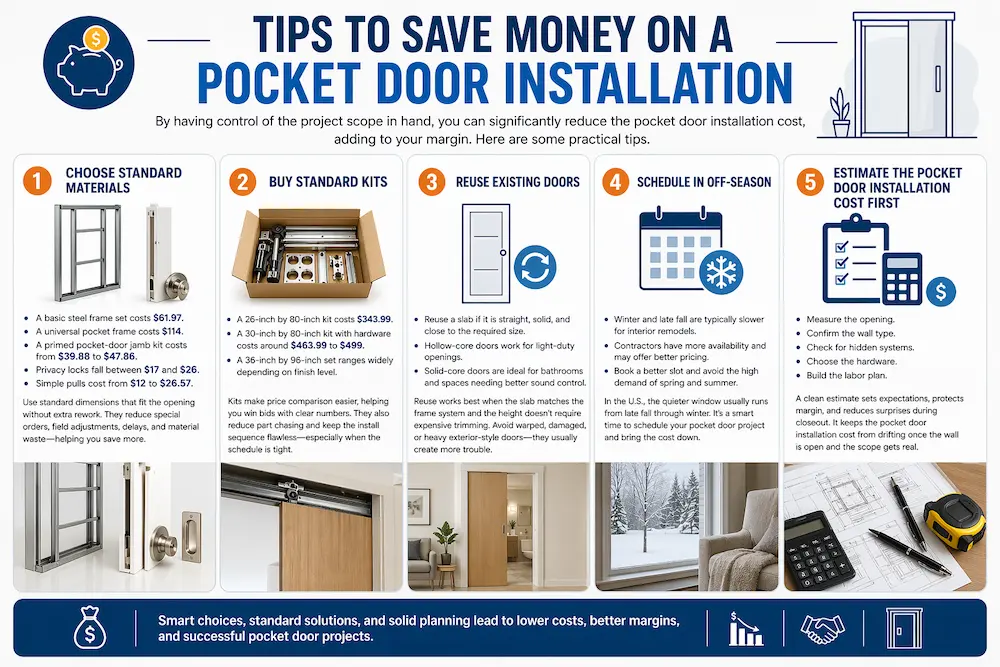
By having control of the project scope in hand, you can significantly reduce the pocket door installation cost, adding to your margin. Here are some practical tips.
● Choose Standard Materials
You can cut many expenses and make your project affordable by making informed choices for materials. Among all pocket door materials discussed above, standard materials always keep ordering simple and labor predictable. For example:
- A basic steel frame set costs $61.97.
- A universal pocket frame costs $114.
- And a primed pocket-door jamb kit costs from $39.88 to $47.86.
- Furthermore, privacy locks fall between $17 and $26 range, and simple pulls can cost from $12 to $26.57.
All are affordable options that also ensure a clean, functional finish that satisfies your clients and improves your market reputation.
This means your actual win comes from using parts that fit the opening without extra rework. Use standard dimensions since they reduce special orders and reduce field adjustments too. That means fewer delays, fewer reworks, and less material waste on the jobsite.
● Buy Standard Kits
A standard kit bundles the moving parts together, and that reduces the pocket door installation cost.
- A 26-inch by 80-inch kit costs $343.99
- A 30-inch by 80-inch kit with hardware costs around $463.99 to $499
And when it comes to a 36-inch by 96-inch set, that range widely in terms of finish level. Simply put, kits make price comparison a lot easier, which ultimately helps contractors win the bid with clear numbers.
Furthermore, a kit reduces part chasing and keeps the install sequence flawless. That helps when the schedule is tight for the targeted project.
● Reuse Existing Doors
Reusing a slab can save money when the door is straight, solid, and already close to the required size. Hollow-core interior doors sometimes work for light-duty openings, while solid-core doors suit bathrooms and other spaces that need better sound control. Reuse makes the most sense when the existing slab matches the frame system, and the height doesn’t force expensive trimming.
Remember that not every door can be reused. Warped slabs, damaged edges, and heavy exterior-style doors usually create more trouble for installers. This means that reuse works best when the slab already fits a standard pocket setup, and the hardware can move over cleanly.
● Schedule in Off-Season
Winter usually gives homeowners more leverage. Interior remodelers often see slower demand after the fall rush, and that can open up scheduling and sometimes pricing. Spring and summer stay busy, while winter and late fall tend to be lower for interior work. For a pocket door, you must book a better slot, avoiding the peak season when demands are high.
In the U.S., the quieter window usually runs from late fall through winter. That is when contractors often have more room for smaller interior projects, which can help bring the pocket door installation cost downward.
● Estimate the Pocket Door Installation Cost First
A winning bid always starts with a line-by-line takeoff. Measure the opening, confirm the wall type, check for hidden systems, choose the hardware, and then build the labor plan. That sequence keeps spending under control.
For project managers, this is where estimating pays off. A clean estimate sets expectations, protects margin, and reduces surprises during closeout. It also keeps the pocket door installation cost from drifting once the wall is open and the scope gets real.
What Benefits Does Pocket Door Installation Estimates Bring?
With precise and accurate estimates, contractors can reduce rework between 2% and 20% on pocket door installation. Moreover, they can ensure informed decision making, mitigate risks, value engineers, save cost & time, & increase bid win chances. Let’s explore each in detail below!
● Informed Decision-Making
A right estimate gives everyone, including the project owner, contractor, and field team, a clearer path.
- Project owners can choose between standard and upgraded finishes.
- Contractors can decide whether the opening needs structural work.
- And laborers can plan the workforce without leaving chances of shortages.
Considering everyone in the project is essential because pocket-door retrofits often touch several trades at once.
So, reliable estimating reduces uncertainty before it turns into change orders, saving cost and time on rework.
● Value Engineering
Early cost estimation enables value engineering that reduces the project cost without affecting the pocket door quality. With this approach, you can replace a pricey finish with a simpler one, choose a standard kit instead of a custom frame, and reduce trim complexity without losing function.
● Effective Risk Management
As a contractor, you must know that problems are hidden inside the wall when you work on a pocket door installation project. Knowing all these hidden issues early is essential for risk mitigation; otherwise, you can waste a lot of time and money.
You can achieve this goal by having a comprehensive list of estimates as they flag hidden wiring, plumbing, load-bearing concerns, and finish repairs before the work begins. Knowing them early enables you to cut all these problems, hence eliminating the rework needs. Additionally, risk control protects the project schedule. In simple words, a pocket door installation project with fewer surprises is easier to sequence.
● Increased Bid-Win Chances
Comprehensive estimates enable contractors to make their bids impressive with realistic numbers. When you submit the bid, clients see that you have factoid in everything, including materials, labor, project location, equipment, overheads, contingencies, etc. All these details make your bid look impressive, increasing your winning chances.
Get accurate pocket door installation estimates today and take control of your costs, reduce risks, and win more bids with confidence.
Commonly Asked Questions
How are pocket doors a space-saver?
A pocket door slides into a hidden wall cavity instead of swinging outward. It saves floor space, works well in tight rooms, and needs a clear framed pocket, track, and aligned hardware.
What makes a pocket door costlier than a simple door?
They cost more than a standard interior door because of the needs for opening the wall, reframing, and reclosing. The hardware also needs tighter alignment, especially in retrofit work.
Can you put a pocket door in an existing wall?
Yes, but the wall must allow enough space and should not hide major utilities without rerouting. Existing-wall installs usually cost more because they involve demolition, framing changes, and finish restoration.
Conclusion
Pocket doors save space, but they need careful planning, particularly when it comes to spendings. The pocket door installation cost depends on wall structure, labor rates, door type, size, finishes, and permit needs.
Retrofit jobs cost more because they involve framing, drywall, and sometimes utilities. With smart estimating, you can keep the budget grounded and the schedule on point. This means that starting the project with estimates before the wall opens is a profitable option.
Like other contractors who mostly don’t have time for estimating headaches, you can outsource services and benefit from a professional’s expertise. Contact Cost Bidding for a quick quote now!