
Wondering, how many shingles in a bundle do you actually get? At the start of every roofing project, most contractors ask this question. Not knowing the answer to it at such an early step can cause you to overpurchase materials or, even worse, run out during the installation process.
The majority of homeowners and contractors use the number of bundles to get an estimate of the roofing cost. Still, most of them do not know how the numbers relate to actual coverage. A typical single bundle will cover approximately 33 square feet of roof area, though this may vary a little.
It is the reason why you need to be accurate when estimating before making an order. Knowing the number of shingles in a bundle can help you calculate the number of roofing squares, minimize waste, and be able to budget. This blog will act as a step-by-step guide to all the details.
What Exactly Is a Shingle Bundle?
A shingle bundle is a packaged bundle of shingles used on the roof that is grouped by the manufacturer to facilitate easy transportation, storage and installation.
When you know how many shingles in a bundle, you would automatically be aware of how roofing work remains in order between supply and installation. The average size area of a roof that a standard bundle will cover is approximately 33 square feet, and this may be slightly different depending on the type of shingle and brand.
Reasons Why Shingles Are Bundled
Shingles are bundled by manufacturers due to practical reasons. The roofing materials may be sold in a hard-to-handle state at the site because they may be heavy and bulky. Bundling maintains the shingles in the shipping process, minimizes the damage and enables roofers to take manageable amounts up the ladders or across the roof.
Estimation is also simplified with each bundle. Single shingles are not counted by contractors in a roof. They instead compute bundles by roof area, which spares time and minimizes errors in the planning process.
After you have a clear idea of the purpose and scope of a bundle, it is much easier to predict what you will need in your material and prevent an expensive error in your roofing project.
Types of Shingles and Pieces per Bundle
Not all shingles are uniform in size and shape. The style of shingles, their thickness, and their layering are also other checks you need to do to determine the count of the shingles in a bundle.
Standard / 3-Tab Shingles
The most common and easiest to use in residential roofing are the standard 3- tab shingles. The average bundle is made up of 26 to 29 shingles in a bundle. These shingles are thinner and lighter. Plus, this attribute enables manufacturers to add more pieces to a package. They are frequently used by contractors in low-cost roofing projects and straightforward roofing designs.
Architectural Shingles
Laminated shingles are also called architectural shingles and have a sturdier design. Due to the additional layers and weight of each shingle, the bundle typically has approximately 21 shingles. Although you receive less of it, you have a higher quality of durability, wind resistance and a more exclusive look.
Why Thicker Shingles Have Fewer Pieces?
Heavy shingles occupy more space and are heavier. Therefore, the manufacturers trim down the pieces in a bundle to make it manageable. The balance will be such that roofers are in a position to carry and install bundles without jeopardizing the quality of the materials.
| Shingle Type | Pieces per Bundle | Key Feature |
| 3-Tab Shingles | 26–29 | Lightweight, cost-effective |
| Architectural Shingles | ~21 | Durable, layered, premium look |
Understanding Roofing Squares
One of the most crucial terms of roofing that you should be aware of before you can estimate the material requirements is the roofing square. This system eases the measurement task and eliminates confusion among contractors in estimating materials. Rather than doing the sums using the large numbers, roofers divide everything into squares in order to do the sums faster and more accurately.
| How Many Square Feet In A Pack Of Shingles? |
| A pack or bundle of shingles has an average size of 33 square feet, and therefore, to cover 1 square of roofing 100 sq ft, you would require an average of 3 bundles. |
This simplified transformation helps the contractors to estimate the materials without having to over-calculate all measurements. Remember, they are not to compute single shingles, but at first to figure out the total area of the roof in squares, and then to multiply the number of bundles by the square.
This approach is important to professional roofers as it helps minimize errors, increases the speed of the planning process and ensures that material is ordered similarly for various roof sizes and designs.
Measure How Many Bundles of Shingles for an 8×10 Roof Via This Method
Tackling a small roofing job like an 8×10 dimensional roof may seem like a piece of cake, but it isn’t! Every unit price can make or break the entire estimate and ultimately lead to underestimation and cost overruns. That’s why it is necessary to take everything into account and stay extremely precise at all times. Here is a three-step plan to estimate bundles for a small (8×10) sized roof:
Step 1: Calculate Roof Area
Begin by determining the area of the roof:
8 × 10 = 80 square feet
Step 2: Convert Area into Bundles
Now use the standard coverage rule. A single bundle of shingles is about 33 sq ft.
80 ÷ 33 = 2.42 bundles
This would require you to have at least 3 bundles to cover the roof.
Step 3: Add Waste Factor (Very Important)
In roofing, there are no precise numbers. You are constantly working with cuts, overlaps and minor design changes. This is why professionals include an additional 10-20% of material.
For an 80 sq ft roof:
- 10% waste = 8 sq ft extra
- Adjusted total = ~88 sq ft
- 88 ÷ 33 = 66 bundles → still 3 bundles minimum
| Quick Estimation Formula For Any Roof |
| You can use this simple formula for fast estimation:
Total Roof Area ÷ 33 = Bundles Needed |
How Many Shingles in a Bundle of Roofing Shingles?
In a roofing project, basic bundle knowledge is not enough. You need the real figures. Besides, finding our the exact number of shingles in a bundle can help you determine how much of the roof you need when it comes to more than just a couple of areas. We will deconstruct it using practical examples to enable you to have confidence in planning.
Roofing Estimates by Roof Size
2000 sq ft Roof
- 2000 ÷ 33 = ~61 bundles
- Add waste (10–15%) = 67–70 bundles total
- Depending on the type, shingles can be different, although one can expect about 1400-1500 shingles in total.
2500 sq ft Roof
- 2500 ÷ 33 = ~76 bundles
- With waste factor = 84–88 bundles
- There can be 1800-2000 shingles pieces of any type of shingles.
3500 sq ft Roof
- 3500 ÷ 33 = ~106 bundles
- With waste adjustment = 115–122 bundles
- The maximum number of pieces in total shingles can exceed 2500.
Why These Numbers Matter
Correct estimation can assist in protecting your budget and prevent any deficits in the middle of the project. The smallest miscalculation may delay the process of installation or increase the costs due to emergency purchases of materials.
Scaling any kind of roof without extra time or breaking the bank is possible only if you understand how many shingles a bundle of roofing shingles holds in real time.
That’s what we already streamline for you in the prescribes 3-step plan.
Why Roof Pitch / Slope Matters?
Roof size does not always tell the full story. The slope or pitch of a roof directly changes how much surface area you actually need to cover. That is why two roofs with the same area can require very different material quantities.
Apart from understanding the number of shingles in a bundle, you must also assess the influence of roof pitch. The fact that the shingles cover a higher vertical elevation, rather than a horizontal plane base, increases the surface area of the roofs. We will explore it in detail using the factors listed below:
Roof Pitch Multipliers Explained
Multipliers of roof pitch are used by contractors to convert flat measurements to actual roofing surface area:
- 3/12 pitch → 1.031 multiplier
- 6/12 pitch → 1.118 multiplier
- 9/12 pitch → 1.25 multiplier
- 12/12 pitch → 1.414 multiplier
The steeper the roof, the greater the multiplier. Ultimately, more shingles will be needed.
Example Calculation
- Suppose you have a home with a 2000 sq ft area with a 6/12 roof pitch:
- Base area = 2000 sq ft
- Apply multiplier = 2000 × 1.118 = 2236 sq ft adjusted roof area
Now convert into bundles:
- 2236 ÷ 33 = ~68 bundles
- Add 10–15% waste = 75–78 bundles total
Why This Step Matters
Many people ignore roof pitch and later on suffer at the hands of the understimation of materials. Such an error causes delays, additional expenses and inappropriate shingles in the process of installation.
After you put slope into the equation, you have a realistic picture of what you need in materials. That’s not the only perk. You also enhance the accuracy of your overall estimation.
Ordering Extra Bundles: Tips for Planning
Smart roofing projects don’t stop at basic calculations. Although you may be aware of how many of the shingles in a bundle there are, you still have to manage the real-world conditions that influence installation and long-term maintenance.
Why You Should Always Order Extra Bundles
When it comes to takeoffs for roofing, numbers are not 100% correct all the time. This is why specialists always stock up additional material to prevent delays and false orders.
Complex Roof Shapes
Valley roofs, hip roofs, dormers or multi-angle roofs are cut and overlapped more frequently. The designs consume more material at a faster face. Thus, additional bundles are necessary to ensure availability when the time comes.
Future Repairs
The damage to shingles can be caused by weather, impact or age in the future. By keeping additional bundles of the same lot, you guarantee perfect matching of the colors when doing repairs.
Limited Edition or Special Colors
As said earlier, shingles come in various types. Industry is filled with limited edition shingles wil special colors. When you run outon those you might not get a perfect match in the future, which impacts the appearance of the roof.
How Much Extra Should Your Order?
The majority of contractors suggest adding:
- 10–15% extra for simple roofs
- 15–20% extra for complex roofs
This buffer cushions your project against shortage and last-minute delays.
Proper Storage Tips for Shingles
Purchasing additional shingles will only be beneficial when you keep materials in order. Shingles can be ruined by the time they get installed due to poor storage. Here are some tips to improve storage capacity and longevity:
- Store bundles on a flat and dry surface
- Store them in the shade and dryness.
- Avoid stacking them too high to prevent bending
- Keep them in a waterproof tarp in case they are stored outside.
DIY vs Hiring a Professional Roofer
When you think of a roofing project, the question that comes to mind is whether you do it yourself or call for a professional. Although you know how many shingles in a bundle, it still needs skill, precision and safety consciousness to install them.
When DIY Makes Sense
Self-help roofing may be applicable under certain conditions. You can consider it if:
- The roof is small, simple, and low in height
- The design has no complex slopes, valleys, or cuts
- You already have basic roofing experience and proper tools
Why Hiring a Professional Often Saves Money
An experienced roofer is a professional who minimizes costly errors. They understand that proper measurements and material acquisition are necessary to install shingles with precision.
Moreover, these guys assist in making sure that they purchase an ample amount of materials. Ignoring them and going for DIY is one of the most common reasons why most of the homeowners incur higher costs. Here are some reasons why you should call a professional:
Safety Comes First
There are high risks involved in roofing. Steep slopes and heavy packages are some of the factors that expose one to injury. Professionals ensure safety equipment is used, correct techniques are practiced, and workers coordinate in groups to minimize the risk.
Quality That Lasts Longer
A roof installed by professionals is stronger and not easily damaged by the weather. Professionals also ensure that alignment is proper, there is fastening, ventilation, etc. All of this increases the durability and energy efficiency.
Common Mistakes to Avoid
Construction projects related to roofing usually fail due to minor yet expensive errors. Poor planning or decision-making can still hit you, no matter if you know how many shingles in a bundle. Here are the most common mistakes to watch out for in your shingles buying and installing journey:
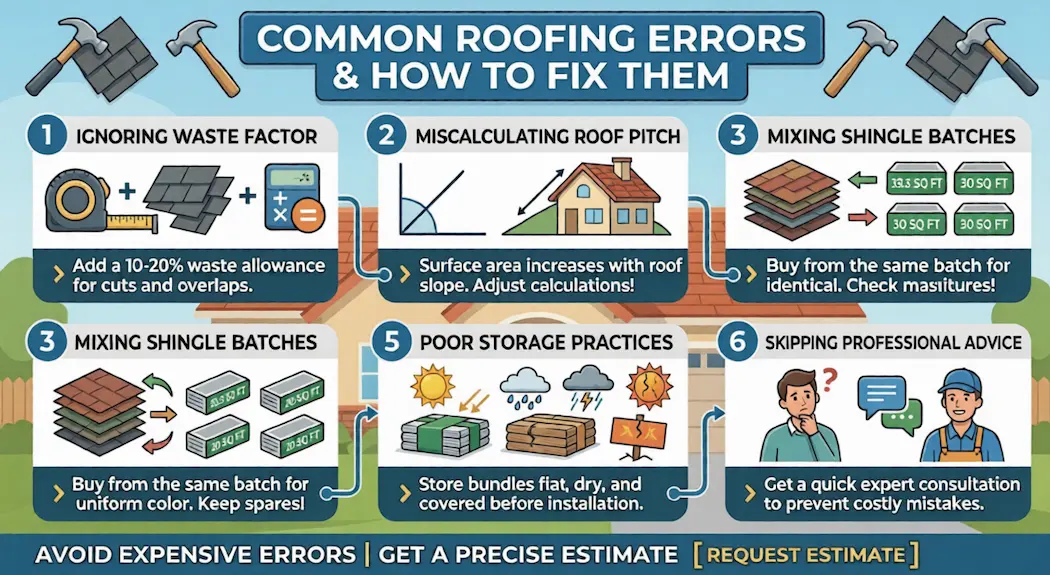
1. Ignoring Waste Factor
There are always cuts, overlaps and adjustments to roofing that cause the loss of significant amount of materials. As long as you do not use the 10-20% waste allowance, you stand a chance of exhausting the job before completing it.
2. Miscalculating Roof Pitch
Most homeowners simply take the flat area and disregard the slope modifications. This causes the underestimation of total material requirements. The pitch of the roof directly correlates with the surface area; therefore, you need to consider it in all calculations.
3. Mixing Different Shingle Batches
The purchase of shingles in different batches will produce visible differences in colour on the roof. It is always best to have sufficient bundles at a time and have spares of the same production run in case of repair.
4. Overlooking Bundle Coverage Differences
All of the shingles do not have the same coverage. When all the bundles are assumed to have an identical area, estimates are inaccurate. Before calculating, always check the manufacturer’s specifications.
5. Poor Storage Before Installation
Before shingles are on the roof, improper storage may cause damage to them. Bending, sticking, or cracking can be brought about by the presence of moisture, heat, or unequal stacking. Bundles should always be kept flat, dry, and covered.
6. Skipping Professional Advice
Doing it alone without any instruction from a professional turns out to be costly at the end. Although you may prefer DIY, a brief visit with a roofer will help to avoid significant errors.
Stop Guessing Material Requirements
Avoid costly errors, miscalculations, and material shortages on your next project. Get a precise material takeoff from our estimating experts.
Conclusion
Accurate roofing practices is all about knowing the fundamentals. The very first step is to know how many shingles in a bundle. After mastering the bundle coverage, roofing squares and pitch changes, estimating the roofing projects becomes easy.
All your calculations, big and little, such as repairing a roof or putting one on altogether, must be based on proper estimation. By doing the right things, you will not run out of materials, minimize unnecessary expenses and keep your project on time.
Roofing does not need to be complicated, separated into easy parts. You are now aware of how to calculate bundles and how to plan for real-world conditions such as slope and waste.
If you do not want the hassle to do all of that yourself, contact our team and get a estimation and takeoff services from our experts in a click.
FAQs
How many shingles are in a standard bundle?
A typical bundle has approximately 26 to 29 shingles with 3-tab shingles. Architectural shingles are generally fewer, with about 21 shingles per bundle, as they are heavier and thicker.
How many bundles of shingles do I need for a 10×12 roof?
A roof size of 10x 12=120 square feet. A bundle is approximately 33 sq ft, so you will need approximately 4 bundles. In addition to the waste factor of 10-20%, 4-5 bundles may be needed to provide a safe cover.
How many shingles are needed for a 1000 sq ft roof?
On a 1000 sq ft roof, the number of bundles per 33 sq ft:
- 1000 ÷ 33 ≈ 3 bundles
- With waste included, plan for 33 to 36 bundles
The number of shingles will depend on the type of shingles, but it typically amounts to 700-900 shingles.
Does roof slope affect shingle requirements?
Yes, the slope of the roof has a direct influence on the material requirements. The steeper the roof, the larger the surface area, and the more shingles are needed. Roof pitch multipliers are used by contractors to correct the calculations and make the correct estimates prior to ordering the materials.