In 2026, construction delays have become more expensive than ever. With continuously increasing material costs, labor shortages, and economic uncertainty, even a small delay can turn into a major financial hit, which often results in 10-30% cost overruns that directly reduce contractors’ margins.
That’s why mastering construction delay claims is now essential for contractors and builders. This guide is on exactly how delay claims are analyzed and calculated.If you are looking for a reliable best construction estimating company, accurate cost planning is the first step before handling delay claims. Let’s start!
What is Meant by Construction Delay Claims?
A construction delay claim is your formal way of asking for more time or extra money when things go out of your control and affect the project schedule. Owners and clients review these claims to determine who should cover the additional days and costs.
As already mentioned, these claims mean a lot this year. According to a recent report, ~98% of construction projects experience delays of an average timeline extending by 37% longer than estimated. In addition to that, the global (war) tensions are causing labor shortages and a sudden increase in material prices. This further makes every extra day on the construction site much more expensive.
How Construction Delay Claims Work?
With a solid claim, you can recover your extended overhead, those escalating material and labor costs, and the productivity you lost, basically protecting the margin you worked hard to build. And it all starts with comparing your original baseline schedule to what actually happened on the ground.
Good documentation is everything in this game. If you’ve got clear records, you prove your case, get paid what you’re owed, and avoid those long fights that waste your time and reduce your profit.
Note: This can only work when you know the types of construction delays and plan things accordingly.
What are the Types of Construction Delays?
Classify delays early, since it helps in making the right decisions whether you want to recover time, money, or both.
-
Excusable Delays
These are the delays of events you could control on the construction site. Examples include harsh weather conditions, owner-directed changes, or unexpected site conditions. In 2026, the year of global conflicts, supply chain issues (from international conditions) are also considered as excusable delays. You can back them up with supplier letters, shipping records, and daily logs. And, for these delays, you can give a solid reason to the owner so that he verifies and gives you the margin you need.
-
Non-Excusable Delays
These are exactly the opposite of excusable delays and stem from your side or your subcontractors. Examples include late starts, poor sequencing, or reworks. As this is your side’s mistake, you must identify its root cause by reviewing your own records. And when identified, find and implement the solution before you face a significant loss.
-
Compensable Delays
This delay is due to the project owner, due to owner-caused problems, like late approvals or design errors. This means you can claim both time and money for compensable delays. And you can recover field overhead, home office costs, and direct impacts. Just prove to the owner that the delay is caused by his mistake and get the compensation.
Note: Don’t play a blaming game, and come with solid evidence, so things keep moving flawlessly.
-
Concurrent Delays
The combined mistakes of both parties cause these delays: project owners and contractors/builders. Here, you can get a time extension but face issues with full cost recovery.
What are the Top 5 Causes of Construction Delays?
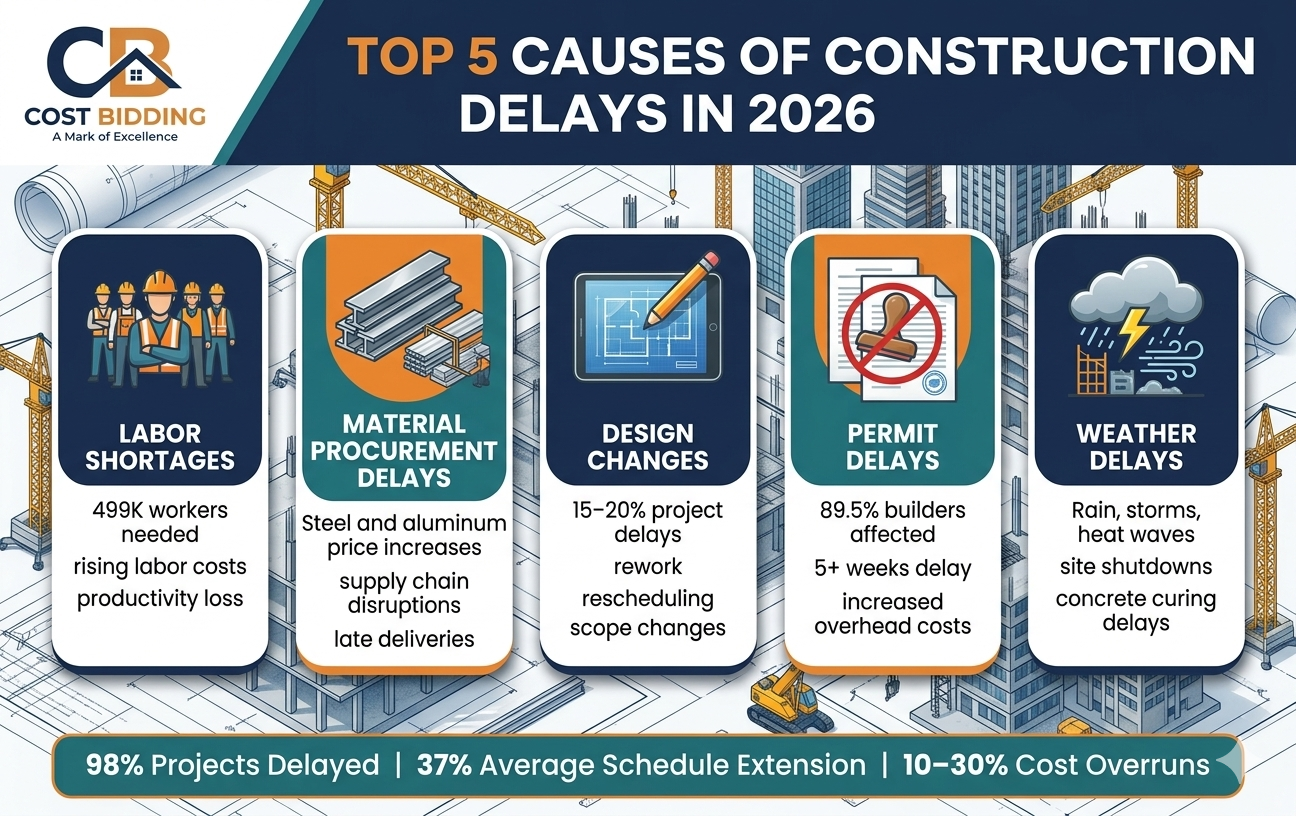
Above, we have given some causes in general; here are the detailed ones.
-
Labor Shortages
Today, the construction sector needs 499,000 new workers. Why? To meet the demand of the increasing construction market. And as the labor is already short, the available ones are increasing their demands by 4.2% yearly.
Furthermore, when this labor shortage hits, your project gets delayed. And when you hire new workers every day to complete the tasks, the project quality gets affected due to productivity loss. In this situation, you must track daily headcounts and actual output to strengthen your records.
-
Material Procurement Delays
Many construction materials, like steel, aluminum, and specialty elements, experience continuous fluctuation in prices due to tariffs and logistics. According to 2025 records, aluminum prices increased by 22% and steel rates raised >13%.
How does this influence the construction project timeline? The back-end game is all about procurement, which is a sequenced process of sourcing, buying, and managing the construction materials required for the targeted project.
Well, preventing and dealing with these disruptions demands proper planning and tight documentation, and that’s where construction takeoff services really come in. They give you accurate quantities and allow for smart material planning early on, before you even commit to buying anything.
Simply put, when materials fail to arrive on time, they cause project delays. In this scenario, you must watch lead times stretch, document every late delivery with emails, invoices, and photos of idle workers.
-
Design Changes
15% to 20% of the construction projects get delayed due to design changes, which is followed by scope modifications. When things change in the blueprints, it affects the complete workflow and forces teams to invest time in rework. Rework means demolishing the finished work, reordering required materials, rescheduling subcontractors, etc.
All these points break the rhythm of construction. To deal with them professionally, you must implement a strict change order process, build time buffers into the schedule, and use centralized digital models.
-
Permit Delays
Like design changes, delays in permits mostly delay the complete construction project. According to the NAHB recent survey, ~89.5% of the builders have experienced >5 weeks of project delays due to late permits. Simply put, without a permit, your team can’t start construction, which means the work will not start on time. Furthermore, this demands that contractors reshuffle labor teams and material deliveries.
These are the setbacks that add to the project’s total cost in the form of increased overhead spendings, cash flow issues, and raised material prices. To avoid that, you must ensure to submit a complete permit set early while maintaining clear communication with authorities, and regular tracking and recording.
-
Delays Due to Weather
Bad weather conditions, like heavy rain, heat waves and storms, can slow or sometimes even stop the workforce at construction sites. These conditions make the site unsafe and impractical, and hence stop labor on site.
When it comes to proving the impact of bad weather on construction delay claims, compare actual site conditions with NOAA historical weather data, as well as track and record all the happenings with photos and time-stamped documentation. This helps contractors and builders show when a particular event happened and affected the project timeline.
Concrete work is especially sensitive here. Before you execute the project, you must know how long concrete takes to dry. For curing, it takes 24-48 hours, and for complete setting, it takes ~28 days. And in case of unfavorable weather, both durations can increase and delay the project.
How does Critical Path Method (CPM) Analysis Help?
You can expertly deal with all the above-mentioned causes using the critical path method (CPM). This method shows exactly which activities extend the project due date.
What is CPM Scheduling?
CPM scheduling is a project management technique. It maps all the construction-site tasks with their durations and dependencies. Using this method, you can identify the longest path through the project. Experts use software, like Primavera or MS Project, to maintain logical ties. When using these tools, make sure you update data regularly to reflect reality.
How Do Critical Path Delays Affect the Project Due Date?
First, understand what a critical path is. It is a long journey of many dependent construction activities that must be completed on time. If one gets affected, the complete sequence will be influenced. Examples include foundation, site preparation, excavation, structural framing, roofing, drywall, insulation, etc.
Note: Delays on non-critical activities usually do not affect the completion date unless they use up all the float.
What is Float and How Does it Lead to Schedule Slippage?
Float is the extra time available to complete a task without delaying the overall construction project. It acts as a safety cushion when minor delays occur. However, once all the floats are used up, any further delay can affect the project schedule and completion date.
Therefore, you must monitor floats in every schedule update. It helps identify when a small delay is no longer harmless and has started to create a real scheduling problem.
What are the Common Delay Analysis Methods?
Understanding different delay analysis methods is essential to make the right choice based on your project records and contract terms. And this is where construction documentation services help contractors and builders organize and validate claim records.
Explore the most common methods below!
As-Planned Vs As-Built Analysis
This method revolves around the comparison of the original project schedule and what actually happened on site.
- In an as-planned schedule, you see how the job was supposed to run.
- In an as-built schedule, you see the real-world sequence of work.
By comparing them, you can easily identify where the project timeline gets affected. Using this method, you can also see missed milestones and resequence the activities.
Note: This method only works when a team has clear records of real-world happenings on the job site.
Time Impact Analysis (Tia)
Using this method, you can assess construction delays by integrating each delay event into the project schedule and measuring its effects on its due date. Simply put, this method shows how long a particular event adds to the project’s estimated timeline. It is commonly used in claims because it clearly links delays to schedule impacts.
Windows Analysis
Windows Analysis divides a construction project into smaller time periods and reviews delays within each period separately. By comparing planned and actual progress during each window, contractors and builders can see how delays developed over time. This method provides a more accurate picture of changing project conditions and schedule performance.
Measured Mile Analysis
This method is all about comparing the productivity of the workforce during normal working hours and the delayed hours (which may be due to disruptions or changed conditions). When you know the clear difference between both, you can calculate how much efficiency was lost on the job site as well as estimate the resulting cost.
Forensic Schedule Analysis
It is a detailed investigation used to determine why a project was delayed and who was responsible. Experts review schedules, updates, daily reports, and project records to reconstruct what actually happened. And this method is often used in major claims and litigation.
How to Calculate Delay Damages?
Use this formula:
Total delay damages = Field office overhead + Home office overhead + Labor escalation + Equipment costs + Material escalation − any credits
-
How to Calculate Field Office Overhead Costs?
It is the daily site cost for trailers, utilities, supervision, security, and similar items. Use the formulae below for the calculation:
Daily field overhead = total site overhead ÷ project days
Delay damage = daily field overhead × delay days
For example, if site overhead is $90,000 for 30 days:
Daily field overhead = $90,000 ÷ 30 = $3,000 per day
For a 30-day delay:
Delay damage = $3,000 × 30 = $90,000
-
How to Calculate Home Office Overhead Costs?
It is where estimators cover company-wide costs, including office rent, salaries, admin, and insurance, that are not tied to one job. Here, first use this formula:
Allocated overhead = total home office overhead × (project billings ÷ total company billings)
Then, calculate the daily rate and damages using the equations below:
Daily rate = allocated overhead ÷ project duration days
Damages = daily rate × delay days
For example, if home office overhead is $600,000, project billings are $2,000,000, and total company billings are $10,000,000:
Allocated overhead = $600,000 × (2,000,000 ÷ 10,000,000) = $120,000
And if the job runs 240 days:
Daily rate = $120,000 ÷ 240 = $500 per day
For 30 delay days:
Damages = $500 × 30 = $15,000
-
How to Calculate Labor Escalation Costs?
This is the extra labor cost caused by wage increases, overtime, or lower productivity during a delay period. In 2026, it also connects directly to broader construction cost escalation, where inflation pushes up overall labor and project costs beyond the original estimate. That means even if your team size stays the same, your actual spending can still increase due to increasing market rates.
Use the formula below for labor escalation cost calculation:
Labor escalation = actual labor cost − planned labor cost
For example, if…
Planned wage = $30/hour
Actual wage during delay = $34/hour
Hours worked = 1,000
Planned labor cost = 1,000 × $30 = $30,000
Actual labor cost = 1,000 × $34 = $34,000
Labor escalation = $34,000 – $34,000 = $4,000
Suggestion: If overtime was used, include the overtime premium too.
-
How to Calculate Equipment Costs?
It is where you factor in idle/free equipment, extended rentals, or extra ownership time. Use the following formula for the calculation of equipment damage cost:
Equipment damage = extended equipment cost + idle time cost − discounts
For example, if..
Monthly rental = $6,000
Delay extension = 1 month
Standby discount = $1,000
Equipment damage = $6,000 − $1,000 = $5,000
-
How to Calculate Material Escalation?
This is the increase in material price between the planned buy date and the actual buy date. Use this formula for material escalation estimate:
Material escalation = actual material cost − planned material cost
For example, if…
Planned steel cost = $50,000
Actual steel cost after delay = $58,000
Material escalation = $58,000 – $50,000 = $8,000
Note: If freight or taxes changed, add those too.
What Documentation is Required for Delay Claims?
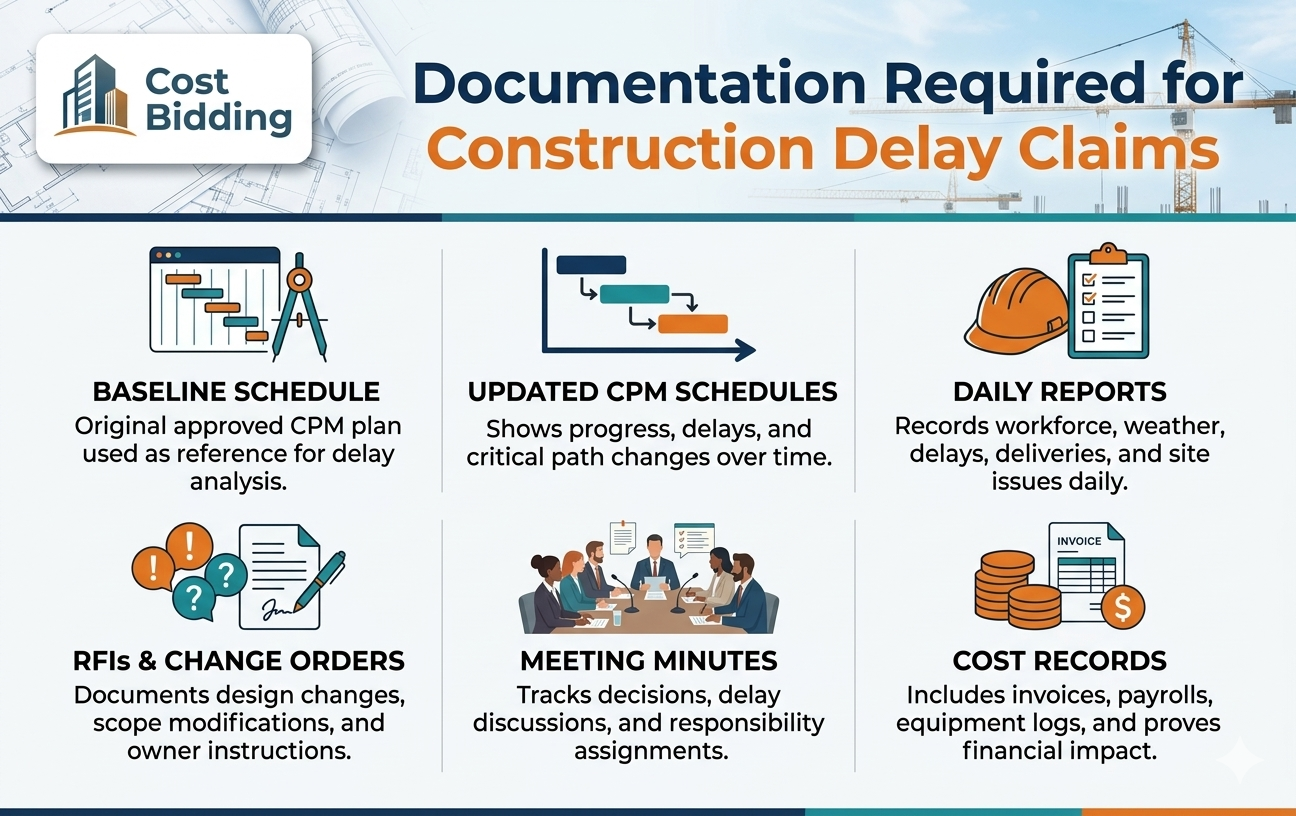
You can only benefit from the claim by presenting solid documentation. So, keep records of the following from day 1.
- Baseline Schedule
- Updated Cpm Schedules
- Daily Reports
- Baseline Schedule
- Updated Cpm Schedules
- Daily Reports
What is Baseline Schedule & How Does it Help?
The baseline schedule is the original CPM plan approved before work begins. It shows the planned sequence, durations, milestones, and logic ties for the project. This document becomes the reference point for measuring delay, since you compare actual progress against what was supposed to happen from the start.
What Do Updated CPM Schedules Show?
Updated CPM schedules show how the project changed over time. They reflect actual progress, delays, resequencing, and shifts in the critical path. These updates are important because they prove when the job started slipping and how each delay affected the planned completion date.
How Daily Reporting Supports Construction Delay Claims?
Daily reports record what happened on site each day. They usually include workforce, weather, deliveries, equipment use, and any problems that slowed work. These reports are valuable because they capture delays immediately, while the details are still fresh and easier to prove later.
What Registration & Change Orders Records Show?
RFIs and change orders create a written record of design questions, scope changes, and owner-directed changes. They help show why work was delayed or altered. In a claim, these documents are useful because they connect the delay to a specific issue instead of a vague site problem.
How does Meeting Minutes Documentation Help?
Meeting minutes document what was discussed and decided during project meetings. Signed minutes are especially useful because they show that delay issues were raised, acknowledged, or assigned for action. They help prove notice, responsibility, and the timeline of events when disputes arise.
What is the Role of Cost Records in Delay Claims?
Cost records show the actual money spent because of the delay. These include invoices, payroll reports, equipment logs, and purchase records. They are essential because delay claims are not just about time; they also need proof of real financial impact and extra expense.
What are the Common Mistakes in Delay Claims?
| Common Mistake | What Does It Mean? | How Can You Avoid These Mistakes? |
| Poor Documentation |
|
|
| Missing Schedule Updates |
|
|
| Late Claim Submission |
|
|
| Ignoring Concurrent Delays |
|
|
How Professional Estimators Help With Construction Delay Claims?
Construction delay claims are complex. They involve schedules, costs, and proof that must line up. Industry reports show construction disputes often take over a year to resolve, which means weak claims can easily get stuck or reduced during negotiation.
Professional estimators help, as they turn project data into precise numbers. They separate real critical-path delays from minor issues, calculate accurate time impact, and connect delays to actual costs, like overhead and labor escalation. They also know what evidence matters most and how to present it in a way that supports the claim. This ultimately reduces errors and makes the claim harder to challenge.
Conclusion
Construction delay claims in 2026 are not just about lost time. However, they are about protecting margin, proving responsibility, and recovering the real cost of disruption. The projects that handle delays well are the ones with precise schedules, strong daily records, clear change documentation, and a proper delay analysis method that matches the facts of the job.
That is where professional support makes the difference. Cost Bidding helps contractors, subs, and builders turn project records into defensible delay claims, accurate cost calculations, and clear supporting documents that stand up in negotiation or dispute. If your project is already getting out of control, do not wait until the loss gets bigger.
Contact us today to get expert help with your construction delay claim and protect the money your project has already earned!
FAQs
How long do I have to file a construction delay claim?
Usually, your contract controls the deadline. Many construction forms use short notice periods, and some standard forms require notice within 28 days of learning of the event. Treat it as a time bar: send a written notice immediately, then follow with the fuller claim package.
Can I claim profit in a delay claim?
Usually not on the original work. Profit is generally not recoverable unless the contract clearly allows it. Delay claims are usually built around extended overhead, escalation, and disruption costs, with profit only possible where the contract or governing law specifically permits it.
What role does weather play in 2026 claims?
In 2026, weather claims are tested against NOAA climate normals and historical records for that location and season. If rain, heat, or storms were worse than normal expectations, the delay is easier to frame as excusable.