A cubic yard is a standard measuring unit used for calculating the quantities of various construction, landscaping, and gardening projects. For concrete, gravel, soil, mulch, and other bulk materials, the measurement of volume is done using cubic yards.
Have you ever wondered how many cubic yards of concrete would be required for my slab? To find it, you must know how big a cubic yard is, whether you’re working on a landscaping project or for research purposes. Understanding the exact measurement method can help you ensure accuracy and efficiency.
Understanding these volume measurements is a crucial part of construction cost estimating, as it ensures you order the exact amount of material needed for your project.
What Is a Cubic Yard?
A cubic yard is a unit of volume that is equal to a cube with a width, length, and height of 1 yard or 3 feet.
In simple words, suppose a cube where each edge is about 3 feet long or 1 yard, just for an idea to understand how big a cubic yard is. A standard washing machine or a large kitchen stove is about the same size as a 1 cubic yard.
The cubic yard is a unit of volume and is based on the international yard. It is equivalent to 0.764555 cubic meters, 765.6 litres, and 27 cubic feet.
How to Calculate Cubic Yards
Measuring a cubic yard is quite a simple task. You are simply measuring volume. The most common way is to use length, width, and height, and multiply them to achieve an exact measurement.
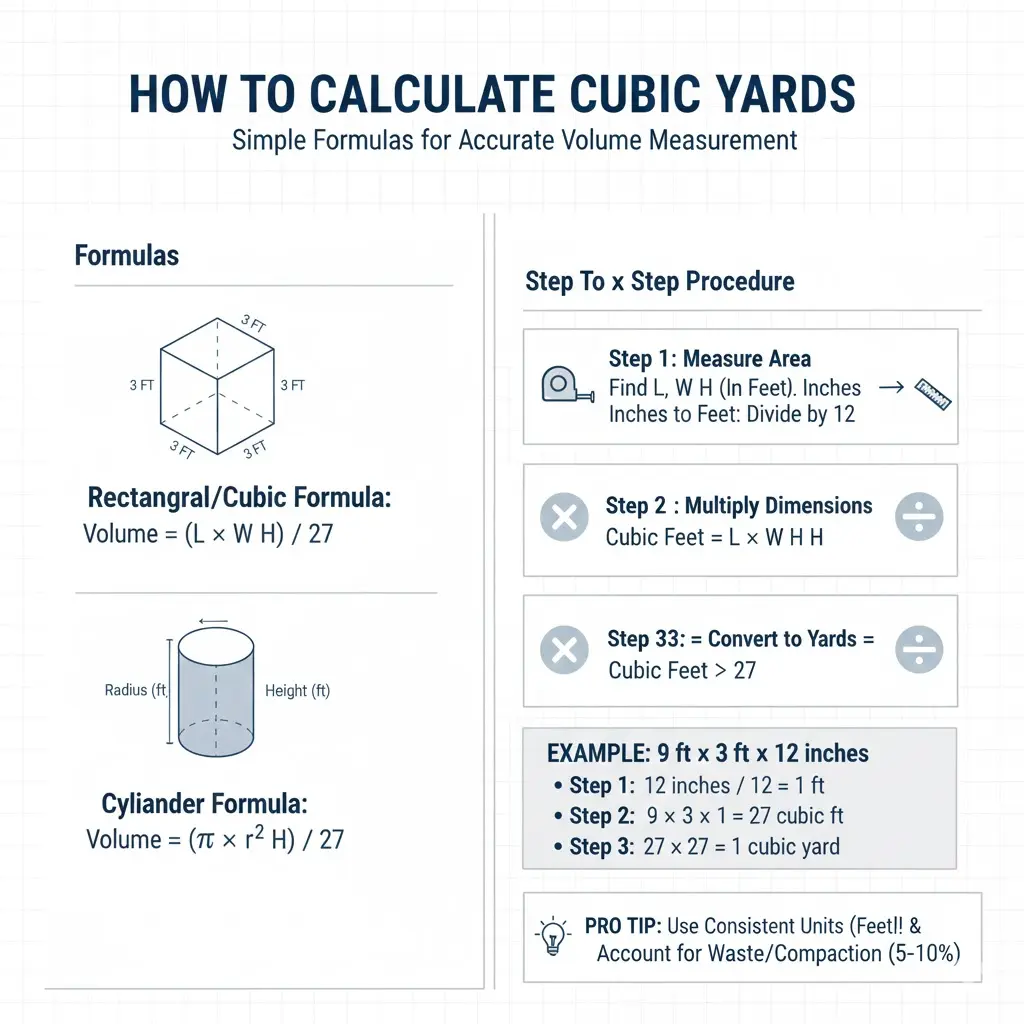
Formula for Cubic Yards:
Rectangular/Cubic Formula: Volume (Cubic Yard) = [ Length (ft) x Width (ft) x Height/Depth(ft) ] / 27
Cylinder or Round Formula: Volume (Cubic Yard) = [π × (Radius(ft)²) × Height(ft)] /27
Here’s a step-by-step procedure describing how to calculate cubic yards.
Step 1: Measure the Area
The first step includes finding all the dimensions: length, width, and height or depth. Make sure all measurements are in feet. For converting inches to feet, divide the number by 12.
- Inches to Feet: Feet = Inches / 12
Step 2: Multiply the Dimensions
The next step includes multiplying the length, width, and height measurements. This will give you volume measurement in cubic feet.
- Cubic Feet = Length × Width × Height
Step 3: Convert Cubic feet into Yards
Now, divide the result by 27 to convert cubic feet into cubic yards.
- Cubic yards = (Length × Width × Height) ÷ 27
Example: Let’s suppose a material that has a length of 9 feet, a width of 3 feet, and a depth of 12 inches.
Step 1: Convert inches to feet: 12 / 12 = 1 foot
Step 2: Multiply the dimensions: 9x3x1 = 27 cubic feet
Step 3: Convert cubic feet into cubic yards: 27 / 27 = 1 cubic yard
Pro Tip: When conducting a measurement, you should make sure that all units are constant. All units should be converted—for example, inches to feet and cubic feet to yards. Without conversions, the results will be inaccurate.
Material Coverage: How Much Area Does a Cubic Yard Cover?
A cubic yard is a fixed volume that holds about 27 cubic feet. That is about 3 ft x 3 ft x 3 ft. A cubic yard covers different amounts of surface area depending on how thick you spread the material.
This is also known as the depth factor. When you spread the same amount of material, let’s suppose volume one cubic yard is spread in a thinner layer; it would cover a larger area. However, if you spread it thicker, it would cover a smaller surface area.
The following table shows the area covered by 1 cubic yard at various depths.
1 Cubic Yard at 2″ deep = 162 sq. ft.
1 Cubic Yard at 3″ deep = 108 sq. ft.
1 Cubic Yard at 4″ deep = 81 sq. ft.
1 Cubic Yard at 6″ deep = 54 sq. ft.
Calculating the correct coverage area is vital for effective construction budgeting, as it helps you avoid over-ordering materials and keeps your project costs under control.
Importance of Cubic Yards in Construction
Before you start any project, it is important to know how much a cubic yard is and where it applies. Cubic yards or yards are one of the most used measurements in different construction projects.
Landscaping: You can use it to find the amount of soil, mulch, or gravel required for flower beds, driveways, and paths.
Gardening: It helps determine the amount of compost, topsoil, peat moss, and other materials required. Materials required for planting, raised garden beds, container gardens, and soil amendments.
Waste Management: You can easily evaluate the volume of debris or waste materials that need to be removed from an area. This can also help you get the exact dumper size for waste removal.
Construction: To determine the volume of sand, concrete, dirt, and other materials required for projects such as sidewalks, foundations, retaining walls, and other structures.
Erosion Management: To control erosion and calculate soil, riprap, or fill needed in slope stabilization and embankments.
Excavation and Earthwork: To estimate how much soil, rock, dirt, or other materials need to be excavated, hauled away, or reused. It can also help in grading and leveling.
Properly identifying these material requirements is a key step in developing detailed construction plans, ensuring every phase of your project is executed with precision.
Estimating Cubic Yards for Construction Projects
Whether you are working on a concrete slab, footings, excavations, or backfills, cubic yard is used for volume measurements. If you want a successful construction project, you must understand how many cubic yards. Now, let’s discuss how to estimate cubic yards for different construction projects.
Concrete and Foundations:
Concrete volume for slabs and footings can be calculated using length, width, and thickness. For slabs, you simply multiply surface area by thickness and convert cubic feet into yards.
With footings, a specific width and depth are used depending upon the type and structural load.
- Isolated/Pad/Strip Footings: cubic yard = [Length(ft) x Width(ft) x Depth(ft)] /27
- Cylindrical Footings: Cubic Yards = [π × (Radius(ft)²) × Height(ft)] /27
Let’s suppose a 40×80 concrete slab project with a thickness of about 0.5 feet. Put it in a formula; cubic yard = [ 40 x 80 x 0.5 ] / 27 = 59.26 cubic yards of concrete required.
Excavation and Backfill:
To excavate dirt or backfill, you must know the area’s length, width, and depth in feet. Using the same cubic yard formula discussed before, you can measure.
A swimming pool excavation of about 20 feet long, 10 feet wide, and 4 feet deep: its volume would be about 800 cubic feet, that is, 29.63 cubic yards of dirt or soil excavated.
Grading and Leveling:
If you are looking to raise or lower the ground elevation of your area, you must know the volume of material. Some of the common materials include dirt, sand, gravel, and crushed stone.
For example, a driveway leveling of an area ranging 40 feet long, 12 feet wide, and 0.25 feet deep. The volume would be: 40x12x0.25 = 120 cubic feet. When converted, it is about 4.44 cubic yards. So, you know that about 4.44 cubic yards of fill is required.
Landscaping Projects:
Cubic yards are mostly used to estimate materials such as soil, mulch, gravel, or sand in landscaping projects. Once dimensions are known, you can easily calculate the volume.
Let’s suppose mulch is required for garden beds if the area is about 25 feet long, 10 feet wide, and about 1 inch thick, or 0.083 ft depth. Multiplying them would give you 20.75 cubic feet. After conversion, you will have the estimates. 0.77 cubic yards of mulch are required for the project.
Why CAD Drafting is the Key to Precise Estimates:
CAD, full form to Computer-Aided Design, is one of the most popular software tools to create, analyze, and optimize 2D/3D models. You can basically generate precise 2D and 3D designs that also help you with material takeoffs and cost estimates. It basically provides you with exact quantities from digital designs. This helps reduce errors or mistakes.
Here are some key advantages of CAD drafting:
- It helps you find the exact dimensions(length, width, height, radius, and depth). Whether you are working on walls, slabs, or foundations, calculating material quantity becomes easy.
- A detailed representation of your 2D/3D models helps you estimate everything properly. Estimators can also make changes to design, dimensions, and materials.
- You don’t need to know how to calculate cubic yards. It helps determine how many cubic yards of material are required for your project.
Mistakes and How to Avoid Them When Measuring Cubic Yards
Imprecise calculations can later create problems for your projects, such as material shortages, unnecessary costs, etc. When determining how much is a cubic yard, you must be wary of common mistakes that can happen in the calculation process. Even a small mistake can lead to inaccurate results.
Here are some common mistakes and methods to avoid them.
– Always be careful of units.
Some people measure the length/depth in inches but forget to convert it into feet. This can change the outcome of results and lead to imprecise estimates. You should convert inches to feet by dividing by 12, then proceed.
– Don’t ignore the Depth Factor
Be careful of the depth factor and don’t ignore it. A cubic yard covers different surfaces depending on thickness—the required area changes based on your project design.
– Evaluate for Waste & Compaction
One mistake people make is not considering waste and compaction. Some materials, like soil, mulch, and gravel, tend to compact or settle once spread. You should add about 5% to 10% to avoid this.
Avoid costly calculation errors by using professional tools to estimate construction costs and ensure your material orders are 100% accurate.
Conclusion
Can’t figure out how much is a cubic yard? A cubic yard is a unit for measuring volume. It is commonly used in measuring concrete pouring, crushed stone, gravel, sand, demolition debris, topsoil, and other tasks.
A cubic yard is used as a standard in construction for effective project planning and quantity measurements. It helps contractors, subcontractors, and project managers understand exactly how much material is required, avoiding errors and downtimes.
Want accurate measurements and estimates in excavation, landscaping, concrete pouring, or utility installation? Connect with Cost Bidding Now!
FAQs
How many cubic feet are in 1 cubic yard?
One yard is equal to 3 ft. Hence, a cubic yard is equal to 27 cubic feet. Using the following formula, we can convert cubic yards into cubic feet:
Cubic feet = Cubic yards × 27
How many wheelbarrows are in a cubic yard?
This depends on your wheelbarrow size. Usually, a wheelbarrow load is 2–3 cubic feet. So it will take 9–14 wheelbarrow loads to make up 1 cubic yard.
How many square feet are in a cubic yard?
It depends upon depth. For example, if you spread out a cubic yard of dirt or mulch, it will cover about 324 square feet of 1 inch. If you exceed the depth by 3 inches, it will cover about 108 square feet.
How much is the weight of 1 cubic yard of concrete?
When the concrete is poured and set, 1 cubic yard of concrete weighs nearly 4,000 pounds. It depends on the type of mixture, water-cement content, additives, and more. While 1 cubic yard of broken concrete weighs about 2,000 to 3,000 pounds, it is due to the air gaps between the pieces.
How much sqft is a cubic yard?
A cubic yard is used to measure the volume, not the area, of the material. It depends on the thickness of the material. The following formula can be used to convert square feet into cubic yards:
Area (sqft) = [Volume ( cubic yards ) x 27] / [Thickness (inches) /12]
For an average 4-inch thick concrete, 1 cubic yard will be equal to 81 sq ft.