Infrastructure construction means the development of highways, utilities, and communication systems. It includes every such structure that makes human life easier and more comfortable.
The infrastructure market in the U.S. in 2024 was about $335 billion. As the market grows further, understanding the key aspects of such projects is crucial for contractors. It helps them make important decisions and prepare for common risks.
Let’s understand the infrastructure development and its key role in U.S. economic growth. We also explain the key elements and challenges you could face as a contractor in this sector.
What is Infrastructure Development and How Does it Fuel Construction?
A common question arises: What is infrastructure development? Infrastructure development is the process of creating or improving city structures and facilities.
It includes projects for transportation networks, utilities, and communication systems. The development process includes designing, planning, estimating, financing, permitting, and construction.
Infrastructure development greatly fuels the construction industry. It creates long-term demand for large construction projects. This impacts employment, demand for raw materials, and innovation for efficient processes.
This engages investors looking for profitable opportunities. The investments in residential, commercial, and industrial construction are increasing. Therefore, bolstering the construction market significantly.
Effective infrastructure projects rely on detailed construction plans to ensure structural integrity and long-term sustainability.
The Role of Infrastructure Construction in Global Economic Growth
According to the 2020 GI Hub study, infrastructure impacts the economic output by 1.5 percent in just 2-5 years. Infrastructure construction is the most vital part of a country’s economy.
All bridges, dams, railways, airports, power generation plants, and communication networks are included. It makes daily life functions seamless. Local businesses improve operational efficiency, productivity, and reduce costs.
Several other factors include creating employment and encouraging local and foreign investments. Infrastructure development is truly a key player in sustainable growth, equality, and quality of life.
Need an accurate estimate for your next infrastructure project?
Defining Project Infrastructure: Key Elements in Building Infrastructure
MERA reports that 1% increase in infrastructure development leads to 0.36% GDP growth. Wandering, what is project infrastructure? Well, infrastructure projects can be divided into 3 main categories. This helps us to understand their purpose and its effect on daily life.
Physical Infrastructure
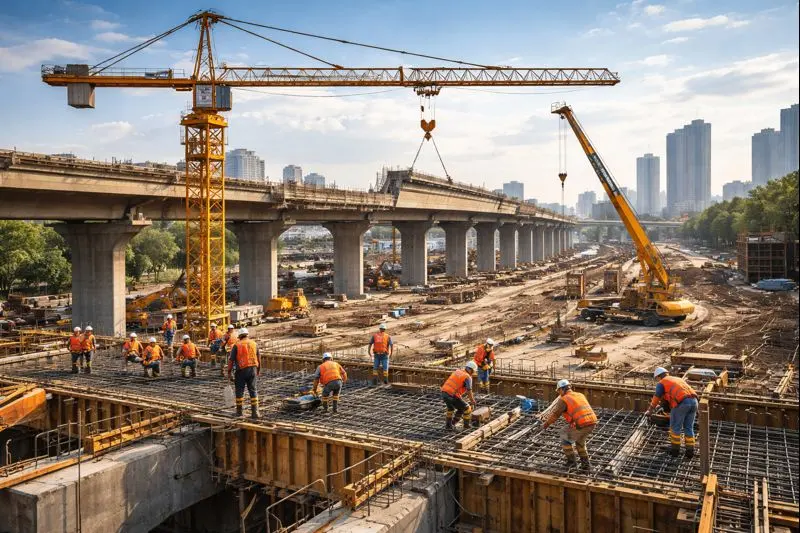
Physical infrastructure is the basic infrastructure to run daily activities. This includes roads, dams, bridges, the power grid, and more. Here are the types of Physical Infrastructure in Construction.
Transportation infrastructure
Transportation infrastructure refers to the systems built for the movement of goods and people. Studies show that these projects impact the returns on capital investment by 5-20%. It includes the following projects.
- Roads and highways
- Bridges and tunnels
- Rail networks and metro systems
- Airports and air traffic facilities
- Seaports and shipping terminals
- Public transport systems like buses, trams, etc.
- Traffic management and signaling systems
Water Supply and Sanitation
The water supply infrastructure includes the facilities that manage the collection, treatment, and distribution of water to the general public.
Sanitation infrastructures include sewage and drainage systems. This helps in managing solid waste for the public. It includes the following projects.
- Water treatment plants and reservoirs
- Distribution pipelines and pumping stations
- Sewage collection and treatment systems
- Drainage and flood control systems
- Public sanitation facilities
Communications Infrastructure
You need systems for communicating. That’s what telecommunication does. It is used for transferring data, voice, images, audio, internet media, and more. This infrastructure is crucial for connectivity across the country.
- Fiber optic networks and internet cables
- Microwave transmission
- Mobile towers and base stations
- Satellite communication systems
- Broadband infrastructure
- Data centers
Building these complex structures requires highly detailed construction drawings to ensure every technical specification is met during the execution phase.
Energy Infrastructure
Energy infrastructure helps in the generation and distribution of energy. It includes both renewable and non-renewable facilities. These are capable to run entire cities and industrial units.
- Water and gas pipelines
- Oil and natural gas refineries
- Power plants
- Electric grid networks
- Windmills and utility-scale solar
Social Infrastructure
Social infrastructure means the development of such structures crucial for social life and well-being. It mainly concerns healthcare, education, and social connectivity. The most common types of social infrastructure are as follows:
Educational Institutions
According to the World Bank, there is a 10% increase in your hourly earnings for every additional year of education. These infrastructures promote learning and skill development of the local population. Educational infrastructure consists of the following projects:
- Schools and Colleges
- Universities and training institutions
- research centers and labs
- Digital learning infrastructure
Healthcare Infrastructure
These infrastructure buildings provide healthcare support. Making sure that quality treatment is available to everyone. It plays a key role in improving life expectancy and stabilize economy.
- Hospitals and medical centers
- Clinics and pharmacies
- Diagnostic centers and laboratories
- Medical transport systems and technology
Housing Infrastructure
Improved living standard impacts construction growth. It is also a key driver of the real estate industry. Housing infrastructure makes local housing easy, affordable, and sustainable. It includes
- Parks and Playgrounds
- Walking tracks
- Local shopping areas
- Street lighting systems
Social Welfare Initiatives
This merges federal funding and state-level administration in the USA. They aim to support the population and ensure easy availability of resources for all. These include programs like food assistance (SNAP), cash aid (TNAF), and more.
- Community centers
- Rehabilitation centers and shelters
- Elderly and disability care centers
- Child welfare centers
Social Security and Insurance
These programs provide financial security for the unemployed. This helps the disabled, ill, and elderly. It plays a key role in consumer spending and economic resilience.
- Telemedicine services and vaccinations
- Pension and retirement schemes
- Digital Insurance platforms
- Government-backed social protection
Financial Infrastructure
Financial infrastructure refers to institutions, methods, and systems that facilitate the flow of finances in an area. They help manage markets, banks, security exchanges, and the stock market. Building infrastructure for finance includes the following.
Banking Infrastructure
Banking infrastructure helps individuals and governments to lend and deposit money. It also allows safe storage and transfer of money.
- ATMs and banks
- Central banks
- Digital banking platforms
- Payment processing centers
Capital Market Infrastructure
These financial bodies facilitate the buying and selling of stocks. It is a great system for investment opportunities. It includes the following supporting structures.
- Stock exchanges
- Clearinghouses
Foreign Exchange Infrastructure
Governments looking to boost tourism, investments, and the economy need financial infrastructure. These systems enable the exchange of currencies. Countries are able to monitor and manage their currency volatility.
- Currency exchange offices
- Payment and settlement systems
- Central bank foreign reserves
These banking systems are essential for maintaining the cash flow required to support large-scale construction budgeting for national development projects.
Infrastructure Building vs. Traditional Construction: Key Differences
Infrastructure buildings refer to the structures that provide public services. They facilitate economic activity and improve connectivity. Traditional construction, on the other hand, includes constructing all sorts of residential, commercial, and industrial projects.
Each has a different purpose, scope, goals, and projects. Let us dive into the key differences between basic construction and infrastructure construction.
| Aspect | Infrastructure | Construction |
| Purpose | Focuses on building large-scale structures for communication, transportation, and utilities | Involves building individual structures to cater to private needs |
| Project Types | Physical, social, and financial infrastructures | Residential, commercial, and industrial |
| Lifecycle | Long-term operation, maintenance, and upgrades | Focus on project delivery and completion |
| Ownership & Funding | Mostly government or public-private partnership (PPP) funded | Mostly privately or project-funded |
| Benefits | Improved economy, quality of life, seamless GDP growth | Provide secure and functional spaces that improve living and working standards |
Overcoming Challenges through Strategic Planning and Execution
Infrastructure construction needs a great level of expertise. Not understanding construction risks can significantly delay progress and increase overspending. These issues may be related to project management, the availability of resources, durability, or compliance. You must know these construction risks. Proper planning to mitigate them is crucial. This helps in making informed decisions and preventing financial loss. Here is a list of common infrastructure construction challenges and how to prevent them.
Timely Resource Availability
Contractors and construction companies need to have the right tools and technology for constructing infrastructure. The worst part is 70 % of all mega infrastructure projects are delayed. This is due to poor planning and resources. Careful planning and conducting a material takeoff and cost estimates is the way. Moreover, having control of your inventory helps predict demand. This prevents stock shortages and delays due to delivery.
Reduced Worker Productivity
As the construction industry grows, the labor has become far less productive. This is due to a lack of communication and poor planning. Moreover, the late deliveries and sitting idle for hours lead to low labor interest.
Proper scheduling eliminates communication issues. It provides a sequence for different processes. Also, the details for the amount of materials and resources are defined, which allows you to make timely decisions. This significantly improves labor productivity.
Compliance Issues
Most of the construction projects don’t adhere to federal and state-level regulations. Each trade has different compliance requirements. Construction and infrastructure development require adherence to get permits and achieve quality outcomes.
Standards like the International Building Code, IMC, IEBC, IPC, ADA, IFC, ODHA safety regulations, and more must be followed.
Less Availability of Workers
There is an immense labor shortage in the USA. There is a need for 439,000 construction workers, according to ABC, Associate Builders and Contractors in the U.S. Construction workers are the backbone of the industry. If skilled workers are not available, then this can damage several components. Moreover, you won’t be able to control the heavy-duty equipment.
Connecting with multiple construction staffing agencies could help. Contact us a few months ahead, so the labor is timely available when needed.
Most infrastructure delays are caused by poor financial forecasting, making it vital to establish a solid construction budgeting framework before the project begins.
Unsafe Construction Practices
The construction injury rate is the highest among other industries. 2.5 out of every 100 construction worker faces injury on a construction site. The most common types of injuries include falling by slip or trip, being struck by objects, electrocution, or being caught in accidents.
Use safety measures and make regular inspections. Ensure that all equipment and machinery are in optimal condition. Moreover, make clean and well-optimized work areas for improved results.
To prevent these common delays, implementing a rigorous process for construction cost estimating is essential to ensure resources are allocated accurately from day one.
Increasing Material Cost
According to NAHB, the cost of construction material increases by 20.4% every year. Bulk purchasing or understanding seasonal demands prevents high-priced purchasing. Moreover, alternatives could be used for the right balance between cost-effectiveness and quality.
Professional cost estimates pave the way out. It provides material prices from the most affordable vendors. He also accounts for market fluctuations and guides with cost-saving strategies.
From vision to reality, let’s construct infrastructure that lasts generations.
Conclusion
Infrastructure construction is crucial in the country’s economy and for maintaining order. This blogs explain what infrastructure development is and the key challenges faced in the industry. The best way to avoid infrastructure construction risks is by planning those scenarios initially. This enables a more controlled approach and prevents delays.
Cost Bidding makes infrastructure construction a plain sail with its quality estimates. Whether labor, material, machinery cost, or valued engineering insights, we offer quality planning and support.
FAQs
What are the 5 main types of infrastructure constructions?
The 5 most important types are highways, roads, subdivisions, sewerage, and aviation infrastructure. However, these are not only types. Other infrastructures include dams, windmills, sidewalks, the electrical grid, and more, which are equally important.
What are the stages of infrastructure development?
There are 7 important stages of infrastructure development. This includes planning, design, and drafts, financing, permit approval, procurement and contracting, construction, and testing.
How does top infrastructure improves economy?
Infrastructure development drives economic growth in different ways. This includes creating jobs, attracting investors, and improving trade. Local businesses find it easy to operate, and this helps several industries to grow substantially.
How much does infrastructure construction cost in the U.S.?
Infrastructure construction cost depends on the type of project. This depends on the type, scale, and location of the project. Moreover, labor, material, equipment, permits, etc., are also cost-driving factors. Infrastructure cost can vary from $100,000 to millions of dollars.