Suppose you stand on a dusty Texas job site at dawn. The team waits while the concrete truck idles. Your bid looked solid 3 weeks ago. But later, the supplier calls. Rebar prices jumped again. Suddenly, your profit margin reduces, and the project owner starts asking tough questions. You know that moment, leading to inaccurate estimates and project failure, which you want to avoid.
What is Rebar anyway? It is the steel bar that gives concrete its strength. Without it, buildings crack and fail under load. In 2026, contractors are facing tighter margins than ever because material prices are fluctuating fast. This means you cannot afford guesses anymore. Now, you need precise & accurate estimates on rebar cost. That is exactly why we break it down here.
In this blog, you will walk away knowing exactly how much rebar costs per foot in 2026 and how to bid with confidence. Let’s start!
Average Rebar Cost in 2026
Steel rebar prices stabilized after last year’s fluctuations, but they still sit higher than in 2024. Right now, in early 2026, teams pay roughly $0.45 to $1.35 per linear foot for common sizes. That covers everything from basic Grade 60 carbon steel to delivered jobsite pricing. But remember, your actual cost of rebar depends on size, grade, and quantity.
Here is the simple table:
| Rebar Size | Weight per Foot (lbs) | Average Rebar Cost Per Foot (2026) |
| #3 | 0.376 | $0.40 – $0.75 |
| #4 | 0.668 | $0.55 – $0.95 |
| #5 | 1.043 | $0.75 – $1.25 |
| #6 | 1.502 | $0.95 – $1.55 |
These values include delivery in most US markets. But you must add 10-15% if you order small quantities or need rush shipping.
Note: Rebar cost per foot jumps when you move up in size because you get more steel. But you also need less total length on many jobs.
Factors Affecting the Rebar Cost in Construction
Prices never stay still. 10 real factors move your rebar cost every single day. Here, we break them down so you can adjust bids fast.
1. Scope of the Project
Bigger projects get better pricing. A 500-square-foot patio might pay full retail. And, a 50,000-square-foot warehouse lands wholesale rates 20-30% lower.
| Project Size | Rebar Cost Adjustment |
| Small (<5 tons) | +15-25% |
| Medium (5-20 tons) | Standard |
| Large (>20 tons) | -20-35% |
2. Rebar Weights
Do you know what rebar weight is? It tells you exactly how much steel you buy per foot. If you miss this, your takeoff will be dead wrong. Well, heavier bars cost more per foot, but you often use fewer of them.
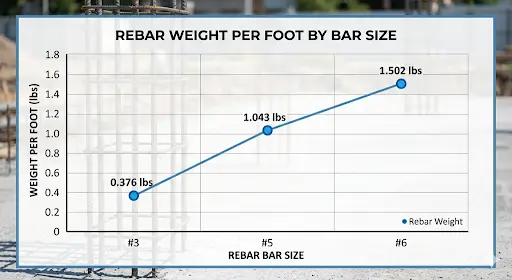
Here is the graph for better understanding:
3. Rebar Grade (40, 60, 75)
Grade 40 is the cheapest but weakest; grade 60 rules most jobs; grade 75 saves steel but costs more upfront. See the table below for a better understanding:
| Grade | Yield Strength (psi) | Price Premium over Grade 40 | Best For |
| 40 | 40,000 | Base | Light slabs, residential |
| 60 | 60,000 | +20-40% | Standard builds, foundations |
| 75 | 75,000 | +45-65% | High-load structures, commercial |
4. Rebar Quantity, Retail vs Wholesale
When it comes to rebar, retail hits hard on small orders while wholesale rewards volume. You can order 10 tons or more to watch prices drop fast.
5. Type of Rebar
Steel still dominates, but fiberglass and coated options change the math. See the table below. It works!
| Rebar Type | Avg. Cost Per Foot | Key Advantage |
| Carbon Steel | $0.60-$1.20 | Cheapest, strong |
| Epoxy Coated | $0.85-$1.60 | Corrosion resistance |
| Galvanized | $1.20-$1.80 | Outdoor durability |
| Stainless | $4.50-$8.00 | Extreme environments |
| GFRP (Fiberglass) | $0.65-$2.50 | Never rusts, lightweight |
Note: Metal rebar remains king for most budgets. But specialty jobs push you toward coated or fiberglass.
6. Raw Material Costs and Market Demand
Scrap steel prices drive everything. When mills pay more for scrap, you pay more for rebar. Strong demand from infrastructure bills keeps 2026 prices firm. You can see this push every time you get a fresh quote.
7. Logistics and Transportation
Fuel costs and truck shortages add $0.05 to $0.15 per foot in remote areas. You can feel it hardest on long-haul deliveries to job sites outside major cities. Plan deliveries early and lock in rates when possible. Otherwise, your rebar cost quietly increases higher than expected.
8. Regulatory and Economic Policies
Tariffs and new environmental rules pushed rebar prices up 5-8% in early 2026. Washington’s decision to reinstate and raise Section 232 steel tariffs to 50% cut cheap imports and lifted domestic costs fast.
9. Technical Specifications and Design
Odd bends, special hooks, or tight spacing add extra labor and waste in rebar projects. Engineers who over-specify drive up your rebar cost fast. You pay more for fabrication and field time. What you need to do is always to review drawings early and question anything that looks excessive. This will help you save a lot of time & money.
10. Labor and Installation Factors
Union labor and tight schedules raise rebar installation costs fast. You should factor 25-35% of the material estimate for labor. Busy job sites and overtime push that number even higher. Therefore, plan your team size early so labor does not eat your profit margin on every rebar placement.
How to Accurately Estimate the Rebar Cost for a Construction Project?
Follow these steps every time.
Step 1: Review structural drawings. Pull every rebar callout.
Step 2: Calculate total length. Add lap splices; usually 40-60 bar diameters.
Step 3: Multiply by unit weight and convert to tons for estimates.
Step 4: Apply the current rebar cost per foot or per ton.
Step 5: Add 5-10% waste, as well as add delivery and tax.
Step 6: Compare retail vs wholesale quotes.
Example:
10,000 linear feet of #4 Grade 60.
Weight = 10,000 × 0.668 = 6,680 lbs = 3.34 tons.
At $0.65/ft average = $6,500 material.
Add 8% waste and delivery = roughly $7,300 total.
Mistakes Related to Rebar Estimating & Their Solutions
1. Neglecting or Incorrectly Calculating Lap Splices
Contractors lose 8-12% on material when they skip proper lap lengths. You must always add a minimum of 40 bar diameters. Plus, double-check with the engineer & fix it once so your takeoff stays accurate.
2. Overlooking Rebar Waste Factors
Most rebar jobs waste 5-10%. Do you know what eats your profit? It is cut-offs, damage, and bad weather. What you can do is to build 8% waste into every bid. Also, track actual waste on past jobs so you can reduce expenses fast.
3. Ignoring Extra Reinforcement
Seismic zones or owner changes add extra bars. Therefore, you should review additions every time. If you miss them, they will cut your profit margin. Almost all estimators who provide rebar estimating services add a line item for potential extras in the assessment.
4. Misinterpreting or Ignoring Structural Drawings
One missed note on spacing costs thousands of dollars in rebar projects. Therefore, you must read every sheet and review the plans with your supervisor before bidding. Clarity now will eliminate future arguments.
5. Using Outdated Pricing or Incorrect Unit Weights
Like other construction materials, rebar prices change monthly. 6 rebar weight per foot is 1.502 lbs; 3 rebar weight per foot is 0.376 lbs; 5 rebar weight per foot is 1.043 lbs. Just remember to update your spreadsheet weekly. You can use estimating tools and software to automate this task. Explore the benefits of software in the “Construction Bidding Software (2026)” guide!
The Role of Rebar Estimators in Accurate Cost Estimation
1. Detailed Quantity Takeoffs
Experienced estimators catch every bar with accurate estimation. They save 5-15% compared to quick guesses you make when time is short. With their assistance, you can sleep better knowing the numbers actually hold up when the concrete truck shows up on site. This means no more last-minute shortages or expensive fixes. Simply put, a precise rebar construction takeoff service protects your bid and keeps the entire project running smoothly from the first pour.
2. Material and Labor Costing
Estimators blend current rebar cost with local labor rates every single time. They make sure that you get bids that actually win work and still make real money. These professionals know exactly what union labor charges in your area and how fuel prices affect delivery. This way, your margin stays up, and you get the revenue you expected.
3. Accounting for Waste and Spacing
Rebar estimating experts build in real-world waste and code-required spacing right from the start. They help you to avoid surprise change orders that eat your margin halfway through the job. Moreover, they factor in cut-offs, field adjustments, and tight clearances that drawings often ignore. This careful planning keeps your teams productive and prevents expensive rework. In the results, you finish projects hassle-free and with better margins in the end.
4. Software Utilization
Modern tools pull live pricing and auto-calculate laps and bends automatically. Using them, estimators help you cut takeoff time in half while errors drop dramatically. Instead of spending nights manually checking every splice, the software flags issues instantly. You can update material costs with one click when steel prices move. This speed and accuracy give you a real edge when bids are due tomorrow morning.
Benefits of Hiring a Rebar Estimator
1. Competitive Bidding
You can submit sharper estimates and win more work. Margins stay good because unforeseen expenses disappear from your bids. Furthermore, accurate rebar takeoffs give you confidence to price competitively without leaving money on the table. This way, you land more jobs while protecting profit on every project.
2. Waste Reduction and Efficiency
Precise and accurate rebar price data cuts waste by 10-20%. Teams install faster with precise lengths and fewer cut-offs. Moreover, your projects finish on budget more often and with less material left over. Simply put, efficient rebar placement keeps labor productive and improves overall job profitability.
3. Budgeting and Scheduling
Accurate forecasts mean better cash flow and tighter schedules. With the assistance of estimators, you can know the exact material needs upfront, so purchasing stays on track. Owners appreciate it when projects run smoothly without unexpected delays or cost overruns. This means reliable estimates build trust and stronger client relationships.
4. Risk Management
Fewer claims, fewer disputes, and better relationships are all possible when you rely on estimators. Getting construction estimating services ensures that you protect profit and reputation at the same time. Precise rebar costing reduces arguments over extras and change orders. Everyone stays aligned from bid day through final pour, creating smoother projects and happier project owners.
Commonly Asked Questions
How much does rebar cost?
In 2026, you need to pay $0.40 to $2.25 per foot, depending on size and grade. Most common #4 Grade 60 lands around $0.65 per foot delivered.
What is Rebar placement and tying called?
It is also called rebaring. It is the process of installing steel bars before the concrete pour. Proper rebaring makes the structure strong and safe.
How much does steel rebar cost?
Steel metal rebar averages $0.55 to $1.35 per foot in 2026. You can save on this by opting for bulk buys, as it drops the cost of rebar significantly.
What is the difference between Grade 40 and Grade 60 rebar?
Grade 40 bends more easily and costs less. Grade 60 is stronger and handles heavier loads. Most commercial jobs require Grade 60.
Ready to stop guessing on rebar costs? Reach out today!
Conclusion
You now know what Rebar is, how much it costs per foot in 2026, and which factors affect its price. Remember that accurate rebar estimating wins bids and protects profit. If you miss the details, you’ll lose money on every pour.
But here is the truth. Most contractors still guess or use last month’s prices due to a shortage of time. That is where professional help changes everything. Our rebar estimating services deliver precise takeoffs, updated pricing, and waste-aware calculations tailored to your region and project scope. Rely on Cost Bidding to full estimating support that turns complex rebar jobs into precise, profitable wins.