The national average to build a parking garage in 2026 falls between $70 and $120 per square foot. The exact number is decided by the cost-affecting factors, including location, foundation, materials, labor charges, garage structure, number of levels, etc. Let’s go into the depths of these cost drivers so you can handle them better to ensure you win the bid with a good margin.
Parking Garage Construction Cost Drivers
● Foundation
Ground is the starting point of your project; therefore, you can’t let it rely on guesses. Smart decision-making is essential here. Coming to the point, there are many types of foundations used for parking garages. What you choose decides the exact foundation cost. See the table below for types and their cost range.
| Sr | Foundation Type | Cost Range Per Sq Ft |
| 1 | Gravel Pad (prep only) | $3–$7 |
| 2 | Concrete Slab-on-Grade | $6–$12 |
| 3 | Footings & Piers | $10–$18 |
| 4 | Mat or Raft Foundation | $15–$25 |
| 5 | Pile Foundations | $20–$45+ |
You must be thinking of the best use of each type. Here are the details:
1. Gravel Pad
It is applicable where temporary or very low-load management is desired. This means it is less suitable for parking garages, but you can use them during the site prep phase.
2. Concrete Slab-on-Grade
It is also called a monolithic slab. It is the type where you can pour the slab and footings together. This type works best for stable, level sites with light to medium loads. Many contractors and builders prefer it for fast and economical building of smaller above-ground structures.
3. Footings & Piers
This type is an ideal option for uneven or moderately poor soils. Isolated footings with piers are used in this option. Choosing this means you will get solid support without going full deep foundation, which costs more than the shallow one.
4. Mat or Raft Foundation
It handles poor or expansive soils well by distributing loads evenly and is ideal for larger footprints where differential settlements are involved. During installation, builders spread one thick reinforced slab across the entire footprint when relying on a mat or raft foundation.
5. Pile Foundations
This handles very soft, loose, or high-water-table soils and is mostly used for tall structures or challenging urban sites. Coming to building, teams drive or drill deep piles into stable strata in a pile foundation.
Pro Tip: Consider the geotechnical report of the site and make choices accordingly.
● Material Used
What you choose as parking garage building materials decides durability, speed, and maintenance. Therefore, you must look for all the best available options and choose the one that costs less but brings the best performance. See different types of materials and their specifications below.
1. Precast Concrete
It is an excellent option for quality control, fast erection, and repetitive designs. Contractors and builders mostly use it for above-ground multi-level garages where schedule means alot. In general, it includes factory-made elements that teams assemble on site.
2. Cast-in-Place Concrete
This material brings design flexibility and seamless monolithic behavior and is strong for complex ramps or seismic zones. Coming to its use, it is poured on site.
3. Structural Steel
As the name reflects, this involves steel. Builders do framing with steel beams and a deck. Regarding its characteristics, it is lighter in weight, comes with longer spans, and is faster in some conditions. It is good to use when you need open layouts or future modifications.
4. Fiber-Reinforced Concrete
Using this material means adding fibers to reduce cracking. With this material, you can achieve the best possible durability standards in high-traffic areas. Most prominently, this reduces traditional rebar needs.
5. Wood
Wood is rarely used in parking garages. Why? Due to fire and load concerns. Therefore, it is limited to small accessory structures or hybrid designs in specific climates.
Coming to the cost of each, the table below shows the numbers.
| Sr | Material | Cost Per Sq Ft |
| 1 | Precast Concrete | $45–$75 |
| 2 | Cast-in-Place Concrete | $55–$90 |
| 3 | Structural Steel | $50–$85 |
| 4 | Fiber-Reinforced Concrete | $50–$80 |
| 5 | Wood (limited) | $30–$55 |
Win: Precast Concrete
● Project Location
Do you know that your project location handles 20-40% of the project cost? Yes, it involves labor rates, permit needs, and logistics, which all vary from location to location. For example, the cost to build a parking garage in California is more than that of Austin. See the table below for cost details.
| Location | Cost Per Sq Ft |
| California | $95–$150+ |
| NYC | $110–$160+ |
| Washington | $85–$130 |
| Florida | $80–$125 |
| Austin, TX | $70–$110 |
| Alaska | $100–$155 |
| Texas (avg) | $65–$105 |
You must be thinking what specifications are causing this much fluctuation among numbers of different locations. The following are the cost drivers in each location mentioned above.
- California + NYC: High labor, strict codes, and material delivery costs:
- Florida: Hurricane
- Alaska: Cold weather and remote logistics
Pro Tip: Always factor in zip code and local wages for laborers to ensure precise and accurate estimates.
● Labor Expenses
For all parking garage projects, contractors look for experienced teams who are short in availability right now, and when available, demand higher rates, especially for structural concrete and high-work. Plus, multiple professionals are involved in the garage building project, each performing a particular role and charging according to what they do. See the table below for their roles and cost details.
| Profession + Role | Hourly Rate |
| Structural Ironworker | $45–$75 |
| Concrete Finisher | $38–$65 |
| Crane Operator | $50–$80 |
| General Labor | $25–$40 |
| Electrician (MEP) | $50–$85 |
Note: Union markets run 20-30% higher.
● Drainage System
You know how water is essential to manage on time. If not done on time, water destroys everything later. And when it comes to drainage systems, you see different types, all with different best uses and costs. See the table below for details!
| Drainage Type | Cost Range | Best For |
| Trench/Linear Drains | $40–$120 per ft | Aisles, high flow |
| Slot Drains | $60–$150 per ft | Aesthetic areas |
| Spot/Point Drains | $150–$400 each | Low points |
| Catch Basins | $300–$1,200 each | Volume collection |
| Permeable Pavers | $8–$20 per sq ft | Sustainable, lighter traffic |
Pro Tip: Choose based on rainfall, slope, and maintenance access. Plus, integrate early with structural design.
● Parking Efficiency
When it comes to parking garages, owners demand to maximize cars per square foot without sacrificing site safety or access. This means increasing parking efficiency.
This reduces the project cost per space by 15-25%. How? Think about double-loaded aisles, angled parking, and optimized ramp slopes that pack more revenue-generating spaces. In other words, targeting 300–350 sq ft per space is a good design, while 400+ sq ft is an inefficient one. Going with the first option will enable you to save maximum on concrete and land.
● Total Parking Space
How big the parking space is decides the exact garage building cost. And remember that the space size affects layout and cost directly. Below is the table that shows options in spaces with area coverage and cost range.
| Space Type | Area (sq ft) | Cost Per Space |
| Standard | 160–180 | $22,000–$48,000 |
| Compact | 130–150 | $18,000–$40,000 |
| Large/SUV | 200–250 | $28,000–$55,000 |
| Accessible (ADA) | 240+ | $35,000–$65,000 |
● Permits & Compliance
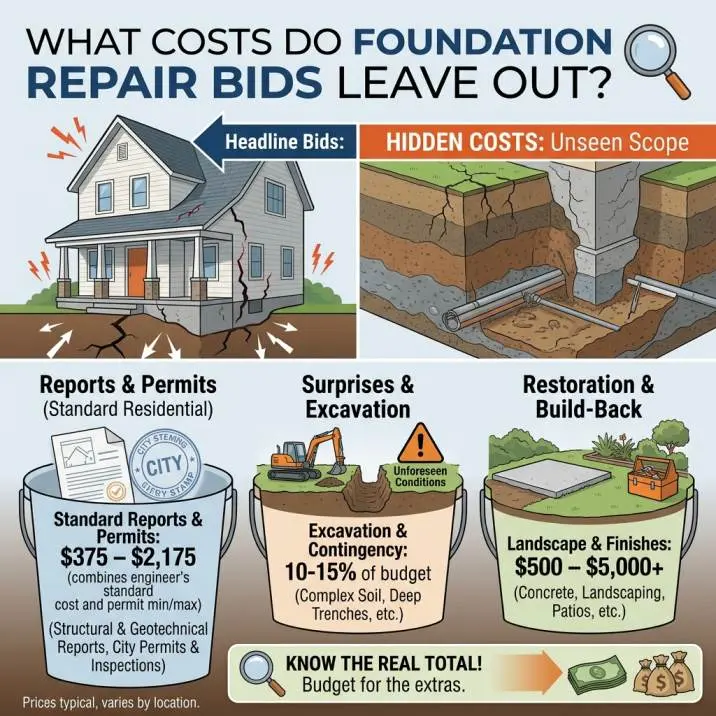
Always navigate building codes, ADA, stormwater, seismic, and fire requirements when planning for parking garages. Ignoring these factors early in the project planning phase can delay the building by a notable time. Add this to the soft cost of the parking garage budget, which commonly falls between 8% and 15% of the project total.
Other Factors that Can Affect the Parking Garage Cost
- Architectural Facade Treatment
- Parking Lot Striping and Markings
- Technology & Additional Program Elements
Don’t let “wrong maths” lead to unfavorable outcomes. From foundation types to local labor rates in Alaska or NYC, get a precise estimate that sets your proposal apart.
How to Estimate the Cost of Parking Garage Construction?
- Determine project scope and requirements by sitting with the owner.
- Define the capacity of the parking garage by locking the number and type of spaces.
- Determine structure type, decking between above, below or hybrid.
- Assess site conditions by benefiting from the geotech report from the authorities.
- Calculate Gross Square Footage by using the formula below:
(Number of spaces × sq ft per space) × efficiency factor (1.3–1.6 typically) + ramps + circulation
- Estimate hard costs by breaking down projects by CSI divisions. And do only add current unit prices. You can use RSMeans to get current local data for materials, labor, and equipment.
- Estimate soft costs, keeping your focus on the parking garage design, permits and testing.
- Factor in contingencies, 5-10% minimum, or higher for complex sites.
- Compare with industry ratios, which means checking your estimates against benchmarks.
Estimation is done, but you are still circulating your margin. Right? Integrate some proven tips to ensure you keep the maximum in your account.
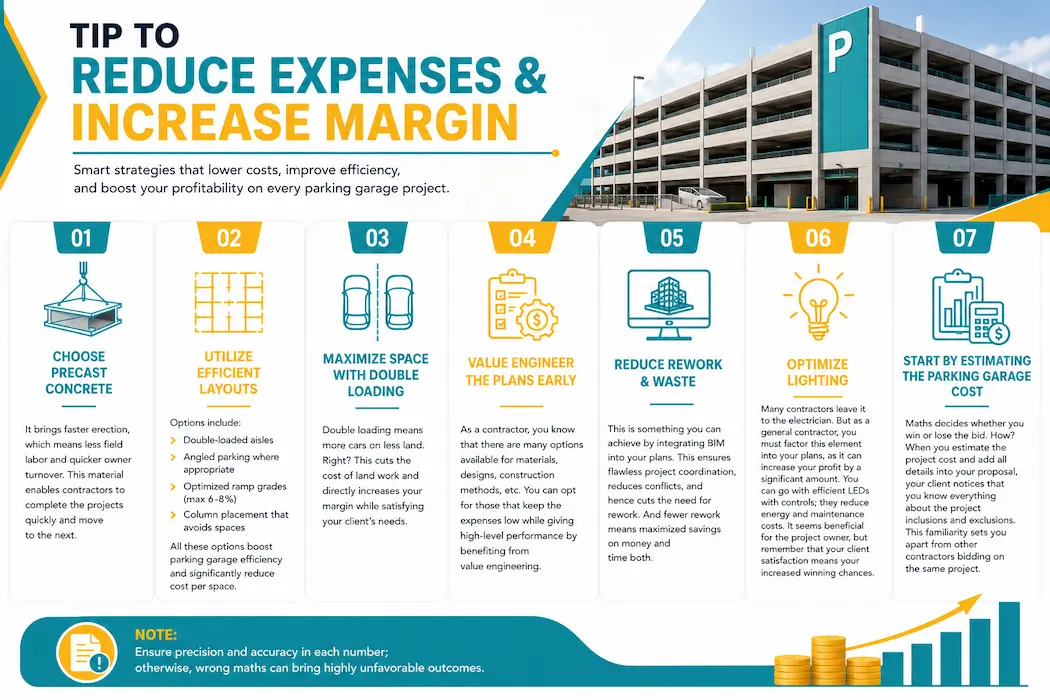
Tip to Reduce Expenses & Increase Margin
● Choose Precast Concrete
As already mentioned, it brings faster erection, which means less field labor and quicker owner turnover. This material enables contractors to complete the projects quickly and move to the next.
● Utilize Efficient Layouts
Options include:
- Double-loaded aisles
- Angled parking where appropriate
- Optimized ramp grades (max 6-8%)
- Column placement that avoids spaces
All these options boost parking garage efficiency and significantly reduce cost per space.
● Maximize Space with Double Loading
Double loading means more cars on less land. Right? This cuts the cost of land work and directly increases your margin while satisfying your client’s needs.
● Value Engineer the Plans Early
As a contractor, you know that there are many options available for materials, designs, construction methods, etc. You can opt for those that keep the expenses low while giving high-level performance by benefiting from value engineering.
● Reduce Rework & Waste
This is something you can achieve by integrating BIM into your plans. This ensures flawless project coordination, reduces conflicts, and hence cuts the need for rework. And fewer rework means maximized savings on money and time both.
● Optimize Lighting
Many contractors leave it to the electrician. But as a general contractor, you must factor this element into your plans, as it can increase your profit by a significant amount. You can go with efficient LEDs with controls; they reduce energy and maintenance costs. It seems beneficial for the project owner, but remember that your client satisfaction means your increased winning chances.
● Start by Estimating the Parking Garage Cost
Maths decides whether you win or lose the bid. How? When you estimate the project cost and add all details into your proposal, your client notices that you know everything about the project inclusions and exclusions. This familiarity sets you apart from other contractors bidding on the same project.
Note: Ensure precision and accuracy in each number; otherwise, wrong maths can bring highly unfavorable outcomes.
Win the Project by Outsourcing Cost Bidding for Precise & Accurate Parking Garage Estimates!
Outsourcing adds another layer of savings to your margin. How? This cuts overhead by cutting the need for an in-house team. Rather than monty salaries, you just pay for the job done by the freelance estimator who brings exterior expertise, better industry knowledge, speed, and above all, accuracy powered by tools and software. Yes, you won’t need to spend on estimating tools and software; another addition to your savings. This means you must outsource an estimator to tackle the whole game of parking garage cost estimation.
Remember that a reliable choice is essential for precise and accurate data. Cost Bidding delivers exactly that. Our garage estimating services come with detailed, transparent breakdowns tailored to your project needs. This means you can focus on building while leaving the game of numbers to our estimators. We’ll definitely build smart together.
Get Garage Estimation Services & Ensure Your Win Now!
FAQs
How much is the parking garage maintenance cost?
In 2026, it can cost from $0.50 to $2.00 per sq ft annually, depending on building age and systems included. If you start with good plans, you can reduce this cost.
How long does it take to build a parking garage?
Above-ground multi-level parking areas commonly take 9–18 months, and underground or complex spaces are completed within 12–24+ months. You can use precast to speed up the construction noticeably.
What is included in the technology and program elements in a parking garage project?
This can include EV chargers, LED lighting, security cameras, access control, and smart signage. All increase an extra layer to the project total when you add them into your plans.