Construction labor cost estimation is the process of calculating the total cost of a crew, including wages, taxes, insurance, and downtime. Most projects fail because of poor labor budgeting.
According to NIST studies, there is no common set of measures of productivity in the industry. It becomes challenging to measure the labor productivity level and predict the impact of improvements at the construction site on your profitability. Using this NIST framework helps move your estimates from guesswork to data-driven accuracy.
This guide breaks labor costs into direct pay, hidden costs, and the math that connects them. The process starts off with three major methods of estimating labor by contractors and then provides all the steps needed for calculating labor costs during the next bid. The errors that result in the loss of profitability are identified while solutions to those problems are presented.
What Is Construction Labor Cost Estimation?
Construction labor cost estimation refers to the process of estimating all costs associated with labor that will be incurred in a construction project. It entails salaries, taxes, insurance, and times when things become tough owing to weather conditions or work correction. The estimate is done while taking into consideration labor costs as a system and not a simple figure.
The two components of labor costs are the direct cost of labor, which involves payments to the workers for the work involved, and the indirect costs.
Direct Labor Costs: What You Pay Workers
Direct labor cost is the pay tied straight to the task. It is the easiest number to find and the easiest to underestimate.
Base Wages
The base pay is the amount of pay that is received for the work done. The wages vary depending on the craft, location, and proficiency level. The framer in the rural county will earn lower wages than the framer in the urban metropolis working on the same house design.
Payroll Taxes (FICA, Medicare, Unemployment)
Every employer pays a share of Social Security and Medicare taxes on top of wages. Federal and state unemployment taxes add more. These taxes usually add 7 to 10 percent to the base wage before anything else is counted.
Workers’ Compensation Insurance
Workers’ comp rates depend on the trade. Roofing carries a far higher rate than office-based supervision because the injury risk is higher. This premium is calculated per 100 dollars of payroll and must be built into every labor hour.
Health Insurance and Benefits
Health coverage, retirement contributions, and paid time off all count as labor cost even though the worker never sees the dollar amount on a check. Skipping benefits in an estimate is one of the fastest ways to underbid a job.
Union Dues and Fringes
Union shops carry fringe packages on top of wages, covering pension funds, training funds, and dues. These fringes can add several dollars per hour and must be pulled from the current labor agreement, not last year’s number.
Indirect Labor Costs: The Hidden Components
Indirect labor costs do not show up on a paycheck stub, but they still come out of project profit. Ignoring them is the single biggest reason estimates run over budget.
Supervision and Management Allocation
A foreman’s time split across three jobs still has to be paid. Estimators must allocate a percentage of supervisor pay to each project based on hours spent, not guesswork.
Training and Onboarding
New workers need time to reach full speed on a specific task. That ramp-up period costs real hours even though productive output is lower. This is one of the most common construction labor cost blind spots for growing crews.
Mobilization Time
Transit to and from the job site counts as paid time on most projects. A crew that spends 45 minutes each way, twice a day, is losing over an hour of productive time without moving.
Non-Productive Time
Weather delays, material shortages, and required safety meetings all pause work while the payroll clock keeps running. Estimators should build a non-productive time buffer into every labor estimate, especially for outdoor trades.
Rework Costs
Rework is essentially doubling your cost for performing the same activity incorrectly and then again to correct that mistake. It happens due to factors like poor oversight, ambiguous plans, and hurried schedules.
Base Rates vs. Burdened Rates: Why Your Calculation May Be Incomplete?
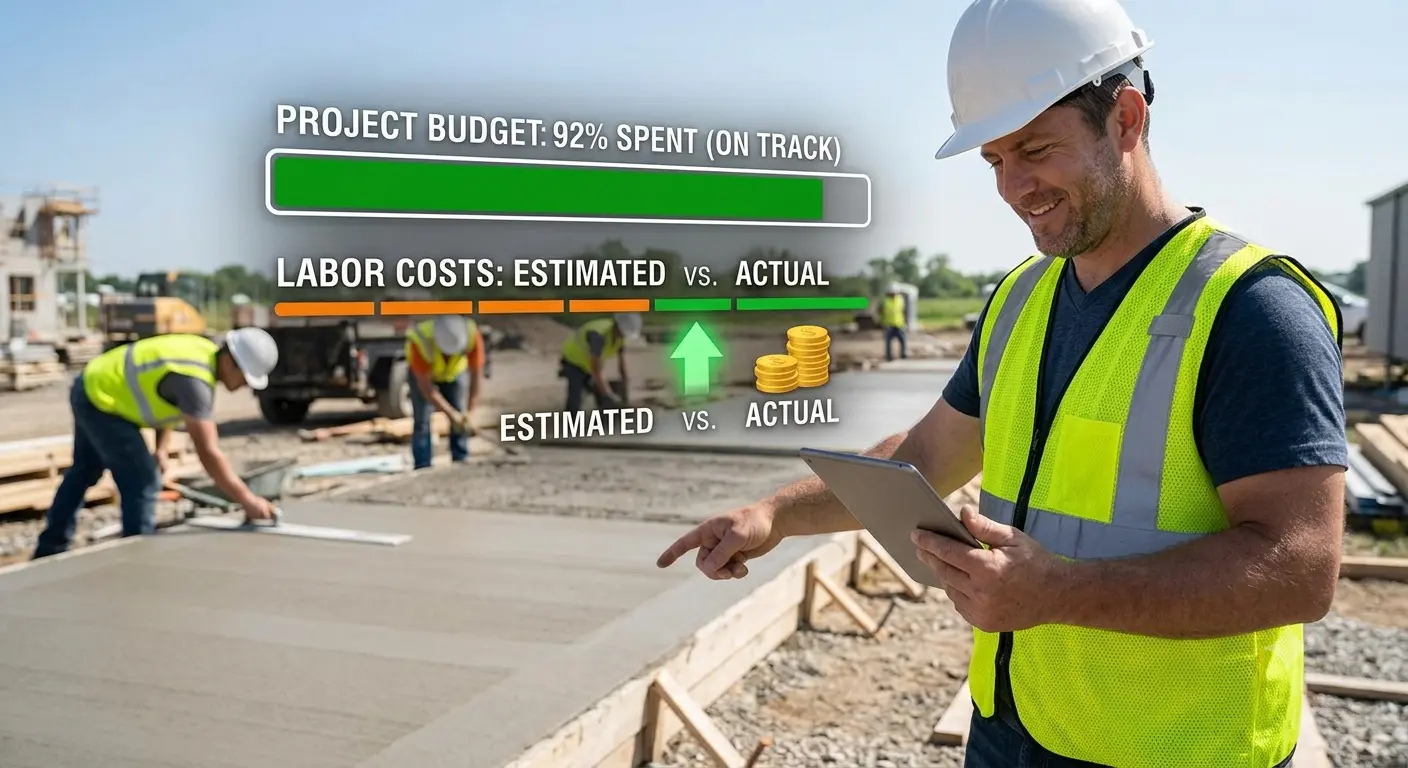
The base rate is what a worker is paid per hour. The burdened rate is the full cost to employ that worker for one hour, once taxes, insurance, and benefits are added. A $28 base wage can carry a burdened rate near $40 once every cost is stacked on top. Bidding off the base rate alone is one of the most common reasons a job that looked profitable on the estimate loses money in the field. Labor cost calculation must always start from the burdened rate, not the number on the paycheck.
Base Rate vs. Burdened Rate Breakdown
The following table shows the components that transform a simple hourly wage into an accurate, project-ready labor cost.
Cost Component | Base Rate | Burdened Rate |
| Hourly Wages (Gross Pay) | Included | Included |
| Payroll Taxes (FICA, FUTA, SUTA) | Excluded | Included |
| Workers’ Compensation Insurance | Excluded | Included |
| Health Insurance/Benefits Contributions | Excluded | Included |
| Retirement/401(k) Matching | Excluded | Included |
| Paid Time Off (PTO) Allocation | Excluded | Included |
How Contractors Estimate Labor Costs?
There are three primary construction cost estimating methods used to calculate labor: bottom-up, percentage, and unit rate. Each method offers unique strengths depending on the scope and type of project.
- The bottom-up approach involves assigning a price tag to each activity separately. Estimating is done by listing activities, determining hours, and multiplying by the burdened rate. Although it is time-consuming, the accuracy offered by the method makes it the preferred one for estimating labor cost for remodeling projects with scope varying from room to room.
- The percentage approach utilizes a predetermined labor percentage relative to the overall cost of the project, depending on the history of previous projects. While it is time-saving, the assumption that the new project will be similar to previous projects may be inaccurate.
- The unit-rate approach utilizes an average cost per unit of work from historical data, such as cost per square foot of drywall or cost per linear foot of framing. It is time-saving and effective for repetitive scopes; however, it fails to account for specific-site issues.
| Method | How It Works | Best For | Key Risk |
| Bottom-Up Estimating | Estimate hours per task, multiply by burdened labor rate | Custom and complex projects | Time-consuming, needs detailed task lists |
| Percentage Method | Apply a labor percentage to total project cost | Fast preliminary bids | Inaccurate if project differs from history |
| Unit Rate Method | Use historical cost per unit of work | Repetitive scopes like framing or drywall | Misses site-specific conditions |
Step-by-Step Process of How to Estimate Labor Hours for a Construction Project
This is the process behind accurate labor cost estimating in construction, broken into five stages.
Gather Your Labor Data
Start with current wage rates, tax rates, and insurance premiums for your area. Pull historical production rates from past jobs of a similar type. Outdated data is the fastest way to build a wrong number.
Calculate Direct Labor with Burden
Multiply the base wage by the burden percentage to get the true hourly cost. Apply that burdened rate to every estimated hour on the task list.
Add Indirect Costs
Layer in supervision allocation, training ramp-up, and mobilization time. These additions often raise the labor total by 15 to 25 percent over direct wages alone.
Factor in Variables
Weather patterns, site logistics, learning curve on new crews, and any variable scope additions all shift labor hours. A project on a tight urban lot with no staging area needs more hours than the same scope on an open site.
Apply Overhead and Monitor Ongoing
Add general overhead tied to labor, then track actual hours against the estimate once work begins. Estimating construction labor hours is not a one-time task. It should be checked weekly against real production.

What Role Does Correct Labor Estimation Play in Ensuring Profitable Construction Projects?
- Labor is normally the biggest cost component in bids, which means that even minor mistakes can snowball quickly.
- Efficient resource allocation occurs when labor hours are estimated precisely, as crews will be assigned to where they are required rather than shuffled around different projects.
- Productivity measurement is possible only through measuring the actual hours versus the initial estimates.
- Estimating accuracy sets the tone for the entire bid. A labor number that is off by 10 percent can wipe out the entire profit margin on a tight-margin job.
- Job costing depends on accurate labor data too, since every change order and progress payment traces back to the original labor breakdown.
- Strong construction project labor planning turns these four functions into one system instead of four separate guesses.
Which Factors Affect Construction Labor Costs?
Understanding the factors that affect construction labor costs helps estimators price jobs with fewer surprises. Labor costs move for reasons inside and outside the estimator’s control.
Market and Economic Factors
- Labor availability drives wages up when skilled trades are in short supply. Prevailing wage laws set a legal floor on public projects.
- Geographic location changes both wage rates and cost of living adjustments. Union affiliation adds fringe costs.
- Inflationary pressure raises material and labor prices together, often faster than contracts account for.
Project and Design Factors
- Design complexity adds hours for cutting, fitting, and coordination between trades.
- Vertical logistics, meaning how materials and workers move up and down a building, slows high-rise work.
- Site accessibility affects how fast crews and equipment can move.
- Schedule acceleration, or compressing a timeline, usually adds overtime cost.
- Project scale changes the efficiency of crew deployment, since larger jobs can spread supervision cost over more hours.
Workforce and Operational Factors
- Labor burden, covered earlier, sets the true hourly cost.
- Crew mix ratio, meaning the balance of apprentices to journeymen, affects both speed and pay rate.
- Trade stacking, when multiple trades work the same space at once, slows everyone down. Turnover rates raise training costs.
- Safety requirements add time for meetings, gear, and inspections, particularly on residential construction labor costs where homeowner presence adds extra coordination.
Environmental Factors
- Extreme temperatures slow outdoor work and increase break time. Precipitation halts exterior trades entirely on some days.
- Daylight hours limit the productive window in winter months.
- Seasonal shifts affect material curing times, which in turn affect labor sequencing.
Benefits of Effective Labor Cost Estimating in Construction Projects
These are proven ways to improve construction labor estimates and protect margin on every job. Profit protection comes first.
- A correct labor number keeps the margin the contractor planned for instead of one eaten by change orders.
- Optimized resource allocation follows close behind, since crews get assigned based on real hour data instead of habit.
- Accurate scheduling depends on realistic labor hours, not optimistic guesses, which keeps subcontractors and suppliers aligned.
- Enhanced bid competitiveness happens when a contractor can price tight without gambling on unknowns, a skill that matters most in remodeling labor cost estimation where scope changes mid-project.
- Fewer disputes and better client trust round out the list, since a well-documented labor estimate gives clients a clear answer when questions come up about cost or schedule changes.
Common Labor Cost Estimation Mistakes in Construction Projects
- False labor productivity assumptions top the list.
- Estimators often assume a full eight-hour day of output, which seldom happens once breaks, setup, and cleanup are counted.
- Overlooking total compensation and burden rates is a close second, since bidding off base wage alone hides 25 to 40 percent of true cost.
- Ignoring environmental and site constraints leads to hours that look fine on paper and fall apart in the field.
- Poor scope management and structural omissions, such as forgetting demolition or site prep labor, create gaps that surface as change orders.
- Outdated software and flawed math processes round out the list, since a single broken spreadsheet formula can throw off an entire bid without anyone noticing until the job is underway.
How to Avoid Mistakes in Construction Cost Estimates
Fix Your Labor Rates
The Problem: Many estimators reuse last year’s wage sheet, missing raises, new tax rates, or updated insurance premiums.
The Actual Solution: Pull current wage and burden data before every bid cycle, not once a year.
Never Bid Blind
The Problem: Estimating from plans alone misses site conditions that change labor hours, like poor access or tight lot lines.
The Actual Solution (Mandatory Site Walk): Send someone to walk the site before finalizing the labor number, even on repeat client work.
Stop Assuming Perfect Workdays
The Problem: Estimates built on 100 percent productive hours ignore breaks, weather, and normal task switching.
The Actual Solution: Apply a realistic productivity factor, typically 75 to 85 percent of a full shift, to every labor hour.
Lock Your Math
The Problem: Manually entering information into a spreadsheet creates possibilities for errors.
The Actual Solution (Lock Your Templates): Create a locked estimating template complete with a pre-flight checklist prior to every bid being issued.
Apply The Second Pair of Eyes Rule
The Problem: Working alone as an estimator means missing errors, since you will read what you meant to type, not necessarily what is there.
The Actual Solution: Make sure a second reviewer verifies the labor math on every bid exceeding a certain dollar amount.
Cover Yourself Against Price Increases
The Problem: Labor costs and materials costs can fluctuate between bid issuance and contract award, especially for longer-term projects.
The Actual Solution (The 30 Day Expiration Clause): Add an expiration clause allowing you to adjust the price based on labor changes within 30 days after the bid was issued.
Your Easy 4 Point Checklist For Every Bid
- Do I have personal experience at the actual job site?
- Am I calculating labor costs based on the real price of labor, which includes tax and insurance?
- Am I using the 80 percent work rate, instead of 100 percent?
Key Takeaways on Construction Labor Cost Estimation
Labor is the most variable factor in any bid for construction work, and it deserves more thought than being placed in just one spreadsheet cell. Direct payroll is merely the beginning, as the payroll taxes, insurances, burden rates, and other indirect costs make the $28 hourly pay into a much bigger amount. Estimators often neglect to account for such factors as training time and supervision.
The three primary approaches used in construction work cost estimation are bottom-up, percentage, and unit rate. Each of them is best suited to specific projects. Selecting the wrong approach will result in an erroneous bid. Using a step-by-step process and checking it weekly by actual hours ensures the accuracy of estimates through all phases of the construction process.
Those contractors who have enough room to earn their margin are those who consider labor cost to be a system, not a mystery. Check your labor cost breakdown and burden rates right now.
Frequently Asked Questions
How do contractors estimate labor costs on a typical project?
Contractors estimate labor costs by listing tasks, applying burdened wage rates, and adding indirect costs like supervision and training. Bottom-up estimating gives the most accurate construction result for complex or custom scopes.
What is the difference between base rate and burdened rate?
Base rate is the hourly wage paid to a worker. Burdened rate adds taxes, insurance, and benefits, showing the true hourly cost to the contractor for that same worker.
How to calculate labor costs for construction projects with variable scope?
Break the scope into smaller tasks, estimate hours for each, then apply the burdened rate. Add a buffer for weather, site access, and learning curve on new crew members.
What percentage should labor cost make up of a total construction budget?
Labor typically runs 20 to 40 percent of total project cost, depending on trade and scope. Highly custom or detailed work often falls on the higher end of that range.
How can contractors improve labor estimate accuracy over time?
Track actual hours against every estimate, then update historical data and productivity rates. Reviewing completed jobs regularly is the most reliable way to sharpen future bids.